

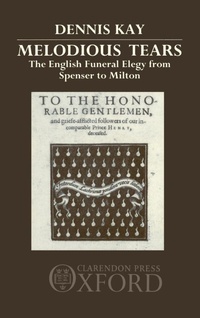
Melodious Tears
The English Funeral Elegy from Spenser to Milton
Published on 9. August 1990
Book
Hardback
304 pages
978-0-19-811789-6 (ISBN)
Description
The funeral elegy is in some important ways the quintessential English Renaissance genre. This book demonstrates how it developed into a kind of laboratory in which writers could put theories of composition into practice. The hospitality of elegy to different styles and modes together with its primary formal obligation to fit the poem decorously to the subject, gave a special value to ingenuity, to virtuosity. Melodious Tears charts the history of the elegy from the time in the mid-sixteenth century when it was exclusively the province of professional writers, the balladeers and chroniclers, up to the 1630s, by which time the fashion for the vernacular elegy had spread throughout the literate classes. Detailed studies of the works of major elegists, particularly Spenser, Sidney, Donne, and Milton are combined with full examination of the range and variety of elegies generated in response to the deaths of Sidney (1586), Queen Elizabeth I (1603), and Prince Henry (1612). A series of appendices contains texts of a number of elegies which survive only in manuscript.
Reviews / Votes
`...there are master-pieces as well as pedestrian poetry in Melodius Tears...In Neo-Latin and in English, for the funeral elegy was "one of the ways poets learnt to write in the vernacular"' were many verses both sincere and introspective as well as many occasional and conventional. This book concisely and insightfully surveys them all.'ibliotheque d'Humanisme el Renaissance `... rich and thoughtful book. The book's liveliest interest is with rhetoric, with the manipulation of poetic manners. Kay's best moments depend on beautifully observant commentary on the strategies of writing.'
Robert Cummings, Times Higher Education Supplement 'he has given us a better sense of the variety of English elegy than we have had before ... What distinguishes Kay's journey along this road is his generosity toward his subjects.'
G.W. Pigman III, California Institute of Technology, Journal of English and Germanic Philology, July 1992 (Volume 91 No. 3) 'One of the values of Kay's study is ... its underscoring of the plural, anthologist elements in the origin of Donne's and Milton's elegies, and its defence of these unprecedentedly inclusive poems against narrow notions of generic unity. With Medlodious Tears, the reader now has a fair-minded and scrupulous survey of the many and various examples of the genre, individual and anthologized, that precede Milton's 'Yet once more'.'
Peter Sacks, The Johns Hopkins University, YES, 23, 1993 'Kay's particular strength in this daunting survey lies in his extensive knwoledge of elegiac conventions, strategies, and structures, which gives his descriptions of derivation and taxonomy an impressive authority. 'Melodious Tears stands as a mine of information, an incisive and learned study.'
Raymond B. Waddington, University of Caliornia, Davis, Renaissance Quarterly 'Dr. Kay's book is a welcome addition to the Oxford English Monographs series. Kay has produced a substantial, scholarly, and well written account of the most seminal; period in the history of the English funeral elegy. His research is wide-ranging and up to date. He is consistently good on the role of the elegiac speaker, his functions, self-presentation and interests, and on the communal aspects of mourning.'
David Thatcher, Archiv, 1992
More details
Series
Language
English
Place of publication
Oxford
United Kingdom
Publishing group
Oxford University Press
Target group
College/higher education
Professional and scholarly
Dimensions
Height: 235 mm
Width: 157 mm
Thickness: 21 mm
Weight
594 gr
ISBN-13
978-0-19-811789-6 (9780198117896)
Copyright in bibliographic data and cover images is held by Nielsen Book Services Limited or by the publishers or by their respective licensors: all rights reserved.
Schweitzer Classification
Person
Content
The English tradition of elegy; the elegies of Spenser and Sidney; elegies on Sidney (1586) and on Queen Elizabeth (1603); Donne's funeral and anniversary poems; elegies on the death of Prince Henry; Jonson to Milton - elegies 1603-1638.