

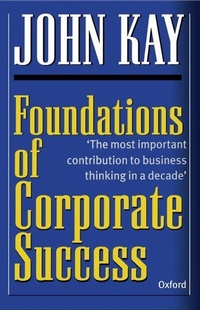
Foundations of Corporate Success
How Business Strategies Add Value
Published on 20. April 1995
Book
Paperback/Softback
432 pages
978-0-19-828988-3 (ISBN)
Description
How did BMW recover from the edge of bankruptcy to become on of Europe's strongest companies? Why did Saatchi and Saatchi's global strategy bring the company to its knees? Why has Philips's outstanding record in innovation not been translated into success in the market? What can be learnt from the marriage contract about the conduct of commercial negotiations? These are some of the questions addressed as John Kay asks `What makes a business successful?'
Drawing on his own business experience and on concepts in economics, legal theory, and sociology, the author presents a fresh approach to questions of business strategy. He rejects the military analogy which underpins much strategic thinking, in which success depends on size and share, on vision and leadership, on shifting patterns of mergers and alliances.
John Kay argues that outstanding businesses derive their strength from a distinctive structure of relationships with employees, customers, and suppliers, and explains why continuity and stability in these relationships is essential for a flexible and co-operative response to change. By integrating organizational and financial perspectives on the performance of the firm, Kay not only gives insights into the creation of effective business strategies, but sheds light on the success - and failure - of national economies.
As the single market develops, this book - full of insight and rigour, yet lively in style - is probably the most important European contribution to strategic thinking for many years. It will be vital reading for all who want to understand what distinguishes the successful company.
Drawing on his own business experience and on concepts in economics, legal theory, and sociology, the author presents a fresh approach to questions of business strategy. He rejects the military analogy which underpins much strategic thinking, in which success depends on size and share, on vision and leadership, on shifting patterns of mergers and alliances.
John Kay argues that outstanding businesses derive their strength from a distinctive structure of relationships with employees, customers, and suppliers, and explains why continuity and stability in these relationships is essential for a flexible and co-operative response to change. By integrating organizational and financial perspectives on the performance of the firm, Kay not only gives insights into the creation of effective business strategies, but sheds light on the success - and failure - of national economies.
As the single market develops, this book - full of insight and rigour, yet lively in style - is probably the most important European contribution to strategic thinking for many years. It will be vital reading for all who want to understand what distinguishes the successful company.
Reviews / Votes
one of the most important 'strategic thinking" books in years...I can think of no better way of preparing for an examination in business strategy * The Director * You must read ... Foundations of Corporate Success. Kay is the currently the best management theorist in Britain, bar none. * Business Age *More details
Language
English
Place of publication
Oxford
United Kingdom
Target group
Professional and scholarly
Product notice
Paperback (trade)
Illustrations
halftones, line figures, tables
Dimensions
Height: 236 mm
Width: 156 mm
Thickness: 27 mm
Weight
623 gr
ISBN-13
978-0-19-828988-3 (9780198289883)
Copyright in bibliographic data and cover images is held by Nielsen Book Services Limited or by the publishers or by their respective licensors: all rights reserved.
Schweitzer Classification
Other editions
Additional editions
Book
03/1993
Oxford University Press
€252.10
Shipment within 15-20 days
Person
John Kay is a visiting Professor of Economics at the London School of Economics, a Fellow of St John's College, Oxford. He is a Fellow of the British Academy, a Fellow of the Royal Society of Edinburgh, and a member of the Scottish Government's Council of Economic Advisers. He is a director of several public companies and contributes a weekly column to the Financial Times. He is the author of many books, including The Truth about Markets (2003) and The Long and the Short of It: finance and investment for normally intelligent people who are not in the industry (2009) and his latest book, Obliquity was published by Profile Books in March 2010.
Content
PART I: CORPORATE SUCCESS ; PART II: BUSINESS RELATIONSHIPS ; PART III: DISTINCTIVE CAPABILITIES ; PART IV: FROM DISTINCTIVE CAPBILITIES TO COMPETITIVE ADVANTAGE ; PART V: COMPETITIVE STRATEGIES ; PART VI: THE STRATEGIC AUDIT ; PART VII: THE FUTURE OF STRATEGY