

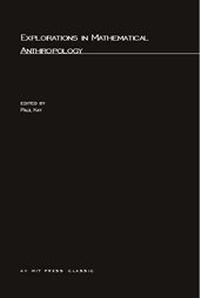
Explorations in Mathematical Anthropology
Published on 28. July 2004
Book
Paperback/Softback
304 pages
978-0-262-61019-3 (ISBN)
Description
Precise discussion of human phenomena has developed to some-extent in all of the social sciences, and it is no surprise to find the trend increasing rapidly in anthropological discourse. This book contains the best available sampling of mathematical, statistical, and computer techniques currently used by anthropologists to tackle a wide range of substantive problems.Paul Kay notes that if mathematics is to serve anthropology, mathematical training for anthropology students, should be made available and credited toward the degree, while students with undergraduate training in technical fields should be encouraged to study anthropology. The sort of formal training that will prove useful, he observes, coincides with the major themes discussed in the book: abstract algebra (including, for example, set theory, mathematical logic, and axiomatic logic); computer technology; probability and statistics with emphasis on derivation of pattern; and probability statistics with emphasis on stochastic processes. As anthropologists become more familiar with formal techniques, Kay points out, they place less importance on statistical tests of significance and more on determining functional expressions of the relationships among variables. What direction will such formalization take? The editor hopes that it will be not toward a school of mathematical anthropology but a continuing development of mathematics and mathematically based techniques as tools of anthropological research.The scope of topics considered in this volume is so wide and various as to be an impressive indication of a strong future for mathematics in anthropology. Briefly, such topics include interinformant reliability, cultural distinctiveness in conceptual areas, cultural systems as mental systems of identification, classification, evaluation, and action, diffusional versus functional explanations, general interaction theory, kinship terminologies as logical systems, folklore, cultural systems as systems of knowledge and belief, systemic culture patterns, endogamy/exogamy, genealogy, relation of social structure to relational terminology, cultural continuity, and culture change.
More details
Series
Language
English
Place of publication
Cambridge, Mass.
United States
Publishing group
MIT Press Ltd
Target group
Professional and scholarly
US School Grade: College Graduate Student and over
Product notice
Paperback (trade)
Dimensions
Height: 229 mm
Width: 152 mm
Weight
513 gr
ISBN-13
978-0-262-61019-3 (9780262610193)
Copyright in bibliographic data and cover images is held by Nielsen Book Services Limited or by the publishers or by their respective licensors: all rights reserved.
Schweitzer Classification