

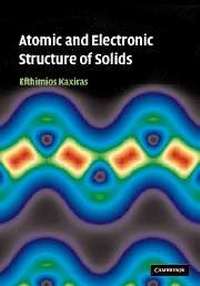
Atomic and Electronic Structure of Solids
Published on 9. January 2003
Book
Hardback
696 pages
978-0-521-81010-4 (ISBN)
Description
This text is a modern treatment of the theory of solids. The core of the book deals with the physics of electron and phonon states in crystals and how they determine the structure and properties of the solid. The discussion uses density functional theory as a starting point and covers electronic and optical phenomena, magnetism and superconductivity. There is also an extensive treatment of defects in solids, including point defects, dislocations, surfaces and interfaces. A number of modern topics where the theory of solids applies are also explored, including quasicrystals, amorphous solids, polymers, metal and semiconductor clusters, carbon nanotubes and biological macromolecules. Numerous examples are presented in detail and each chapter is accompanied by problems and suggested further readings. An extensive set of appendices provides all the necessary background for deriving all the results discussed in the main body of the text.
More details
Language
English
Place of publication
Cambridge
United Kingdom
Target group
Professional and scholarly
Illustrations
Worked examples or Exercises; 50 Tables, unspecified; 100 Halftones, unspecified
Dimensions
Height: 255 mm
Width: 180 mm
Thickness: 38 mm
Weight
1589 gr
ISBN-13
978-0-521-81010-4 (9780521810104)
Copyright in bibliographic data and cover images is held by Nielsen Book Services Limited or by the publishers or by their respective licensors: all rights reserved.
Schweitzer Classification
Other editions
New editions
Efthimios Kaxiras | John D. Joannopoulos
Quantum Theory of Materials
Book
06/2019
Cambridge University Press
€78.00
Shipment within 15-20 days
Additional editions
Efthimios Kaxiras
Atomic and Electronic Structure of Solids
E-Book
02/2005
Cambridge University Press
€79.99
Available for download
Person
Efthimios Kaxiras received his PhD in theoretical physics at the Massachusetts Institute of Technology, and worked as a Postdoctotal Fellow at the IBM T.J. Watson Research Laboratory in Yorktown Heights. He joined Harvard University in 1991 where he is currently a Professor of Physics and the Gordon McKay Professor of Applied Physics. He has worked on theoretical modeling of the properties of solids, including their surfaces and defects; he has published over 130 articles in refereed journals, including several invited review articles and book chapters. He has also presented his work in international conferences and workshops throughout the world, through more than 70 invited lectures. He has co-organized a number of scientific meetings and co-edited 3 volumes of conference proceedings. He is a member of the American Physical Society, the American Chemical Society, the Materials Research Society, Sigma Xi - Scientific Research Society, and a Chartered Member of the Institute of Physics (London).
Content
Preface; Acknowledgements; Part I. Crystalline Solids: 1. Atomic structure of crystals; 2. The single-particle approximation; 3. Electrons in crystal potential; 4. Band structure of crystals; 5. Applications of band theory; 6. Lattice vibrations; 7. Magnetic behaviour of solids; 8. Superconductivity; Part II. Defects, Non-Crystalline Solids and Finite Structures: 9. Defects I: point defects; 10. Defects II: line defects; 11. Defects III: surfaces and interfaces; 12. Non-crystalline solids; 13. Finite structures; Part III. Appendices: A. Elements of classical electrodynamics; B. Elements of quantum mechanics; C. Elements of thermodynamics; D. Elements of statistical mechanics; E. Elements of elasticity theory; F. The Madelung energy; G. Mathematical tools; H. Nobel Prize citations; I. Units and symbols; References; Index.