

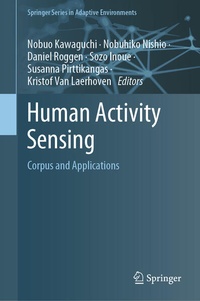
Human Activity Sensing
Corpus and Applications
Published on 24. September 2019
Book
Hardback
XII, 250 pages
978-3-030-13000-8 (ISBN)
Description
Activity recognition has emerged as a challenging and high-impact research field, as over the past years smaller and more powerful sensors have been introduced in wide-spread consumer devices. Validation of techniques and algorithms requires large-scale human activity corpuses and improved methods to recognize activities and the contexts in which they occur.
This book deals with the challenges of designing valid and reproducible experiments, running large-scale dataset collection campaigns, designing activity and context recognition methods that are robust and adaptive, and evaluating activity recognition systems in the real world with real users.
More details
Series
Edition
2019 ed.
Language
English
Place of publication
Cham
Switzerland
Publishing group
Springer International Publishing
Target group
Professional and scholarly
Edition type
Annotated edition
Illustrations
98 farbige Abbildungen, 42 s/w Abbildungen
XII, 250 p. 140 illus., 98 illus. in color.
Dimensions
Height: 241 mm
Width: 160 mm
Thickness: 20 mm
Weight
565 gr
ISBN-13
978-3-030-13000-8 (9783030130008)
DOI
10.1007/978-3-030-13001-5
Schweitzer Classification
Other editions
Additional editions
Book
09/2020
Springer
€106.99
Shipment within 7-9 days
E-Book
09/2019
1st Edition
Springer
€96.29
Available for download
Content
Optimizing of the Number and Placements of Wearable IMUs for Automatic Rehabilitation Recording.- Identifying Sensors via Statistical Analysis of Body-Worn Inertial Sensor Data.- Compensation Scheme for PDR using Component-wise Error Models.- Towards the Design and Evaluation of Robust Audio-Sensing Systems.- A Wi-Fi Positioning Method Considering Radio Attenuation of Human Body.- Drinking gesture recognition from poorly annotated data: a case study.- Understanding how Non-experts Collect and Annotate Activity Data.- MEASURed: Evaluating Sensor-based Activity Recognition Scenarios by Simulating Accelerometer Measures from Motion Capture.- Benchmark performance for the Sussex-Huawei locomotion and transportation recognition challenge 2018.- Effects of Activity Recognition Window Size and Time Stabilization in the SHL Recognition Challenge.