

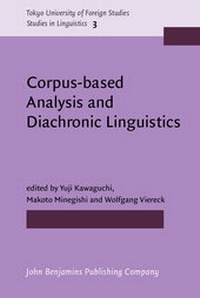
Corpus-based Analysis and Diachronic Linguistics
Published on 7. December 2011
Book
Hardback
293 pages
978-90-272-0770-8 (ISBN)
Description
Nowadays, linguists do not question the existence of synchronic variation, and the dichotomy between synchrony and diachrony. They recognize that synchrony can be motivated regionally (diatopic variation), sociolinguistically (diastratic variation), or stylistically (diaphasic variation). But, further, they can also recognize the hybrid nature of synchrony, which is referred to as "dynamic synchrony." This conception of synchrony assumes that similar patterns of usage can coexist in a community during a certain period and that their mutual relations are not static but conflicting enough to result in a future systematic change through symptomatic synchronic variation. Emergence of a large corpus of written texts for some languages has enabled quantitative as well as qualitative analyses of the synchronic conditions for diachronic changes, over both long and short spans of time. Most of the 14 papers in this volume represent studies on synchronic and diachronic variations based on such corpus data. For sale in all countries except Japan. For customers in Japan: please contact Yushodo Co.
More details
Series
Language
English
Place of publication
Amsterdam
Netherlands
Target group
Professional and scholarly
Dimensions
Height: 245 mm
Width: 164 mm
Weight
690 gr
ISBN-13
978-90-272-0770-8 (9789027207708)
Copyright in bibliographic data and cover images is held by Nielsen Book Services Limited or by the publishers or by their respective licensors: all rights reserved.
Schweitzer Classification
Other editions
Additional editions
Yuji Kawaguchi | Makoto Minegishi | Wolfgang Viereck
Corpus-based Analysis and Diachronic Linguistics
E-Book
12/2011
1st Edition
John Benjamins Publishing Company
€118.99
Available for download
Persons
Content
1. Message from the President (by Kameyama, Ikuo); 2. Center for Corpus-based Linguistics and Language Education (by Minegishi, Makoto); 3. Introduction (by Kawaguchi, Yuji); 4. The Atlas Linguarum Europae: A diachronic analysis of its data (by Viereck, Wolfgang); 5. Variationism and underuse statistics in the analysis of the development of relative clauses in German (by Ludeling, Anke); 6. Variation and change in the Montferrand Account-books (1259-1367) (by Lodge, R. Anthony); 7. Cognitive aspects of language evolution and language change: The example of French historical texts (by Raible, Wolfgang); 8. The importance of diasystematic parameters in studying the history of French (by Schosler, Lene); 9. The reorganisation of mood in the epistemic subsystem - The case of French belief predicates in diachronic dynamics (by Becker, Martin); 10. French liaison in the 18th Century - Analysis of Gile Vaudelin's texts (by Kawaguchi, Yuji); 11. Issues in the typographic representation of medieval primary sources (by Emiliano, Antonio); 12. An analysis of the misuse of the participle in old Russian texts (by Onda, Yoshinori); 13. A preliminary analysis of Arabic derived verbs in the Leeds Quran Corpus - With special reference to Stem III (CaaCaC) (by Ratcliffe, Robert R.); 14. On the narrow and open "e" contrast in Santali (by Minegishi, Makoto); 15. The classification of Apabhramsa - A corpus-based approach of the study of Middle Indo-Aryan (by Yamahata, Tomoyuki); 16. Changes in the meaning and construction of Polysemous words: The case of mieru and mirareru (by Shiba, Ayako); 17. Language change from the viewpoint of distribution patterns of standard Japanese forms (by Yarimizu, Kanetaka); 18. Index of proper nouns; 19. Index of subjects; 20. Contributors