

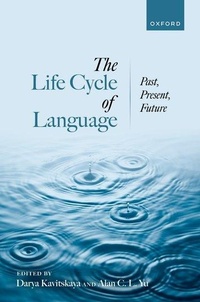
The Life Cycle of Language
Past, Present, and Future
Published on 30. November 2023
Book
Hardback
494 pages
978-0-19-284581-8 (ISBN)
Description
This volume brings together an international group of linguists from a diverse range of research backgrounds to explore the cycles of change in the world's languages. Historical linguistics does not solely focus on reconstructing a language's linguistic past and exploring the mechanisms underlying previous language changes; it also addresses broader questions concerning the development and ongoing evolution of language. The chapters in this book draw on data both from languages from the distant past, such as Hittite, Proto-Turkic, and Proto-Bantu, and from present-day languages including Akan, Cantonese, Kuuk Thaayorre, Selis-Ql'ispe, Nivacle, and Spanish. The contributions showcase current research in historical linguistics and exemplify the dynamism and inherently interdisciplinary nature of the field.
Reviews / Votes
I warmly recommend the volume to potential readers. This is a significant publication that offers new and invaluable academic insights into the underlying dynamics of different kinds of language change phenomena at different linguistic levels and related research interfaces. * Philemon Gomwalk, Linguist List *More details
Language
English
Place of publication
Oxford
United Kingdom
Target group
College/higher education
Product notice
sewn/stitched
Cloth over boards
Dimensions
Height: 226 mm
Width: 163 mm
Thickness: 53 mm
Weight
907 gr
ISBN-13
978-0-19-284581-8 (9780192845818)
Copyright in bibliographic data and cover images is held by Nielsen Book Services Limited or by the publishers or by their respective licensors: all rights reserved.
Schweitzer Classification
Other editions
Additional editions
E-Book
12/2023
1st Edition
OUP eBook
€98.99
Available for download
Persons
Darya Kavitskaya is Associate Professor in the Department of Slavic Languages and Literatures and in the Linguistics Department at the University of California, Berkeley. Her main research interests are contrast preservation and loss and opacity, and she is particularly interested in palatalization and vowel harmony. Her work focuses on phonological issues in Slavic, Turkic, and Uralic, and is connected to other linguistic fields such as historical linguistics, phonetics, and language acquisition.
Alan C. L. Yu is the William Colvin Professor of Linguistics and the College at the University of Chicago. His research focuses on language variation and change, particularly from an individual-difference perspective. He is the author of A Natural History of Infixation (OUP, 2007), the editor of Origins of Sound Change: Approaches to Phonologization (OUP, 2013), and co-editor of The Handbook of Phonological Theory, 2nd Edition (Wiley Blackwell, 2011). He is co-General Editor of Laboratory Phonology, and Associate Editor of the International Journal of American Linguistics. He was elected a Fellow of the Linguistic Society of America in 2016.
Alan C. L. Yu is the William Colvin Professor of Linguistics and the College at the University of Chicago. His research focuses on language variation and change, particularly from an individual-difference perspective. He is the author of A Natural History of Infixation (OUP, 2007), the editor of Origins of Sound Change: Approaches to Phonologization (OUP, 2013), and co-editor of The Handbook of Phonological Theory, 2nd Edition (Wiley Blackwell, 2011). He is co-General Editor of Laboratory Phonology, and Associate Editor of the International Journal of American Linguistics. He was elected a Fellow of the Linguistic Society of America in 2016.
Editor
Associate ProfessorAssociate Professor, Department of Slavic Languages and Literatures, University of California BerkeleyAssociate Professor, Department of Slavic Languages and Literatures, University of California Berkeley
William Colvin Professor of Linguistics and the CollegeWilliam Colvin Professor of Linguistics and the College, University of ChicagoWilliam Colvin Professor of Linguistics and the College, University of Chicago
Content
Part I. Reconstructing the past
1: Larry M. Hyman: The fall and rise of vowel length in Bantu
2: Darya Kavitskaya and Adam McCollum: The rise and fall of rounding harmony in Turkic
3: Alice Gaby: The life cycle of the Kuuk Thaayorre desiderative
4: Mary Paster: Akan morphological 'reversal' in historical context
5: Matthew L. Juge: Increasing morphological mismatch via category loss: The Spanish future subjunctive
6: David Goldstein: Toward a non-teleological account of demonstrative reinforcement
7: Lyle Campbell: Typology and history of unusual traits in Nivacle
8: Jay H. Jasanoff: Greek )e*g*w*k*a and the perfect of PIE *ogneh3 'know'
9: H. Craig Melchert: The surface position of Hittite subordinating kuit
10: Juliette Blevins: PIE *meh2- 'grow, be fruitful' and Proto-Basque *ma, *maha 'fruit': An apple by any other name...
Part II. Philological and documentary past and present
11: Donca Steriade: Paradigm structure in Sanskrit reduplicants
12: Sarah Thomason: Sound symbolic words in Seli%s;-Ql'ispe
13: Gabriela Caballero: Tone and morphological structure in a documentation-based grammar of Choguita Raramuri
14: Hannah J. Haynie and Maziar Toosarvandani: The structure of dialect diversity in Mono: Evidence from the Sydney M. Lamb papers
15: Clare S. Sandy: Recovering prosody from Karuk texts: Deciphering J. P. Harrington's diacritics
16: Justin Spence: Stylistic differentiation in California Dene texts
17: Lucy Thomason: Winter story themes in Meskwaki: Familiar creatures seen with new eyes
18: Lisa Conathan: The material and the textual in documentation of Native American languages
19: Christine Beier and Lev Michael: Community-participatory orthography development in the Maijuna communities of Peruvian Amazonia
20: Marianne Mithun: The value of family relations for revitalization
Part III. Looking forward: New approaches
21: Molly Babel and Melinda Fricke: Sound structure and the psycholinguistics of language contact
22: Alan C. L. Yu, Carol K. S. To, and Yao Yao: Child-directed speech as a potential source of phonetic precursor enhancement in sound change: Evidence from Cantonese
23: Chundra Cathcart: Paradigmatic heterogeneity and homogenization: Probing Paul's principle
24: Jeff Good: Language change in small-scale multilingual societies: Trees, waves, and magnets?
25: Claire Bowern: Gradualness and abruptness in linguistic split: A Nyulnyulan case study
1: Larry M. Hyman: The fall and rise of vowel length in Bantu
2: Darya Kavitskaya and Adam McCollum: The rise and fall of rounding harmony in Turkic
3: Alice Gaby: The life cycle of the Kuuk Thaayorre desiderative
4: Mary Paster: Akan morphological 'reversal' in historical context
5: Matthew L. Juge: Increasing morphological mismatch via category loss: The Spanish future subjunctive
6: David Goldstein: Toward a non-teleological account of demonstrative reinforcement
7: Lyle Campbell: Typology and history of unusual traits in Nivacle
8: Jay H. Jasanoff: Greek )e*g*w*k*a and the perfect of PIE *ogneh3 'know'
9: H. Craig Melchert: The surface position of Hittite subordinating kuit
10: Juliette Blevins: PIE *meh2- 'grow, be fruitful' and Proto-Basque *ma, *maha 'fruit': An apple by any other name...
Part II. Philological and documentary past and present
11: Donca Steriade: Paradigm structure in Sanskrit reduplicants
12: Sarah Thomason: Sound symbolic words in Seli%s;-Ql'ispe
13: Gabriela Caballero: Tone and morphological structure in a documentation-based grammar of Choguita Raramuri
14: Hannah J. Haynie and Maziar Toosarvandani: The structure of dialect diversity in Mono: Evidence from the Sydney M. Lamb papers
15: Clare S. Sandy: Recovering prosody from Karuk texts: Deciphering J. P. Harrington's diacritics
16: Justin Spence: Stylistic differentiation in California Dene texts
17: Lucy Thomason: Winter story themes in Meskwaki: Familiar creatures seen with new eyes
18: Lisa Conathan: The material and the textual in documentation of Native American languages
19: Christine Beier and Lev Michael: Community-participatory orthography development in the Maijuna communities of Peruvian Amazonia
20: Marianne Mithun: The value of family relations for revitalization
Part III. Looking forward: New approaches
21: Molly Babel and Melinda Fricke: Sound structure and the psycholinguistics of language contact
22: Alan C. L. Yu, Carol K. S. To, and Yao Yao: Child-directed speech as a potential source of phonetic precursor enhancement in sound change: Evidence from Cantonese
23: Chundra Cathcart: Paradigmatic heterogeneity and homogenization: Probing Paul's principle
24: Jeff Good: Language change in small-scale multilingual societies: Trees, waves, and magnets?
25: Claire Bowern: Gradualness and abruptness in linguistic split: A Nyulnyulan case study