

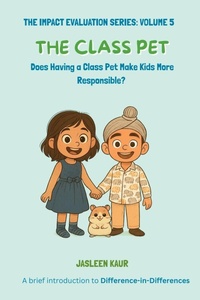
The Class Pet
Does Having a Class Pet Make Kids More Responsible?
Published on 19. September 2025
Book
Paperback/Softback
30 pages
979-8-9999394-4-9 (ISBN)
Description
Does having a class pet make kids more responsible? When Class A gets a hamster named Mr. Whiskers while Class B doesn't, Momo and Puri notice "but both classes were already getting more responsible!" How can they tell what the hamster really changed? By comparing how much each class improved! Just like economists track changes over time to find true impacts. Classroom adventures that show why comparing differences makes all the difference. Prepare for "aha!" moments at any age!
Building tomorrow's problem-solvers, one story at a time.
This is Volume 5 in the Impact Evaluation Series for Children. It is a brief introduction to Difference-in-Difference Design.
More details
Series
Language
English
Product notice
Paperback (trade)
Unsewn / adhesive bound
Dimensions
Height: 229 mm
Width: 152 mm
Thickness: 2 mm
Weight
82 gr
ISBN-13
979-8-9999394-4-9 (9798999939449)
Copyright in bibliographic data and cover images is held by Nielsen Book Services Limited or by the publishers or by their respective licensors: all rights reserved.
Schweitzer Classification
Person
Jasleen is a policy researcher and data analyst with a PhD in Public Policy from UT Austin, where her dissertation examined gender dynamics in international development organizations through analysis of 3,500 Asian Development Bank projects. Her research expertise spans experimental design, causal inference, and large-scale impact evaluation, developed through roles at prestigious institutions including J-PAL South Asia. At J-PAL, she led a randomized controlled trial with nearly 8,000 participants evaluating gender interventions across rural India. At the time of writing this book, she is working at Uptogether as a Survey Analyst, conducting longitudinal analysis of cash transfer impacts. She specializes in translating complex statistical analyses into actionable policy recommendations. Her work has been published in peer-reviewed journals and presented at international conferences. She is driven by the belief that rigorous data analysis can inform more effective, equitable policies that strengthen communities.