

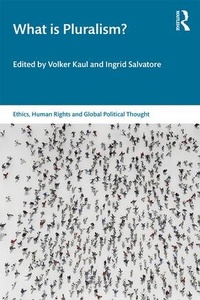
What is Pluralism?
1st Edition
Published on 3. June 2020
Book
Paperback/Softback
246 pages
978-0-367-41059-9 (ISBN)
Description
Is pluralism inherent to the human condition? Does it have its origins in the diversity of cultures? Are disagreements among individuals the same as disagreements among societies?
Focusing on these critical questions essential to the understanding of modern societies, this book traces the origins of pluralism in contemporary political thought and presents new, original interpretations of the idea by contemporary philosophers. The chapters in the volume bring clarity into an ongoing fractious debate and reveal the underlying roots and fissures in our understanding of a dynamic and contested idea. Drawing on the works of John Rawls, Juergen Habermas, and other major political philosophers, they delve into the different strands of the concept, their possible real-world political outcomes, and popular misconceptions.
A key text, this volume will be essential reading for scholars and researchers of politics, political theory and philosophy, and social theory.
Focusing on these critical questions essential to the understanding of modern societies, this book traces the origins of pluralism in contemporary political thought and presents new, original interpretations of the idea by contemporary philosophers. The chapters in the volume bring clarity into an ongoing fractious debate and reveal the underlying roots and fissures in our understanding of a dynamic and contested idea. Drawing on the works of John Rawls, Juergen Habermas, and other major political philosophers, they delve into the different strands of the concept, their possible real-world political outcomes, and popular misconceptions.
A key text, this volume will be essential reading for scholars and researchers of politics, political theory and philosophy, and social theory.
More details
Series
Language
English
Place of publication
London
United Kingdom
Publishing group
Taylor & Francis Ltd
Target group
College/higher education
Dimensions
Height: 234 mm
Width: 156 mm
Weight
480 gr
ISBN-13
978-0-367-41059-9 (9780367410599)
Copyright in bibliographic data and cover images is held by Nielsen Book Services Limited or by the publishers or by their respective licensors: all rights reserved.
Schweitzer Classification
Other editions
Additional editions
Volker Kaul | Ingrid Salvatore
What is Pluralism?
Book
06/2020
1st Edition
CRC Press
€207.80
Shipment within 15-20 days
Volker Kaul | Ingrid Salvatore
What is Pluralism?
E-Book
05/2020
1st Edition
Routledge India
€65.99
Available for download
Volker Kaul | Ingrid Salvatore
What is Pluralism?
E-Book
05/2020
1st Edition
Routledge India
€65.99
Available for download
Persons
Volker Kaul teaches at the Department of Political Science at LUISS "Guido Carli" University in Rome and is lecturer at the CEA Rome Center, Italy. He also coordinates the research area "East-West Dialogues" for the foundation Reset-Dialogues on Civilizations.
Ingrid Salvatore is an associate professor of political philosophy at the University of Salerno, Italy.
Ingrid Salvatore is an associate professor of political philosophy at the University of Salerno, Italy.
Content
Introduction PART I: Epistemic Pluralism and Democracy 1. From Pluralism to Liberalism: The Long Way Around 2. Pluralism and Deliberation 3. Social Choice or Collective Decision-making: What is Politics All About? 4. Liberalism, Pluralism, and a Third Way PART II: Political Pluralism and Reasonable Consensus 5. Sideways at the Entrance of the Cave: A Pluralist Footnote to Plato 6. Pluralism and the Possibility of a Liberal Political Consensus 7. Modus Vivendi Liberalism, Practice-dependence and Political Legitimacy 8. A Pluralist Model of Democracy 9. Rawls, Religion, and the Clash of Civilizations PART III: Cultures, Religions, and Politics 10. The Practice of Liberty 11. Sharing a Conception of Justice, Sharing a Conception of the Good: Liberalism as a Pluralist Theory vs. Pluralism as a Non-Liberal Theory 12. Pluralism and Solidarity: Non-Authoritarian Reasoning and Non-Fundamentalist Attitude 13. Populism, Liberalism and Nationalism