

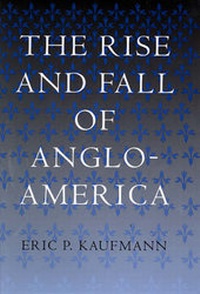
The Rise and Fall of Anglo-America
Published on 15. June 2004
Book
Hardback
384 pages
978-0-674-01303-2 (ISBN)
Description
As the 2000 census resoundingly demonstrated, the Anglo-Protestant ethnic core of the United States has all but dissolved. In a country founded and settled by their ancestors, British Protestants now make up less than a fifth of the population. This demographic shift has spawned a "culture war" within white America. While liberals seek to diversify society toward a cosmopolitan endpoint, some conservatives strive to maintain an American ethno-national identity. Eric Kaufmann traces the roots of this culture war from the rise of WASP America after the Revolution to its fall in the 1960s, when social institutions finally began to reflect the nation's ethnic composition.
Kaufmann begins his account shortly after independence, when white Protestants with an Anglo-Saxon myth of descent established themselves as the dominant American ethnic group. But from the late 1890s to the 1930s, liberal and cosmopolitan ideological currents within white Anglo-Saxon Protestant America mounted a powerful challenge to WASP hegemony. This struggle against ethnic dominance was mounted not by subaltern immigrant groups but by Anglo-Saxon reformers, notably Jane Addams and John Dewey. It gathered social force by the 1920s, struggling against WASP dominance and achieving institutional breakthrough in the late 1960s, when America truly began to integrate ethnic minorities into mainstream culture.
Kaufmann begins his account shortly after independence, when white Protestants with an Anglo-Saxon myth of descent established themselves as the dominant American ethnic group. But from the late 1890s to the 1930s, liberal and cosmopolitan ideological currents within white Anglo-Saxon Protestant America mounted a powerful challenge to WASP hegemony. This struggle against ethnic dominance was mounted not by subaltern immigrant groups but by Anglo-Saxon reformers, notably Jane Addams and John Dewey. It gathered social force by the 1920s, struggling against WASP dominance and achieving institutional breakthrough in the late 1960s, when America truly began to integrate ethnic minorities into mainstream culture.
Reviews / Votes
Illuminating...Mr. Kaufmann shows how the culture of 'white Anglo-Saxon protestants,' or Wasps, was constructed and, from the early 20th century, gradually dismantled. -- Christopher Caldwell Financial Times 20041009 [A] compelling study...Kaufmann writes with admirable detachment and objectivity, and reveals the mechanism by which the White Anglo-Saxon Protestant founders of the U.S. lost their political and cultural dominance. Kaufmann shows how a longstanding cosmopolitan element within Wasp ideology shifted from a symbolic role to the core of national life, and the Wasp population recast their own role accordingly. In other words, they did it to themselves...It is so refreshing to read a generous, open and positive book on this subject--what a pity that it is Huntington who has attracted the attention. -- Nicholas Cull Times Higher Education Supplement 20050603More details
Language
English
Place of publication
Cambridge, Mass
United States
Target group
Professional and scholarly
Illustrations
35 line illustrations
Dimensions
Height: 235 mm
Width: 156 mm
Weight
685 gr
ISBN-13
978-0-674-01303-2 (9780674013032)
Copyright in bibliographic data and cover images is held by Nielsen Book Services Limited or by the publishers or by their respective licensors: all rights reserved.
Schweitzer Classification
Person
Eric P. Kaufmann is Professor of Politics at Birkbeck, University of London.
Content
1. Introduction I. The WASP Ascendancy 2. The Rise of Anglo-America 3. Limited Liberals: "Double-Consciousness" in Anglo-American Thought, 1750-1920 4. Conservative Egalitarians: The Progressive Mind in the Nineteenth Century II. The Cosmopolitan Vanguard, 1900-1939 5. Pioneers of Equality: The Liberal Progressives 6. Cosmopolitan Clerics: The Role of Ecumenical Protestantism 7. Expressive Pathfinders: The New York Modernists III. The Fall of Anglo-America 8. Cosmopolitanism Institutionalized, 1930-1970 9. The Decline of Anglo-America 10. Cultural Modernization: Making Sense of Anglo-America's Demise 11. American Whiteness: Dominant Ethnicity Resurgent? 12. Liberal Ethnicity and Cultural Revival: A New Paradigm 13. Conclusion Notes References Acknowledgments Index