

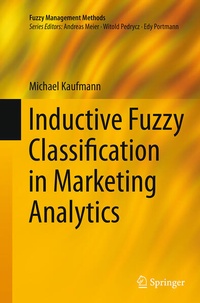
Inductive Fuzzy Classification in Marketing Analytics
Published on 17. September 2016
Book
Paperback/Softback
XX, 125 pages
978-3-319-38160-2 (ISBN)
Description
To enhance marketing analytics, approximate and inductive reasoning can be applied to handle uncertainty in individual marketing models. This book demonstrates the use of fuzzy logic for classification and segmentation in marketing campaigns. Based on practical experience as a data analyst and on theoretical studies as a researcher, the author explains fuzzy classification, inductive logic and the concept of likelihood and introduces a blend of Bayesian and Fuzzy Set approaches, allowing reasonings on fuzzy sets that are derived by inductive logic. By application of this theory, the book guides the reader towards a gradual segmentation of customers which can enhance return on targeted marketing campaigns. The algorithms presented can be used for visualization, selection and prediction. The book shows how fuzzy logic can complement customer analytics by introducing fuzzy target groups. This book is for researchers, analytics professionals, data miners and students interested in fuzzy classification for marketing analytics.
More details
Series
Edition
Softcover reprint of the original 1st ed. 2014
Language
English
Place of publication
Cham
Switzerland
Publishing group
Springer International Publishing
Target group
Professional and scholarly
Illustrations
35 s/w Abbildungen
XX, 125 p. 35 illus.
Dimensions
Height: 23.5 cm
Width: 15.5 cm
Weight
238 gr
ISBN-13
978-3-319-38160-2 (9783319381602)
DOI
10.1007/978-3-319-05861-0
Schweitzer Classification
Other editions
Additional editions
Michael Kaufmann
Inductive Fuzzy Classification in Marketing Analytics
Book
06/2014
1st Edition
Springer
€106.99
Shipment within 10-15 days
Person
Michael Kaufmann is a computer scientist with specialization in analytics and machine learning. Currently he is working as a business analyst at FIVE Informatik, where he consults executive boards of small and medium enterprises. He was data architect at Swiss Mobiliar and a Data Warehouse Analyst at Post Finance. He is a postdoctoral researcher publishing scientific articles on applications of fuzzy classification. He got his degree of Doctor Scientiarum Informaticarum (Dr. sc. Inf.) in 2012 and his Master's and Bachelor's degrees in Computer Science in 2004 and 2005, respectively, from the University of Fribourg, Switzerland.
Content
A Gradual Concept of Truth.- Fuzziness and Induction.- Analytics and Marketing.- Prototyping and Evaluation.- Precisiating Fuzziness by Induction.