

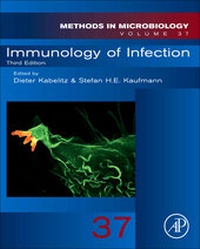
Immunology of Infection: Volume 37
3rd Edition
Published on 23. September 2010
Book
Hardback
544 pages
978-0-12-374842-3 (ISBN)
Description
Immunology of Infection, 3e, edited by two leading experts in the field, presents the most appropriate up-to-date experimental approaches in the detail required for modern microbiological research. Focusing on the methods most useful for the microbiologist interested in analyzing host-pathogen relationships, this volume will be essential reading for all researchers working in microbiology, immunology, virology, mycology and parasitology.
This new edition of Immunology of Infection provides ready-to-use "recipes" and the latest emerging techniques as well as novel approaches to the tried and tested, established methods included in the successful first edition.
Methods in Microbiology is the most prestigious series devoted to techniques and methodology in the field. Established for over 30 years, Methods in Microbiology will continue to provide you with tried and tested, cutting-edge protocols to directly benefit your research.
This new edition of Immunology of Infection provides ready-to-use "recipes" and the latest emerging techniques as well as novel approaches to the tried and tested, established methods included in the successful first edition.
Methods in Microbiology is the most prestigious series devoted to techniques and methodology in the field. Established for over 30 years, Methods in Microbiology will continue to provide you with tried and tested, cutting-edge protocols to directly benefit your research.
Reviews / Votes
Praise for the first edition:"The book is clearly presented, packed with protocols, and well illustrated" --Microbiology Today
"...it represents a valuable addition to the microbiologists' reference source." --Immunology Today
More details
Series
Edition
3rd edition
Language
English
Place of publication
San Diego
United States
Publishing group
Elsevier Science Publishing Co Inc
Target group
Professional and scholarly
Ads in relevant publications, included in all subject area mailings, displayed at related exhibits and online
Dimensions
Height: 235 mm
Width: 191 mm
Weight
1300 gr
ISBN-13
978-0-12-374842-3 (9780123748423)
Copyright in bibliographic data and cover images is held by Nielsen Book Services Limited or by the publishers or by their respective licensors: all rights reserved.
Schweitzer Classification
Other editions
Additional editions
Stefan H. E. Kaufmann | Dieter Kabelitz
Immunology of Infection
E-Book
05/2014
3rd Edition
Academic Press
€155.00
Available for download
Persons
Dieter Kabelitz is full professor at the University of Kiel, Germany, and Director of the Institute of Immunology. Dieter Kabelitz studied medicine in Freiburg and Munich, Germany. He was a post-doc in Uppsala/Sweden and at Rockefeller University, New York. In 1988, he was appointed Associate Professor for Cellular Immunology at the University of Heidelberg. From 1992 to 1999 he was Head of the Department of Immunology at the Paul-Ehrlich Institute in Langen, Germany. Since 1999 he is a full professor at the University of Kiel and Director of the Institute of Immunology. His scientific expertise is in the field of the functional characterization of human T cells with a special focus on ?? T cells. Current projects aim to explore the potential of human ?? T cells for the immunotherapy of cancer. He has published more than 360 papers listed in PubMed/Medline. Dieter Kabelitz was chairman of the Collaborative Research Center (SFB) 415 "Specificity and Pathophysiology of Signal Transduction Pathways" funded at Kiel University by the German Research Foundation (DFG). He is a founding member and member of the Steering Committee of the DFG-funded Cluster of Excellence "Inflammation-at-Interfaces". He was President of the German Society for Immunology (DGfI) in 2011 and 2012, and he is a Council member of the International Union of Immunological Societies (IUIS) and chair of the Education Committee (EDU) of IUIS.
Content
I. General Methods
Radbruch A - Phenotyping and isolation of functionally distinct leukocyte populations; Schuetze S - Magnetic isolation of subcellular compartments; Berzofsky J - Prediction of MHC ligands and T-cell epitopes; McMichael A - Quantitative analysis of T-cell responses; Schurr E - Genetics of susceptibility and resistance to infection; Wiker H - Proteomic approaches to study immunity in infection; Sioud M - siRNA as a tool to study immune responses in infection; Schroeder JM - Isolation and characterization of antimicrobial peptides; Karin M - Toll - and NOD-like receptors in anti-infective immunity; von Andrian UH - Visualization of immune responses in vivo
II. Murine Models
A. In vitro analysis
Czuprynski CJ - Isolation of lymphocytes from infected animals; Busch DH - Killer cell assays; Kiyono H - Quantification of murine T-cell cytokine responses; Gordon S - Isolation and functional charactzerization of macrophages
B. In vivo analysis
Ehlers S - Measuring immune responses in vivo; Belkaid Y - Control of infection by regulatory T-cells; Stockinger B - Th17 cells in inflammation
C. Specific Models
Orme IM - Murine models of tuberculosis; Muller I - The leishmaniasis model; Autenrieth IB - Murine models of infection with extracellular bacteria; Flynn JL - Local immune responses in the lung; Romani L - Murine models of fungal infections; Powrie F - Immunity in the gut; Reddehase MJ - Murine cytomegalovirus infection; Lingnau K/von Gabain A - Boosting of immune responses by adjuvants
III. Human System
Banchereau J - Subpopulations of human dendritic cells; Yssel H - Measuring human cytokine responses; Seitzer U - Measuring immune responses in situ; Garcia JV - Humanized mice for the analysis of human immune responses
IV. Appendix
Benoist C - The NIH knock-out mouse project; Beutler B - Forward genetic analysis to understand innate immunity
Radbruch A - Phenotyping and isolation of functionally distinct leukocyte populations; Schuetze S - Magnetic isolation of subcellular compartments; Berzofsky J - Prediction of MHC ligands and T-cell epitopes; McMichael A - Quantitative analysis of T-cell responses; Schurr E - Genetics of susceptibility and resistance to infection; Wiker H - Proteomic approaches to study immunity in infection; Sioud M - siRNA as a tool to study immune responses in infection; Schroeder JM - Isolation and characterization of antimicrobial peptides; Karin M - Toll - and NOD-like receptors in anti-infective immunity; von Andrian UH - Visualization of immune responses in vivo
II. Murine Models
A. In vitro analysis
Czuprynski CJ - Isolation of lymphocytes from infected animals; Busch DH - Killer cell assays; Kiyono H - Quantification of murine T-cell cytokine responses; Gordon S - Isolation and functional charactzerization of macrophages
B. In vivo analysis
Ehlers S - Measuring immune responses in vivo; Belkaid Y - Control of infection by regulatory T-cells; Stockinger B - Th17 cells in inflammation
C. Specific Models
Orme IM - Murine models of tuberculosis; Muller I - The leishmaniasis model; Autenrieth IB - Murine models of infection with extracellular bacteria; Flynn JL - Local immune responses in the lung; Romani L - Murine models of fungal infections; Powrie F - Immunity in the gut; Reddehase MJ - Murine cytomegalovirus infection; Lingnau K/von Gabain A - Boosting of immune responses by adjuvants
III. Human System
Banchereau J - Subpopulations of human dendritic cells; Yssel H - Measuring human cytokine responses; Seitzer U - Measuring immune responses in situ; Garcia JV - Humanized mice for the analysis of human immune responses
IV. Appendix
Benoist C - The NIH knock-out mouse project; Beutler B - Forward genetic analysis to understand innate immunity