

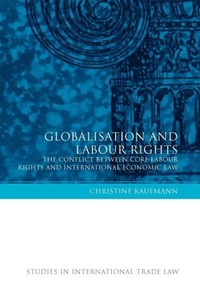
Globalisation and Labour Rights
The Conflict Between Core Labour Rights and International Economic Law
Published on 17. January 2007
Book
Hardback
416 pages
978-1-84113-599-1 (ISBN)
Description
In a world of work that has changed dramatically over the last few years, states see themselves confronted with new actors and conflicting international legal obligations. This book examines the tensions between core labour rights as defined by the International Labour Organisation, and the interests of international economic institutions (e.g. WTO, IMF, World Bank, OECD). It provides an analysis of the legal interactions between international regulations and state policy with regard to potential regulatory conflicts, at both the horizontal and vertical level. The study suggests a model of multilevel consistency as a way of reconciling the highly specialised and fragmented legal systems of core labour rights on the one hand, and trade liberalisation on the other, to form the coherent framework of a consistent legal order. Its detailed analysis and recommendations are designed for both academic readers and practitioners in international organisations and governments.
Reviews / Votes
This book by Christine Kaufmann is timely as it deals with 'core labour rights' and the effects of globalisation...Quite uncommon for lawyers, Kaufmann provides the economic rationale underlying national economic and social policies. She also provides a comprehensive outlook on the Swiss system relating to labour rights, which should be extremely helpful for students of comparative law...Her examination of social labelling programmes in the context of the Agreement on Technical Barriers to Trade and the Government Procurement Agreement is extremely interesting...The book is useful to students and scholars of international law. It is well-structured and one can follow the line of thought in an adequate manner... It would be fair to say that this book offers a solid and detailed inquiry into the conflicts between core labour rights and international economic law. Rekha Oleschak Pillai The Swiss Review of International Economic Relations March 2008 ...important and scholarly... Bob Hepple Industrial Law Journal Vol. 36, No. 4, December 2007 Globalisation and Labour Rights can be unreservedly recommended to lawyers and economists alike, not least because of its comprehensive coverage..for economists and lawyers it provides a broad overview and shows that international commercial law can and must take account of labour law. Johanna Felkl European Journal of Labour Law Vol. 3 2008 Kaufmann's book is a well-documented contribution, which presents an academically attractive thesis...Academic contributions such as Kaufmann's are of most interest in that they define strategies to reconcile international trade law with social values. Julien Burda Global Law Books 23rd October 2008More details
Series
Language
English
Place of publication
Oxford
United Kingdom
Publishing group
Bloomsbury Publishing PLC
Target group
Professional and scholarly
Product notice
With printed dust jacket
Dimensions
Height: 234 mm
Width: 156 mm
Thickness: 24 mm
Weight
740 gr
ISBN-13
978-1-84113-599-1 (9781841135991)
Copyright in bibliographic data and cover images is held by Nielsen Book Services Limited or by the publishers or by their respective licensors: all rights reserved.
Schweitzer Classification
Other editions
Additional editions
Christine Kaufmann
Globalisation and Labour Rights
The Conflict Between Core Labour Rights and International Economic Law
E-Book
01/2007
1st Edition
Hart Publishing
€111.99
Available for download
Person
Christine Kaufmann is Professor of Law and Co-Director of the Institute of International and Comparative Constitutional Law at the University of Zurich.
Content
Introduction: Setting Out the Problems
1. The Legal Framework for Core Labour Rights
2. International Economic Organisations and Core Labour Rights: Conflicting Interests
3. Cross-border Economic Activities: Multinational Enterprises and the Linkage Debate
4. Reconciling Conflicting Interests: The Roles of Nation States and the International Community
5. Conclusions
1. The Legal Framework for Core Labour Rights
2. International Economic Organisations and Core Labour Rights: Conflicting Interests
3. Cross-border Economic Activities: Multinational Enterprises and the Linkage Debate
4. Reconciling Conflicting Interests: The Roles of Nation States and the International Community
5. Conclusions