

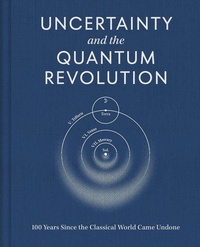
Uncertainty and the Quantum Revolution
Will be published approx. on 5. January 2027
Book
Hardback
272 pages
978-1-60583-128-2 (ISBN)
Description
Essays examining the evolution of scientific understanding on the one hundredth anniversary of quantum mechanics.
In 1925 and 1926, the near-simultaneous development of two seemingly different mathematical approaches describing the behavior of subatomic particles revolutionized our understanding of the nature of matter. Werner Heisenberg's matrix mechanics and Erwin Schroedinger's wave equation were soon shown to be equivalent formulations of the same underlying concepts, and this new field of quantum mechanics immediately upended traditional conceptions of reality. One puzzling implication of the theory was that random chance seemed to govern behavior at the microscopic level. Another was Heisenberg's formulation of the uncertainty principle, which showed that it is impossible to accurately determine the simultaneous position and momentum of a subatomic particle. Combined with Albert Einstein's theory of relativity, the quantum revolution shattered Isaac Newton's centuries-old concepts of absolute space and time, and with it the deterministic predictability of classical mechanics.
The one hundredth anniversary of quantum mechanics presents a perfect opportunity to examine the historical foundations upon which these innovations were built and to explore the subsequent evolution of scientific understanding resulting from the new theory. The turn of the twentieth century saw a series of startling discoveries, including X-rays, radioactivity, and the electron, as well as the birth of quantum theory and special relativity with its famous equation E=mc2. By the end of World War II, the equivalence of mass and energy would radically alter the trajectory of human affairs following the detonation of the first atomic bomb.
In 1925 and 1926, the near-simultaneous development of two seemingly different mathematical approaches describing the behavior of subatomic particles revolutionized our understanding of the nature of matter. Werner Heisenberg's matrix mechanics and Erwin Schroedinger's wave equation were soon shown to be equivalent formulations of the same underlying concepts, and this new field of quantum mechanics immediately upended traditional conceptions of reality. One puzzling implication of the theory was that random chance seemed to govern behavior at the microscopic level. Another was Heisenberg's formulation of the uncertainty principle, which showed that it is impossible to accurately determine the simultaneous position and momentum of a subatomic particle. Combined with Albert Einstein's theory of relativity, the quantum revolution shattered Isaac Newton's centuries-old concepts of absolute space and time, and with it the deterministic predictability of classical mechanics.
The one hundredth anniversary of quantum mechanics presents a perfect opportunity to examine the historical foundations upon which these innovations were built and to explore the subsequent evolution of scientific understanding resulting from the new theory. The turn of the twentieth century saw a series of startling discoveries, including X-rays, radioactivity, and the electron, as well as the birth of quantum theory and special relativity with its famous equation E=mc2. By the end of World War II, the equivalence of mass and energy would radically alter the trajectory of human affairs following the detonation of the first atomic bomb.
More details
Language
English
Place of publication
United States
Target group
Professional and scholarly
Illustrations
244 color plates
Dimensions
Height: 254 mm
Width: 203 mm
Weight
454 gr
ISBN-13
978-1-60583-128-2 (9781605831282)
Copyright in bibliographic data and cover images is held by Nielsen Book Services Limited or by the publishers or by their respective licensors: all rights reserved.
Schweitzer Classification
Persons
Derek Kaufman is actively engaged in philanthropy, public policy advocacy, and investing. From 2008 until 2015, he was head of global fixed income at the hedge fund Citadel and a member of the firm's portfolio committee. Kaufman is currently on the boards of Third Way, the Folger Shakespeare Library, American Jewish World Service, the Institute for the Quantitative Study of Inclusion, Diversity, and Equity, the Advisory Council of the Sadie Collective, and the Leadership Council of the Robin Hood Foundation. Kaufman received a bachelor's degree in applied math and economics from Harvard College.
Content
Foreword by Neil deGrasse Tyson
Opening Essays by Arati Prabhakar
1 The Clockwork Universe by Hannah Marcus
2 Fields of Force and the Relativity of Time by Peter Galison
3 Revealing the Invisible - The Classical World Comes Undone by Michael Gordin
4 Inside the Atom - Structure and Surprise by Suman Seth
5 From the Microscopic to the Universal - Bringing Theory to Life by Janna Levin
6 The Quantum Revolution - Redefining Reality by Ryan Dahn
7 The Limits of Knowledge - Uncertainty and Relativity by David Lindley
8 Quantum Fields and Antimatter - A Strange New World by David Kaiser
9 Splitting the Atom - Shattering Stability by Maria Rentetzi
10 The Manhattan Project - Science in the Shadows by Alex Wellerstein
11 To the Edge of Understanding by Ben Wilson
Opening Essays by Arati Prabhakar
1 The Clockwork Universe by Hannah Marcus
2 Fields of Force and the Relativity of Time by Peter Galison
3 Revealing the Invisible - The Classical World Comes Undone by Michael Gordin
4 Inside the Atom - Structure and Surprise by Suman Seth
5 From the Microscopic to the Universal - Bringing Theory to Life by Janna Levin
6 The Quantum Revolution - Redefining Reality by Ryan Dahn
7 The Limits of Knowledge - Uncertainty and Relativity by David Lindley
8 Quantum Fields and Antimatter - A Strange New World by David Kaiser
9 Splitting the Atom - Shattering Stability by Maria Rentetzi
10 The Manhattan Project - Science in the Shadows by Alex Wellerstein
11 To the Edge of Understanding by Ben Wilson