

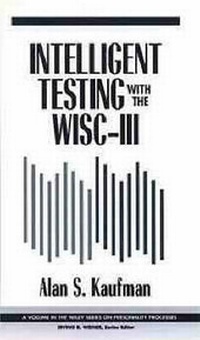
Intelligent Testing with the WISC-III
Published on 25. August 1994
Book
Hardback
480 pages
978-0-471-57845-1 (ISBN)
Description
The WISC is the most widely used children's IQ test in the world. This superlative text--replacing the author's earlier volume dealing with the WISC-R-- provides examiners with a sensible, systematic method of interpreting WISC-III test profiles. Outlines seven steps which allow examiners to organize these scores in meaningful ways. Enables them to understand a child's specific areas of strength and weakness and to translate these cognitive assets and deficits into appropriate suggestions for intervention. Includes 10 comprehensive case reports to effectively illustrate the procedure, plus numerous valuable tables not found in other publications.
More details
Series
Language
English
Place of publication
New York
United States
Target group
Professional and scholarly
Dimensions
Height: 245 mm
Width: 164 mm
Thickness: 36 mm
Weight
871 gr
ISBN-13
978-0-471-57845-1 (9780471578451)
Copyright in bibliographic data and cover images is held by Nielsen Book Services Limited or by the publishers or by their respective licensors: all rights reserved.
Schweitzer Classification
Other editions
New editions
Alan S. Kaufman | Susan Engi Raiford | Diane L. Coalson
Intelligent Testing with the WISC-V
Book
02/2016
Wiley
€93.00
Shipment within 15-20 days
Previous edition

Alan S. Kaufman
Intelligent Testing with the WISC-R
Book
05/1979
Wiley
€56.33
Article exhausted; check for reprint
Person
Content
Intelligent Testing
Abilities Measured by the WISC-III Subtests and the Clinical Lore That Surrounds Them
Seven Steps for Interpreting the WISC-III Profile: From IQs to Factor Indexes to Scaled Scores
Interpreting Verbal-Nonverbal Discrepancies (V-P IQ and VC-PO Index)
The ``Validity'' Factors: Freedom from
Distractibility and Processing Speed
Interpreting Subtest Profiles
Comprehensive Clinical and Psychoeducational Case Studies
Abilities Measured by the WISC-III Subtests and the Clinical Lore That Surrounds Them
Seven Steps for Interpreting the WISC-III Profile: From IQs to Factor Indexes to Scaled Scores
Interpreting Verbal-Nonverbal Discrepancies (V-P IQ and VC-PO Index)
The ``Validity'' Factors: Freedom from
Distractibility and Processing Speed
Interpreting Subtest Profiles
Comprehensive Clinical and Psychoeducational Case Studies