

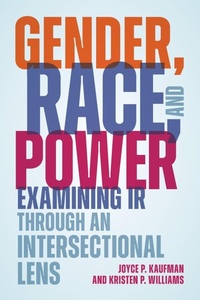
Gender, Race, and Power
Examining IR through an Intersectional Lens
Published on 27. September 2024
Book
Paperback/Softback
186 pages
978-1-5381-8212-3 (ISBN)
Description
Kaufman and Williams present critical issues in international relations through an intersectional approach that examines race, gender, class, ethnicity, and power to arrive at better explanations for such core IR issues as war and peace, security, human rights, development and international political economy, and the global environment.
Their approach builds on early calls amongst feminist IR theorists, imploring "Where are the women?" It is only fairly recently that students of IR have broadened the approach to the field to incorporate the dimensions of race, ethnicity, and class as well as gender. Kaufman and Williams help guide readers exploring questions like: How does gender matter for understanding war and peace? How does race matter? Where are the men? What is intersectionality in IR? How does an intersectional approach change or broaden our understanding of international relations?
Their approach builds on early calls amongst feminist IR theorists, imploring "Where are the women?" It is only fairly recently that students of IR have broadened the approach to the field to incorporate the dimensions of race, ethnicity, and class as well as gender. Kaufman and Williams help guide readers exploring questions like: How does gender matter for understanding war and peace? How does race matter? Where are the men? What is intersectionality in IR? How does an intersectional approach change or broaden our understanding of international relations?
Reviews / Votes
Kaufman and Williams offer a much-needed and accessible examination of International Relations, explaining the myriad ways in which gender, race, empire, and power intersect and shape the core of every key issue in the field of International Relations. Gender, Race, and Power should be essential reading for every Introduction to IR course. -- Kerry F. Crawford, James Madison University Kaufman and Williams present a powerful pedagogical tool for students of gender and IR. Both challenging and robust, this textbook does not hesitate to challenge many preconceptions in the fields of political and IR theory with their intersectional approach. This will be a seminal book for students and faculty who wish to develop a nuanced understanding of the politics-policy-ethics nexus of the security debate. -- Elisabeth Hope Murray, Embry-Riddle Aeronautical University Gender, Race, and Power: Examining IR through an Intersectional Lens models an approach of grounding research on international relations with an intersectional theoretical framework. By using intersectionality as a guide for understanding complex and global case-studies, Kaufman and Williams reveal important power disparities that must be understood if we are invested in understanding inequities around the globe. Intersectionality is a thread that connects each of these case-studies to the study of power and how it manifests across different contexts of human security, the global economy, climate change and more. International relations cannot be fully understood without attention to intersectionality, and Kaufman and Williams illuminate why this theoretical approach is so important for understanding global problems and solutions. -- Margaret Perez Brower, University of Washington With Gender, Race, and Power,Kaufman and Williams take a delightful step in the direction of a genuinely plural IR. This is a book built from real curiosity, heterodoxy, and collaboration. It positively brims with important and timely discussion, on such diverse topics as war, peace, intervention, economy, and environment. Kaufman and Williams are not trying to undo IR, but to show how intersectional analysis, developed out of feminist and postcolonial research, answers questions in and of world politics in empirically and intellectually impactful ways. Gender, Race, and Power is a wonderful contribution, a must-read for anyone interested in expanding their international relations horizons. -- Penny Griffin, University of New South Wales, AustraliaMore details
Language
English
Place of publication
United States
Publishing group
Bloomsbury Publishing Plc
Target group
College/higher education
US School Grade: From College Freshman to College Graduate Student, Interest Age: From 18 to 22 years
Illustrations
17 BW Illustrations, 1 Map
Dimensions
Height: 229 mm
Width: 152 mm
Thickness: 11 mm
Weight
282 gr
ISBN-13
978-1-5381-8212-3 (9781538182123)
Copyright in bibliographic data and cover images is held by Nielsen Book Services Limited or by the publishers or by their respective licensors: all rights reserved.
Schweitzer Classification
Persons
Joyce P. Kaufman is professor emerita of political science at Whittier College and Director of the Women, Peace and Security Program of the Institute of World Affairs. She is the author of numerous books, articles and papers on women and war, U.S. foreign and security policy, and international relations. She received her B.A. and M.A. from New York University and her Ph.D. from the University of Maryland.Kaufman is the sole author of Introduction to International Relations, 3rd edition (Rowman and Littlefield, 2022); A Concise History of United States Foreign Policy, 5th edition (Rowman and Littlefield, 2021); andNATO and the Former Yugoslavia: Crisis. With Andrew Dorman she was co-editor of Providing for National Security: A Comparative Analysis (Stanford University Press, 2014); and The Future of Transatlantic Relations, (Stanford University Press, 2011) and contributed original chapters to both. She is also the author of a number of original articles including "Women and Political Violence in Northern Ireland: Newspaper Imagery during the Troubles," Women's History Review, 30:7 (2021); "The U.S. and NATO in a Trump Administration: Lessons of the Past and Prospects for the Future," International Affairs, 93: 2 (2017) 251-66; and "NATO and the Former Yugoslavia," in The Journal of Conflict Studies, Winter 2000.
Kristen P. Williams (PhD, UCLA) is professor of political science at Clark University. She is the author, co-author, and co-editor of several books, chapters, and journal articles on women/gender and war, nationalism and ethnic conflict, and hegemony and international relations. Williams is the sole author of Despite Nationalist Conflicts: Theory and Practice of Maintaining World Peace (Praeger, 2001). With Neal G. Jesse, she co-authored Identity and Institutions: Conflict Reduction in Divided Societies (SUNY, 2005) and Ethnic Conflict A Systematic Approach to Conflict (CQ Press, 2011). She co-edited Beyond Great Powers and Hegemons: Why Secondary States Support, Follow or Challenge, (Stanford University Press, 2012). Her academic articles have been published in journals, including Political Psychology, International Feminist Journal of Politics, Journal of Research in Gender Studies, and International Politics, and Oxford Bibliographies in International Relations. Her most recent publication is a chapter in the edited volume, the Oxford Handbook of Gender, War and the Western World since 1600(Oxford University Press, 2020).
Kristen P. Williams (PhD, UCLA) is professor of political science at Clark University. She is the author, co-author, and co-editor of several books, chapters, and journal articles on women/gender and war, nationalism and ethnic conflict, and hegemony and international relations. Williams is the sole author of Despite Nationalist Conflicts: Theory and Practice of Maintaining World Peace (Praeger, 2001). With Neal G. Jesse, she co-authored Identity and Institutions: Conflict Reduction in Divided Societies (SUNY, 2005) and Ethnic Conflict A Systematic Approach to Conflict (CQ Press, 2011). She co-edited Beyond Great Powers and Hegemons: Why Secondary States Support, Follow or Challenge, (Stanford University Press, 2012). Her academic articles have been published in journals, including Political Psychology, International Feminist Journal of Politics, Journal of Research in Gender Studies, and International Politics, and Oxford Bibliographies in International Relations. Her most recent publication is a chapter in the edited volume, the Oxford Handbook of Gender, War and the Western World since 1600(Oxford University Press, 2020).
Content
List of Text Boxes
Preface
List of Abbreviations
Introduction
Chapter 1: Intersectionality and IR
Introduction: Starting with the War in Ukraine
Intersectionality and IR
Mainstream IR Theories: Realism, Liberalism, and Constructivism
Critiques of Mainstream IR: Race, Gender, and Empire-and Intersectionality
Conclusion: Overview of Chapters 2-6
Chapter 2: Intersectionality and Issues of War, Peace, and Security
Introduction
What is War?
What is Peace?
War and Peace from an Intersectional Perspective: Human Security
The Women, Peace, and Security Agenda and UNSCR 1325
Critiques of UNSCR 1325: Intersectionality Matters
Intersectional Analysis: Northern Ireland as a Case Study
Conclusion
Chapter 3: Intersectionality, Human Rights, and Humanitarian Intervention
Introduction
Human Rights as a Concept and a Norm
Women and Their Impact on the UN Charter and UDHR
UDHR and Human Rights from an Intersectional Perspective
Applying an Intersectional Analysis: CEDAW as a Case Study
Humanitarian Intervention and the Responsibility to Protect (R2P)
Conclusion
Chapter 4: Intersectionality, the Global Economy, and Issues of Development
Introduction
IR Approaches to the Global Economy
Gendering Development: WID, WAD, and GAD
Global Health and Economic Development: COVID-19 as a Case Study
Conclusion
Chapter 5: Intersectionality and the Environment
Introduction
Development and Evolution of International Environmental Politics
International Relations and the Environment
Intersectionality and International/Global Environmental Politics
Case Study: Intersectionality and Climate Change
Gendering Climate Change and Global Governance
Conclusion
Chapter 6: Examining IR from an Intersectional Perspective: Lessons Learned
Introduction
Answering the Questions
Intersectionality and the Case Studies
Conclusion: The Challenges and Possible Next Steps
Glossary
About the Authors
Preface
List of Abbreviations
Introduction
Chapter 1: Intersectionality and IR
Introduction: Starting with the War in Ukraine
Intersectionality and IR
Mainstream IR Theories: Realism, Liberalism, and Constructivism
Critiques of Mainstream IR: Race, Gender, and Empire-and Intersectionality
Conclusion: Overview of Chapters 2-6
Chapter 2: Intersectionality and Issues of War, Peace, and Security
Introduction
What is War?
What is Peace?
War and Peace from an Intersectional Perspective: Human Security
The Women, Peace, and Security Agenda and UNSCR 1325
Critiques of UNSCR 1325: Intersectionality Matters
Intersectional Analysis: Northern Ireland as a Case Study
Conclusion
Chapter 3: Intersectionality, Human Rights, and Humanitarian Intervention
Introduction
Human Rights as a Concept and a Norm
Women and Their Impact on the UN Charter and UDHR
UDHR and Human Rights from an Intersectional Perspective
Applying an Intersectional Analysis: CEDAW as a Case Study
Humanitarian Intervention and the Responsibility to Protect (R2P)
Conclusion
Chapter 4: Intersectionality, the Global Economy, and Issues of Development
Introduction
IR Approaches to the Global Economy
Gendering Development: WID, WAD, and GAD
Global Health and Economic Development: COVID-19 as a Case Study
Conclusion
Chapter 5: Intersectionality and the Environment
Introduction
Development and Evolution of International Environmental Politics
International Relations and the Environment
Intersectionality and International/Global Environmental Politics
Case Study: Intersectionality and Climate Change
Gendering Climate Change and Global Governance
Conclusion
Chapter 6: Examining IR from an Intersectional Perspective: Lessons Learned
Introduction
Answering the Questions
Intersectionality and the Case Studies
Conclusion: The Challenges and Possible Next Steps
Glossary
About the Authors