

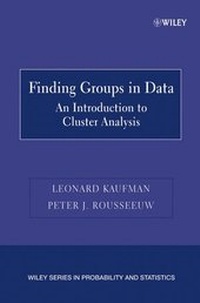
Finding Groups in Data
An Introduction to Cluster Analysis
Will be published approx. on 3. May 2005
Book
Paperback/Softback
342 pages
978-0-471-73578-6 (ISBN)
Description
An introduction to the practical application of cluster analysis, Finding Groups in Data presents a selection of methods that together can deal with most applications. These methods are chosen for their robustness, consistency, and general applicability. The text discusses the main approaches to clustering and provides guidance in choosing between the available methods. It also discusses various types of data, including interval-scaled and binary variables as well as similarity data and explains how these can be transformed prior to clustering. With numerous exercises to aid learning, Finding Groups in Data provides an invaluable introduction to cluster analysis with an emphasis on methods that are both easy to use and modern.
More details
Series
Edition
1. Auflage
Language
English
Place of publication
United States
Publishing group
John Wiley & Sons Inc
Target group
Professional and scholarly
Product notice
Paperback (trade)
Unsewn / adhesive bound
Illustrations
Graphs: 113 B&W, 0 Color
Dimensions
Height: 234 mm
Width: 156 mm
Thickness: 20 mm
Weight
559 gr
ISBN-13
978-0-471-73578-6 (9780471735786)
Schweitzer Classification
Other editions
Additional editions
E-Book
11/2009
99th Edition
Wiley
€123.99
Available for download

Book
03/1990
99th Edition
Wiley
€110.81
Article exhausted; check different version
Persons
LEONARD KAUFMAN, PhD, is affiliated with Vrije University in Brussels, Belgium.
PETER J. ROUSSEEUW, PhD, is a Professor in the Department of Mathematics and Computer Science at the University of Antwerp in Belgium.
Content
1. Introduction.
2. Partitioning Around Medoids (Program PAM).
3. Clustering large Applications (Program CLARA).
4. Fuzzy Analysis.
5. Agglomerative Nesting (Program AGNES).
6. Divisive Analysis (Program DIANA).
7. Monothetic Analysis (Program MONA).
Appendix 1. Implementation and Structure of the Programs.
Appendix 2. Running the Programs.
Appendix 3. Adapting the Programs to Your Needs.
Appendix 4. The Program CLUSPLOT.
References.
Author Index.
Subject Index.