

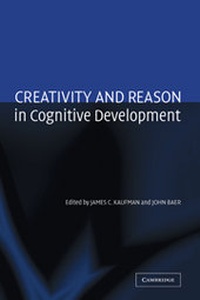
Creativity and Reason in Cognitive Development
Published on 29. May 2006
Book
Hardback
388 pages
978-0-521-84385-0 (ISBN)
Description
To what extent do creativity and imagination decline in childhood? What factors might influence a decline? Theories of cognitive development show only uni-directional progress (although theorists may disagree whether such progress occurs steadily in small continuous improvements or comes in stages separated by plateaus during which developmental gains are consolidated). Declines in levels of skill are quite uncommon, yet many have observed just such an unusual pattern with regard to the development of creativity and of the imagination. Is there something about the development of one kind of thinking that undermines imaginative and creative thinking? Is it perhaps the process of schooling itself, with its focus on the acquisition of knowledge and the production of correct (rather than imaginative) answers, which promotes this decline? This book explores these questions from a variety of perspectives. Essays from psychologists and educators from diverse backgrounds discuss the relationships among creativity, reason, and knowledge.
More details
Language
English
Place of publication
Cambridge
United Kingdom
Target group
Professional and scholarly
Dimensions
Height: 233 mm
Width: 157 mm
Thickness: 24 mm
Weight
643 gr
ISBN-13
978-0-521-84385-0 (9780521843850)
Copyright in bibliographic data and cover images is held by Nielsen Book Services Limited or by the publishers or by their respective licensors: all rights reserved.
Schweitzer Classification
Other editions
New editions
James C. Kaufman | John Baer
Creativity and Reason in Cognitive Development
Book
02/2016
2nd Edition
Cambridge University Press
€137.90
Shipment within 15-20 days
Additional editions
James C. Kaufman | John Baer
Creativity and Reason in Cognitive Development
E-Book
06/2006
1st Edition
Cambridge University Press
€36.99
Available for download
Persons
James C. Kaufman is an Assistant Professor of Psychology at the California State University at San Bernardino, where he is also the director of the Learning Research Institute. He received his B.A. in Psychology from the University of Southern California and his Ph.D. from Yale University in Cognitive Psychology, where he worked with Robert J. Sternberg. Kaufman's main area of expertise is creativity. With Sternberg and Jean Pretz, he developed the propulsion model of creative contributions, outlined in The Creativity Conundrum (Psychology Press, 2002). He coined 'the Sylvia Plath Effect', based on an analysis of female poets, in a paper in Journal of Creative Behavior, and his recent work on poets dying young has been featured in the New York Times, NPR, BBC, CNN, and newspapers and magazines across the world. His other books include International Handbook of Creativity, Intelligence, Applied Psychology and Free Will, Creativity Across Domains: Faces of the Muse, Gender Differences in Mathematics, and The Evolution of Intelligence. John Baer (Ph.D.) is Professor of Educational Psychology at Rider University. He earned his B.A. at Yale, where he double majored in psychology and Japanese Studies and graduated magna cum laude. He received his Ph.D. from Rutgers in developmental and cognitive psychology. He won the American Psychological Foundation's Berlyne Prize for his research on creativity in 1993, and in 1997 the Eighth National Conference on College Teaching and Learning presented Dr Baer with its annual Award for Innovative Excellence in Teaching, Learning, and Technology. He has published seven books, including Creativity and Divergent Thinking: A Task-Specific Approach; Creative Teachers, Creative Students; and Creativity Across Domains: Faces of the Muse (with James C. Kaufman).
Content
1. Preface James C. Kaufman and John Baer; Part I. Cognitive Perspectives: 2. Expertise and reason in creative thinking: evidence from case studies and the laboratory Robert W. Weisberg; 3. Creative genius, knowledge, and reason: the lives and works of eminent creators Dean Keith Simonton; 4. Dynamic processes within associative memory stores: piecing together the neural basis of creative cognition Adam S. Bristol and Indre V. Viskontas; 5. The creativity of everyday moral reasoning: empathy, disgust and moral persuasion David A. Pizarro, Brian Detweiler-Bedell and Paul Bloom; 6. Reasoning and personal creativity Mark A. Runco; 7. Alternative knowledge structures in creative thought: schema, associations, and cases Michael D. Mumford, Cassie S. Blair and Richard T. Marcy; 8. The role of the knowledge base in creative thinking John F. Feldhusen; 9. The role of domain knowledge in creative problem solving Richard E. Mayer; 10. Creative thinking and reasoning: can you have one without the other? Daniel Fasko, Jr.; 11. From alexithymia - born of trauma and oppression to symbolic elaboration, the creative expression of emotions, and rationality Warren TenHouten; 12. Opening up creativity: the lenses of axis and focus Mia Keinaenen, Kim Sheridan and Howard Gardner; Part II. Developmental and Educational Perspectives: 13. Creativity in young children's thought Susan A. Gelman and Gail M. Gottfried; 14. A young artist's story: advancing knowledge and the development of artistic talent and creativity in children Susan M. Rostan; 15. Is it reasonable to be creative? Jacques-Henri Guignard and Todd Lubart; 16. Does culture always matter: for creativity, yes; for deductive reasoning, no! Weihua Niu, John X. Zhang and Yingrui Yang; 17. Higher level thinking in gifted education Joyce VanTassel-Baska; 18. The relationship among schooling, learning, and creativity: 'all roads lead to creativity' or 'you can't get there from here'? Ronald A. Beghetto and Jonathan A. Plucker; 19. How early school experiences impact creativity: an ecological perspective Cynthia Paris, Nancy Edwards, Ellyn Sheffield, Maureen Mutinsky, Terri Olexa, Susan Reilly and John Baer; 20. Conclusions John Baer and James C. Kaufman.