

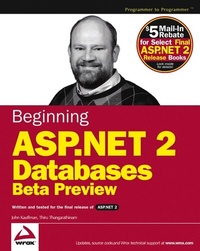
Beginning ASP.NET 2.0 Databases
Beta Preview
1st Edition
Published on 1. March 2005
Book
Paperback/Softback
428 pages
978-0-7645-7081-0 (ISBN)
Description
What is this book about?
With help from Microsoft ASP.NET insider Bradley Millington, John Kaufman covers both VB.NET and C# coding for ASP.NET databases so you don't have to decide up front which language you want more and retailers no longer have to manage inventory on separate language versions.
What does this book cover?
This edition is completely written from scratch on the ASP.NET "Whidbey" Beta to ensure the coverage is most appropriate for this greatly changed version.
The book focuses on solving business problems in a logical progression, from connecting to displaying to changing the data. Additional chapters cover enhancements to the presentation and alternate types of data. The book follows the practice of going beyond the basic techniques to discuss the permutations, pitfalls, and best practices that occur in real business scenarios.
With help from Microsoft ASP.NET insider Bradley Millington, John Kaufman covers both VB.NET and C# coding for ASP.NET databases so you don't have to decide up front which language you want more and retailers no longer have to manage inventory on separate language versions.
What does this book cover?
This edition is completely written from scratch on the ASP.NET "Whidbey" Beta to ensure the coverage is most appropriate for this greatly changed version.
The book focuses on solving business problems in a logical progression, from connecting to displaying to changing the data. Additional chapters cover enhancements to the presentation and alternate types of data. The book follows the practice of going beyond the basic techniques to discuss the permutations, pitfalls, and best practices that occur in real business scenarios.
More details
Persons
John Kauffman has written numerous books about ASP and the incorporation of data into ASP pages. Born in Philadelphia and educated at Penn State, he has lived, taught, and programmed on three continents as he follows his wife's diplomatic assignments.
When not writing, he spends his time sailing, teaching electronics to high school groups, and chauffeuring his kids to hockey and music practices.
When not writing, he spends his time sailing, teaching electronics to high school groups, and chauffeuring his kids to hockey and music practices.
Content
Foreword.
Introduction.
Chapter 1: Introduction to ASP.NET 2.0 and ADO.NET.
Chapter 2: Connecting to an Access Database.
Chapter 3: Connecting to SQL Server and SQL Server Express.
Chapter 4: Connecting to Other Relational Databases.
Chapter 5: Displaying Data in Tables.
Chapter 6: Customizing the Appearance of Tables.
Chapter 7: Paging and Sorting Data.
Chapter 8: Displaying Data in Lists.
Chapter 9: Filtering and Master-Child Data.
Chapter 10: Displaying Data in Templated Controls.
Chapter 11: Updating and Deleting Data.
Chapter 12: Inserting New Records.
Chapter 13: Business Objects as a Source of Data.
Chapter 14: XML and Other Hierarchical Data.
Chapter 15: Caching Data.
Chapter 16: Handling Events for Data Controls.
Appendix A: A Short and Practical Introduction to SQL Statements.
Appendix B: Exercise Answers.
Index.
Introduction.
Chapter 1: Introduction to ASP.NET 2.0 and ADO.NET.
Chapter 2: Connecting to an Access Database.
Chapter 3: Connecting to SQL Server and SQL Server Express.
Chapter 4: Connecting to Other Relational Databases.
Chapter 5: Displaying Data in Tables.
Chapter 6: Customizing the Appearance of Tables.
Chapter 7: Paging and Sorting Data.
Chapter 8: Displaying Data in Lists.
Chapter 9: Filtering and Master-Child Data.
Chapter 10: Displaying Data in Templated Controls.
Chapter 11: Updating and Deleting Data.
Chapter 12: Inserting New Records.
Chapter 13: Business Objects as a Source of Data.
Chapter 14: XML and Other Hierarchical Data.
Chapter 15: Caching Data.
Chapter 16: Handling Events for Data Controls.
Appendix A: A Short and Practical Introduction to SQL Statements.
Appendix B: Exercise Answers.
Index.