

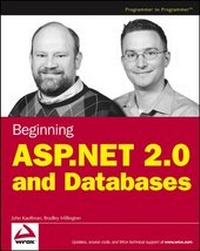
Beginning ASP.NET 2.0 and Databases
1st Edition
Published on 1. July 2006
Book
Paperback/Softback
536 pages
978-0-471-78134-9 (ISBN)
Description
ASP.NET is Microsoft's popular technology for creating dynamic web sites that pull unique information for each visitor rather than showing everyone the same static HTML pages. The introduction of the exciting 2.0 version allows for a far easier relationship between data and ASP.NET than ever before. In this book, bestselling author John Kauffman and Microsoft ASP.NET data insider Bradley Millington guide you through the most important uses of ASP.NET-working with databases in your ASP.NET web sites.
As you progress from simple to more complex topics, you'll be introduced to the many additional ASP.NET and data connectivity tools that Microsoft's Web Platform and Tools team has released. Kauffman and Millington take you beyond the basics to discuss the permutations, pitfalls, and best practices that occur in real business scenarios.
What you will learn from this book
* Fundamentals of connecting web pages to databases
* The connections to Access, SQL Server, Oracle(r), XML, and other data sources
* Various tricks and traps for displaying data in grids, lists, and trees
* How to allow users to change, add, and delete data
* Techniques for creating data objects and events
* Ways to handle data errors
Who this book is for
This book is for anyone who needs a web front-end or is looking to add data to a site. A comfortable level of understanding with ASP.NET version 1.x or ASP version 3.0 is recommended. Readers should also have some familiarity with databases.
Wrox Beginning guides are crafted to make learning programming languages and technologies easier than you think, providing a structured, tutorial format that will guide you through all the techniques involved.
As you progress from simple to more complex topics, you'll be introduced to the many additional ASP.NET and data connectivity tools that Microsoft's Web Platform and Tools team has released. Kauffman and Millington take you beyond the basics to discuss the permutations, pitfalls, and best practices that occur in real business scenarios.
What you will learn from this book
* Fundamentals of connecting web pages to databases
* The connections to Access, SQL Server, Oracle(r), XML, and other data sources
* Various tricks and traps for displaying data in grids, lists, and trees
* How to allow users to change, add, and delete data
* Techniques for creating data objects and events
* Ways to handle data errors
Who this book is for
This book is for anyone who needs a web front-end or is looking to add data to a site. A comfortable level of understanding with ASP.NET version 1.x or ASP version 3.0 is recommended. Readers should also have some familiarity with databases.
Wrox Beginning guides are crafted to make learning programming languages and technologies easier than you think, providing a structured, tutorial format that will guide you through all the techniques involved.
More details
Edition
1., Auflage
Language
English
Place of publication
New York
United States
Publishing group
John Wiley and Sons Ltd
Target group
Professional and scholarly
Illustrations
Illustrations
Dimensions
Height: 23.5 cm
Width: 19 cm
Thickness: 31 mm
Weight
861 gr
ISBN-13
978-0-471-78134-9 (9780471781349)
Schweitzer Classification
Persons
John Kaufman (Ogdensburg NY) is a trainer and writer working in Asia and North America specializing in connecting databases to the web. While teaching he keeps a list of student questions and mistakes and uses that information as the basis for future material in books. John authored best-seller Beginning ASP Databases and coauthored several other best-sellers including Beginning Active Server Pages 3. Bradley Millington (Redmond, WA) is a Microsoft Program Manager for the Web Platform and Tools Team with primary responsibility for the database controls in ASP.NET. He is a well-known frequent speaker at Microsoft technical conferences including TechEd and PDC.
Content
Introduction.
Chapter 1: Introduction to ASP.NET 2.0 and ADO.NET.
Chapter 2: Connecting to an Access Database.
Chapter 3: Connecting to SQL Server and SQL Server Express.
Chapter 4: Connecting to Other Relational Databases.
Chapter 5: Displaying Data in Tables.
Chapter 6: Customizing the Appearance of Tables.
Chapter 7: Sorting and Paging Data.
Chapter 8: Displaying Data in Selection Lists.
Chapter 9: Filtering and Master--Details Scenarios.
Chapter 10: Displaying Data in Templated Controls and Data Binding.
Chapter 11: Updating and Deleting Data.
Chapter 12: Inserting New Records.
Chapter 13: Validation.
Chapter 14: Business Objects As a Source of Data.
Chapter 15: XML and Other Hierarchical Data.
Chapter 16: Caching Data.
Chapter 17: Handling Events for Data Controls.
Chapter 18: Performance Checklist.
Chapter 19: Case Study: FAQ System.
Appendix A: A Short and Practical Introduction to SQL Statements.
Appendix B: Exercise Answers.
Index.
Chapter 1: Introduction to ASP.NET 2.0 and ADO.NET.
Chapter 2: Connecting to an Access Database.
Chapter 3: Connecting to SQL Server and SQL Server Express.
Chapter 4: Connecting to Other Relational Databases.
Chapter 5: Displaying Data in Tables.
Chapter 6: Customizing the Appearance of Tables.
Chapter 7: Sorting and Paging Data.
Chapter 8: Displaying Data in Selection Lists.
Chapter 9: Filtering and Master--Details Scenarios.
Chapter 10: Displaying Data in Templated Controls and Data Binding.
Chapter 11: Updating and Deleting Data.
Chapter 12: Inserting New Records.
Chapter 13: Validation.
Chapter 14: Business Objects As a Source of Data.
Chapter 15: XML and Other Hierarchical Data.
Chapter 16: Caching Data.
Chapter 17: Handling Events for Data Controls.
Chapter 18: Performance Checklist.
Chapter 19: Case Study: FAQ System.
Appendix A: A Short and Practical Introduction to SQL Statements.
Appendix B: Exercise Answers.
Index.