

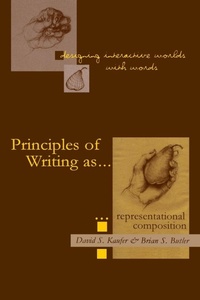
Designing Interactive Worlds With Words
Principles of Writing As Representational Composition
1st Edition
Published on 1. March 2000
Book
Paperback/Softback
312 pages
978-0-8058-3424-6 (ISBN)
Description
No two writing situations are exactly the same and skilled writers, like skilled painters, must develop the know-how to represent the objects of their writing as part of a flexible art. This special art of writing lies hidden between grammar--the well-formedness of sentences--and genre--the capacity of texts to perform culturally holistic communicative functions (e.g., the memo, the strategic report, the letter to the editor). Concealed between grammar and genre, this less visible art of writing is what Kaufer and Butler call "representational composition." Texts within this hidden art are best viewed not primarily as grammatical units or as genre functions, but as bearers of design elements stimulating imagistic, narrative, and information-rich worlds, and as an invitation to readers to explore and interact with them.
This volume presents a systematic study of the principles that underlie writing as representational composition. Drawing from student models derived from a studio method, the authors use each chapter to present a different aspect of what unfolds--across the course of the book--into a cumulative, interactive, and unified body of representational principles underlying the design of texts. They reveal what makes the textual representations achieved by expert writers worthwhile, and, at the same time, difficult for novice writers to reproduce. Extending the framework of their 1996 volume, Rhetoric and the Arts of Design, into a realm of textual design, this volume will interest students and instructors of writing, rhetoric, and information design.
This volume presents a systematic study of the principles that underlie writing as representational composition. Drawing from student models derived from a studio method, the authors use each chapter to present a different aspect of what unfolds--across the course of the book--into a cumulative, interactive, and unified body of representational principles underlying the design of texts. They reveal what makes the textual representations achieved by expert writers worthwhile, and, at the same time, difficult for novice writers to reproduce. Extending the framework of their 1996 volume, Rhetoric and the Arts of Design, into a realm of textual design, this volume will interest students and instructors of writing, rhetoric, and information design.
More details
Language
English
Place of publication
New York
United States
Publishing group
Taylor & Francis Inc
Target group
College/higher education
Professional and scholarly
Dimensions
Height: 229 mm
Width: 152 mm
Thickness: 17 mm
Weight
452 gr
ISBN-13
978-0-8058-3424-6 (9780805834246)
Copyright in bibliographic data and cover images is held by Nielsen Book Services Limited or by the publishers or by their respective licensors: all rights reserved.
Schweitzer Classification
Other editions
Additional editions
David S. Kaufer | Brian S. Butler
Designing Interactive Worlds With Words
Principles of Writing As Representational Composition
Book
04/2000
1st Edition
Routledge
€133.69
Shipment within 10-20 days
David S. Kaufer | Brian S. Butler
Designing Interactive Worlds With Words
Principles of Writing As Representational Composition
E-Book
04/2000
Routledge
€45.99
Available for download
David S. Kaufer | Brian S. Butler
Designing Interactive Worlds With Words
Principles of Writing As Representational Composition
E-Book
04/2000
1st Edition
Routledge
€45.99
Available for download
David S. Kaufer | Brian S. Butler
Designing Interactive Worlds With Words
Principles of Writing As Representational Composition
E-Book
03/2000
1st Edition
Routledge
€65.19
Available for download
Persons
David S. Kaufer, Brian S. Butler
Content
Contents: Foreword. Preface. Introduction: Writing and Representational Composition. Part I: Portraiture. Self-Portraiture. Observer Portraiture. Part II: Landscapes. The Feel of Extended Space. The Feel of Elapsed Time. Part III: Invitations for Interaction. Invitations to Learn. Invitations to Do and Learn. Invitations to Decide. Epilogue: The Promise of Representational Theory in Writing Education.