

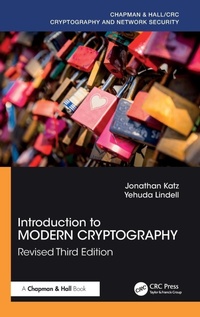
Introduction to Modern Cryptography
Revised Third Edition
3rd Edition
Published on 17. August 2025
Book
Hardback
640 pages
978-1-032-49679-5 (ISBN)
Description
Introduction to Modern Cryptography, the most relied-upon textbook in the field, provides a mathematically rigorous yet accessible treatment of this fascinating subject. The authors have kept the book up-to-date while incorporating feedback from instructors and students alike; the presentation is refined, current, and accurate.
The book's focus is on modern cryptography, which is distinguished from classical cryptography by its emphasis on definitions, precise assumptions, and rigorous proofs of security. A unique feature of the text is that it presents theoretical foundations with an eye toward understanding cryptography as used in the real world. This revised edition fixed typos and includes all the updates made to the third edition, including:
Enhanced treatment of several modern aspects of private-key cryptography, including authenticated encryption and nonce-based encryption.
Coverage of widely used standards such as GMAC, Poly1305, GCM, CCM, and ChaCha20-Poly1305.
New sections on the ChaCha20 stream cipher, sponge-based hash functions, and SHA-3.
Increased coverage of elliptic-curve cryptography, including a discussion of various curves used in practice.
A new chapter describing the impact of quantum computers on cryptography and providing examples of quantum-secure encryption and signature schemes.
Containing worked examples and updated exercises, Introduction to Modern Cryptography, Revised Third Edition can serve as a textbook for undergraduate- or graduate-level courses in cryptography, a reference for graduate students, researchers, and practitioners, or a general introduction suitable for self-study.
The book's focus is on modern cryptography, which is distinguished from classical cryptography by its emphasis on definitions, precise assumptions, and rigorous proofs of security. A unique feature of the text is that it presents theoretical foundations with an eye toward understanding cryptography as used in the real world. This revised edition fixed typos and includes all the updates made to the third edition, including:
Enhanced treatment of several modern aspects of private-key cryptography, including authenticated encryption and nonce-based encryption.
Coverage of widely used standards such as GMAC, Poly1305, GCM, CCM, and ChaCha20-Poly1305.
New sections on the ChaCha20 stream cipher, sponge-based hash functions, and SHA-3.
Increased coverage of elliptic-curve cryptography, including a discussion of various curves used in practice.
A new chapter describing the impact of quantum computers on cryptography and providing examples of quantum-secure encryption and signature schemes.
Containing worked examples and updated exercises, Introduction to Modern Cryptography, Revised Third Edition can serve as a textbook for undergraduate- or graduate-level courses in cryptography, a reference for graduate students, researchers, and practitioners, or a general introduction suitable for self-study.
More details
Edition
3rd edition
Language
English
Place of publication
United Kingdom
Publishing group
Taylor & Francis Ltd
Target group
College/higher education
Undergraduate Advanced
Illustrations
44 s/w Abbildungen, 44 s/w Zeichnungen
44 Line drawings, black and white; 44 Illustrations, black and white
Dimensions
Height: 240 mm
Width: 161 mm
Thickness: 39 mm
Weight
1118 gr
ISBN-13
978-1-032-49679-5 (9781032496795)
Copyright in bibliographic data and cover images is held by Nielsen Book Services Limited or by the publishers or by their respective licensors: all rights reserved.
Schweitzer Classification
Other editions
Additional editions
E-Book
08/2025
3rd Edition
Chapman and Hall
€158.99
Available for download
E-Book
08/2025
3rd Edition
Chapman and Hall
€158.99
Available for download
Previous edition
Book
12/2020
3rd Edition
CRC Press
€170.84
Article exhausted; check for reprint
Persons
Jonathan Katz is a senior staff research scientist at Google. He was formerly a professor in the Department of Computer Science at the University of Maryland, where he also served as director of the Maryland Cybersecurity Cener. He is a fellow of the IACR and the ACM.
Yehuda Lindell is head of cryptogeraphy at Coinbase, and a professor in the Department of Computer Science at Bar-Ilan University. He is a fellow of the IACR.
Yehuda Lindell is head of cryptogeraphy at Coinbase, and a professor in the Department of Computer Science at Bar-Ilan University. He is a fellow of the IACR.
Content
1.Introduction
2.Perfectly Secret Encryption
3.Private-Key Encryption
4.Message Authentication Codes
5.CCA-Security and Authenticated Encryption
6.Hash Functions and Applications
7.Practical Constructions of Symmetric-Key Primitives
8.Theoretical Constructions of Symmetric-Key Primitives
9.Number Theory and Cryptographic Hardness Assumptions
10.Algorithms for Factoring and Computing Discrete Logarithms
11.Key Management and the Public-Key Revolution
12.Public-Key Encryption
13.Digital Signature Schemes
14.Quantum-Secure Cryptography
15.Advanced Topics in Public-Key Encryption
2.Perfectly Secret Encryption
3.Private-Key Encryption
4.Message Authentication Codes
5.CCA-Security and Authenticated Encryption
6.Hash Functions and Applications
7.Practical Constructions of Symmetric-Key Primitives
8.Theoretical Constructions of Symmetric-Key Primitives
9.Number Theory and Cryptographic Hardness Assumptions
10.Algorithms for Factoring and Computing Discrete Logarithms
11.Key Management and the Public-Key Revolution
12.Public-Key Encryption
13.Digital Signature Schemes
14.Quantum-Secure Cryptography
15.Advanced Topics in Public-Key Encryption