

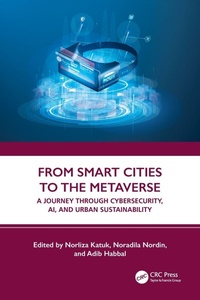
From Smart Cities to the Metaverse
A Journey through Cybersecurity, AI, and Urban Sustainability
1st Edition
Published on 22. September 2025
Book
Paperback/Softback
222 pages
978-1-041-02543-6 (ISBN)
Description
This book offers a comprehensive exploration of the convergence between smart city infrastructure and the emerging metaverse. This book highlights the importance of integrating advanced technologies such as artificial intelligence, virtual reality/augmented reality, and blockchain to enhance urban living experiences while addressing such innovations' security and ethical challenges. Its applications span urban planning, transportation, education, historic preservation, and inclusive city development, making it an essential resource for modern urban development.
The book covers many key areas critical to understanding and implementing smart cities and the metaverse. It starts with both domains' foundational concepts and technological underpinnings, followed by a deep dive into the security infrastructure and challenges smart cities face. Cybersecurity is given special attention, exploring motives and methods of cyberattacks and proposing mitigation techniques and best practices. The book also examines AI chatbots, intelligent transportation, and the integration of digital twins, providing practical case studies and insights. Furthermore, it addresses the socioeconomic implications, governance, and ethical considerations, ensuring a holistic approach to the subject.
The motivation for writing this book stems from the contributors' recognition of the transformative potential of smart cities and the metaverse in creating sustainable, efficient, and inclusive urban environments. By bridging the gap between theoretical research and practical application, the contributors aim to equip researchers, policymakers, and technologists with the knowledge and tools needed to navigate and shape the future of urban living in a digitally interconnected world.
The book covers many key areas critical to understanding and implementing smart cities and the metaverse. It starts with both domains' foundational concepts and technological underpinnings, followed by a deep dive into the security infrastructure and challenges smart cities face. Cybersecurity is given special attention, exploring motives and methods of cyberattacks and proposing mitigation techniques and best practices. The book also examines AI chatbots, intelligent transportation, and the integration of digital twins, providing practical case studies and insights. Furthermore, it addresses the socioeconomic implications, governance, and ethical considerations, ensuring a holistic approach to the subject.
The motivation for writing this book stems from the contributors' recognition of the transformative potential of smart cities and the metaverse in creating sustainable, efficient, and inclusive urban environments. By bridging the gap between theoretical research and practical application, the contributors aim to equip researchers, policymakers, and technologists with the knowledge and tools needed to navigate and shape the future of urban living in a digitally interconnected world.
More details
Language
English
Place of publication
London
United Kingdom
Publishing group
Taylor & Francis Ltd
Target group
College/higher education
Professional and scholarly
Professional Practice & Development, Professional Reference, and Undergraduate Advanced
Illustrations
44 s/w Abbildungen, 44 s/w Zeichnungen, 5 s/w Tabellen
5 Tables, black and white; 44 Line drawings, black and white; 44 Illustrations, black and white
Dimensions
Height: 234 mm
Width: 156 mm
Thickness: 13 mm
Weight
368 gr
ISBN-13
978-1-041-02543-6 (9781041025436)
Copyright in bibliographic data and cover images is held by Nielsen Book Services Limited or by the publishers or by their respective licensors: all rights reserved.
Schweitzer Classification
Other editions
Additional editions
Norliza Katuk | Noradila Nordin | Adib Habbal
From Smart Cities to the Metaverse
A Journey through Cybersecurity, AI, and Urban Sustainability
E-Book
09/2025
CRC Press
€69.99
Available for download
Norliza Katuk | Noradila Nordin | Adib Habbal
From Smart Cities to the Metaverse
A Journey through Cybersecurity, AI, and Urban Sustainability
E-Book
09/2025
CRC Press
€69.99
Available for download
Norliza Katuk | Noradila Nordin | Adib Habbal
From Smart Cities to the Metaverse
A Journey through Cybersecurity, AI, and Urban Sustainability
Book
09/2025
1st Edition
CRC Press
€273.90
Shipment within 15-20 days
Persons
Norliza Katuk is an Associate Professor of cybersecurity at the School of Computing, Universiti Utara Malaysia (UUM). She earned a bachelor's degree in information technology at Universiti Utara Malaysia in 2000, a master's degree in computer science at Universiti Teknologi Malaysia in 2002, and a doctoral degree in information technology at Massey University, New Zealand, in 2012. In her current role as the Deputy Director for Global Engagement at the Centre for International Affairs and Cooperation (CIAC), she leads international partnerships and academic mobility initiatives that enhance the university's global presence. Her research interests include information security and privacy, cybersecurity awareness, internet technology, IoT, disaster management, e-learning, and human-computer interaction. As a prolific scholar, Dr Katuk has published widely in international journals and serves as a reviewer for several esteemed publications. She also has experience editing and writing books, further contributing to the academic discourse in her fields. Additionally, she serves as the Chief Editor of the Journal of Information and Communication Technology (JICT).
Noradila Nordin earned a BEng (First Class Hons.) in computer engineering in 2010 and an MSc (with Distinction) in telecommunications engineering in 2011 at Queen Mary University of London. She was awarded the prestigious King's Scholarship by the Government of Malaysia to pursue a PhD, which she earned in 2017 at University College London. Her PhD, awarded by the Department of Electronic and Electrical Engineering, focused on multichannel cross-layer routing for sensor networks. In 2012, she began her academic career as a Lecturer at the School of Engineering and Technology, Insaniah University College, Malaysia. By 2018, she had advanced to Senior Lecturer at the School of Computing, Universiti Utara Malaysia (UUM). Since September 2023, she has been serving as a Lecturer at the School of Games and Creative Technology at the University for the Creative Arts in the United Kingdom.
Adib Habbal (Senior Member, IEEE) earned a PhD in computer science, specialising in networked computing, at Universiti Utara Malaysia (UUM). He is an Associate Professor of computer engineering and the Founding Head of the Innovative Networked Systems (INETs) Research Group at Karabuk University, Tuerkiye. Dr Habbal's research has garnered significant funding from various prestigious organisations. His prolific output includes over 100 refereed publications in top-tier journals and conference proceedings, particularly in the areas of future internet technologies and cybersecurity. His current research interests include IoT, applied AI/ML, cybersecurity, blockchain technology, and digital trust.
Noradila Nordin earned a BEng (First Class Hons.) in computer engineering in 2010 and an MSc (with Distinction) in telecommunications engineering in 2011 at Queen Mary University of London. She was awarded the prestigious King's Scholarship by the Government of Malaysia to pursue a PhD, which she earned in 2017 at University College London. Her PhD, awarded by the Department of Electronic and Electrical Engineering, focused on multichannel cross-layer routing for sensor networks. In 2012, she began her academic career as a Lecturer at the School of Engineering and Technology, Insaniah University College, Malaysia. By 2018, she had advanced to Senior Lecturer at the School of Computing, Universiti Utara Malaysia (UUM). Since September 2023, she has been serving as a Lecturer at the School of Games and Creative Technology at the University for the Creative Arts in the United Kingdom.
Adib Habbal (Senior Member, IEEE) earned a PhD in computer science, specialising in networked computing, at Universiti Utara Malaysia (UUM). He is an Associate Professor of computer engineering and the Founding Head of the Innovative Networked Systems (INETs) Research Group at Karabuk University, Tuerkiye. Dr Habbal's research has garnered significant funding from various prestigious organisations. His prolific output includes over 100 refereed publications in top-tier journals and conference proceedings, particularly in the areas of future internet technologies and cybersecurity. His current research interests include IoT, applied AI/ML, cybersecurity, blockchain technology, and digital trust.
Content
Section I: Foundations and Emerging Trends. 1. Introduction to Smart City and Metaverse. 2. Fundamentals of the Metaverse. 3. AI-Powered Smart Cities. 4. Smart Concrete: IoT-Enabled Smart Materials for Smart Cities. Section II: Security and Resilience. 5. Security Infrastructure and Challenges in Smart Cities. 6. Cybersecurity in a Smart City Environment: Motives and Methods for Launching Attacks. 7. Governance and Ethics in the Metaverse. Section III: Innovations and Applications. 8. Metaverse for Smart Cities. 9. Metaverse for Sustaining City Historic Places. 10. AI Chatbots and Smart Cities: A Case Study of Intelligent Transportation. 11. AI Chatbot and Metaverse. Section IV: Sustainability and Inclusivity. 12. Augmented and Virtual Realities for Special Needs: Fostering Inclusive Education in Urban Sustainability. 13. Food Sharing for Sustainability and Inclusivity in the Metaverse.