

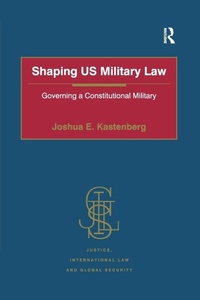
Shaping US Military Law
Governing a Constitutional Military
1st Edition
Published on 26. October 2016
Book
Paperback/Softback
268 pages
978-1-138-27403-7 (ISBN)
Description
Since the United States' entry into World War II, the federal judiciary has taken a prominent role in the shaping of the nation's military laws. Yet, a majority of the academic legal community studying the relationship between the Court and the military establishment argues otherwise providing the basis for a further argument that the legal construct of the military establishment is constitutionally questionable. Centering on the Cold War era from 1968 onward, this book weaves judicial biography and a historic methodology based on primary source materials into its analysis and reviews several military law judicial decisions ignored by other studies. This book is not designed only for legal scholars. Its intended audience consists of Cold War, military, and political historians, as well as political scientists, and, military and national security policy makers. Although the book's conclusions are likely to be favored by the military establishment, the purpose of this book is to accurately analyze the intersection of the later twentieth century's American military, political, social, and cultural history and the operation of the nation's armed forces from a judicial vantage.
Reviews / Votes
'A thorough survey of the Supreme Court's role in shaping the distinctive military justice system, and the surprising interactions between seemingly extraneous events and the uniformed services, this book will likely end up on the shelf of every military attorney, but should also be part of the education of everyone with an interest in how the United States military governs itself.' John M. Bickers, Northern Kentucky University, USA 'Josh Kastenberg has produced a fascinating and often provocative study of military law that fills a yawning gap in the existing literature. Because of his exquisite grasp of both law and history he is able to present a fresh perspective on judicial developments in military law that is simply unavailable elsewhere. What is more is that he designed his approach to be accessible not just to legal scholars, but also to students, policymakers, as well as the general public. This is sure to be a must read? for anyone interested in understanding how the judiciary shapes the legal architecture of American military governance as the armed forces address the extraordinarily complex challenges of the 21st century.' Maj. Gen. Charles J. Dunlap, Jr., USAF (Ret.) and Duke University, USAMore details
Language
English
Place of publication
London
United Kingdom
Publishing group
Taylor & Francis Ltd
Target group
College/higher education
Dimensions
Height: 234 mm
Width: 156 mm
Thickness: 15 mm
Weight
418 gr
ISBN-13
978-1-138-27403-7 (9781138274037)
Copyright in bibliographic data and cover images is held by Nielsen Book Services Limited or by the publishers or by their respective licensors: all rights reserved.
Schweitzer Classification
Other editions
Additional editions
E-Book
04/2016
1st Edition
Routledge
€77.99
Available for download
E-Book
04/2016
1st Edition
Routledge
€77.99
Available for download
Book
06/2014
1st Edition
Routledge
€206.60
Shipment within 10-20 days
Person
Joshua E. Kastenberg is currently a military judge in the United States Air Force Trial Judiciary. Previously he was Chief of Operations - International Law Doctrine at the Pentagon and chief legal advisor to the commander US Air Forces in Iraq. The views expressed are his own.
Content
Preface; Chapter 1 Introduction: A Historic Methodology of Military Law and Governance; Chapter 2; O'Callahan v. Parker; : The Last Year of the Warren Court; Chapter 3 The Burger Court, Military Governance, and the Vietnam Conflict; Chapter 4 Restoring Military Discipline and Maintaining the Military's Subordination to the Civil Government; Chapter 5 Judicial Supervision of the Military in the Era of Equal Protection; Chapter 6 Rehnquist Court: From; Solorio v. United States; to the War on Terror; Chapter 7 Conclusion;