

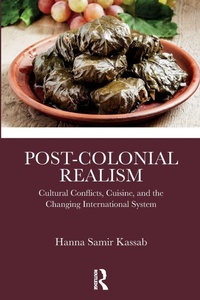
Post-Colonial Realism
Cultural Conflicts, Cuisine, and the Changing International System
1st Edition
Published on 21. August 2025
Book
Paperback/Softback
164 pages
978-1-041-05222-7 (ISBN)
Description
In Post-Colonial Realism, Hanna Samir Kassab develops a theoretical framework to explain, understand, and predict international conflict, placing culture at the center of international political analysis.
Kassab contends that nationalism, a belief system, forms an intervening variable that shapes the foreign policy behavior of states. Studying food is central to understanding nationalist belief systems that shape international politics. By combining theories of nationalism with post-colonialist understandings of cultural revitalization, Kassab conceptualizes state motivation to understand how cultural symbols shape nationalist identities, to see the fault lines of civilization through food, and to appreciate the centrality of identity issues. Using ethnography to understand food ownership as part of nationalist conflict, Kassab examines neighboring states (Greece, North Macedonia, Turkey and Armenia) alongside India. In each country study chapter, he compares at least two nationalisms and views of cuisine ownership. He later maps out potential future flashpoints as the international system becomes increasingly competitive due to the changing structure of the international system: unipolarity to multipolarity.
Post-Colonial Realism offers a more robust and flexible theory of international relations, concentrating not on abstractions but on individuals and their collective beliefs.
Kassab contends that nationalism, a belief system, forms an intervening variable that shapes the foreign policy behavior of states. Studying food is central to understanding nationalist belief systems that shape international politics. By combining theories of nationalism with post-colonialist understandings of cultural revitalization, Kassab conceptualizes state motivation to understand how cultural symbols shape nationalist identities, to see the fault lines of civilization through food, and to appreciate the centrality of identity issues. Using ethnography to understand food ownership as part of nationalist conflict, Kassab examines neighboring states (Greece, North Macedonia, Turkey and Armenia) alongside India. In each country study chapter, he compares at least two nationalisms and views of cuisine ownership. He later maps out potential future flashpoints as the international system becomes increasingly competitive due to the changing structure of the international system: unipolarity to multipolarity.
Post-Colonial Realism offers a more robust and flexible theory of international relations, concentrating not on abstractions but on individuals and their collective beliefs.
More details
Language
English
Place of publication
London
United Kingdom
Publishing group
Taylor & Francis Ltd
Target group
College/higher education
Postgraduate and Undergraduate Advanced
Illustrations
22 s/w Abbildungen, 22 s/w Photographien bzw. Rasterbilder
22 Halftones, black and white; 22 Illustrations, black and white
Dimensions
Height: 229 mm
Width: 152 mm
Thickness: 10 mm
Weight
268 gr
ISBN-13
978-1-041-05222-7 (9781041052227)
Copyright in bibliographic data and cover images is held by Nielsen Book Services Limited or by the publishers or by their respective licensors: all rights reserved.
Schweitzer Classification
Other editions
Additional editions
Hanna Samir Kassab
Post-Colonial Realism
Cultural Conflicts, Cuisine, and the Changing International System
E-Book
08/2025
Routledge
€55.49
Available for download
Hanna Samir Kassab
Post-Colonial Realism
Cultural Conflicts, Cuisine, and the Changing International System
E-Book
08/2025
Routledge
€55.49
Available for download
Hanna Samir Kassab
Post-Colonial Realism
Cultural Conflicts, Cuisine, and the Changing International System
Book
08/2025
1st Edition
Routledge
€207.20
Shipment within 15-20 days
Person
Hanna Samir Kassab is an Associate Professor of Political Science and Security Studies at East Carolina University.
Content
Preface: Food and Everyday Nationalism Chapter 1: Introduction Chapter 2: Greece Chapter 3: North Macedonia Chapter 4: Turkey Chapter 5: Armenia Chapter 6: India. Conclusions