

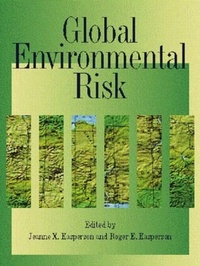
Global Environmental Risk
1st Edition
Will be published approx. on 1. July 2001
Book
Paperback/Softback
592 pages
978-1-85383-801-9 (ISBN)
Description
Despite international initiatives such as the Earth Summit in 1992 and ongoing efforts to implement the Kyoto Protocol, human activities continue to register a destructive toll on the planetary environment. At root, research on global environmental risk seeks new pathways for reversing unsustainable trends, curtailing ongoing destructive activities, and creating a life-sustaining planet. This book takes stock of the distinctive challenges posed by global environmental risks, the capacity of knowledge systems to identify and characterize such risks, and the competence of human society to manage the unprecedented complexity. Particular attention trains on engaging, in ways conducive to enhancing social learning and adaptation, the large uncertainties inherent in these risks.
Various chapters enlist different scales of analysis to explore the manifestation and causes of global environmental risks in all the diversity of their regional expression. Throughout, the editors and contributors accord prominence to the vulnerability of people and places to environmental degradation. Understanding vulnerability is a neglected key to assessing the nature of the risks and determining strategies for altering trajectories of threat. Global risk futures, the editors argue, are not intractable, and are still amenable to a risk-analysis enterprise that is democratic in principle, humanistic in concept, and geared to the realities that pertain to the particular societies, locales, and regions that will ultimately bear the risk.
Various chapters enlist different scales of analysis to explore the manifestation and causes of global environmental risks in all the diversity of their regional expression. Throughout, the editors and contributors accord prominence to the vulnerability of people and places to environmental degradation. Understanding vulnerability is a neglected key to assessing the nature of the risks and determining strategies for altering trajectories of threat. Global risk futures, the editors argue, are not intractable, and are still amenable to a risk-analysis enterprise that is democratic in principle, humanistic in concept, and geared to the realities that pertain to the particular societies, locales, and regions that will ultimately bear the risk.
Reviews / Votes
'A comprehensive examination of the threats to human beings and an assessment of what we value.'What's New Online
More details
Series
Language
English
Place of publication
London
United Kingdom
Publishing group
Taylor & Francis Ltd
Target group
College/higher education
Dimensions
Height: 235 mm
Width: 156 mm
Weight
876 gr
ISBN-13
978-1-85383-801-9 (9781853838019)
Copyright in bibliographic data and cover images is held by Nielsen Book Services Limited or by the publishers or by their respective licensors: all rights reserved.
Schweitzer Classification
Other editions
Additional editions
Jeanne X. Kasperson | Roger E. Kasperson
Global Environmental Risk
E-Book
05/2013
1st Edition
Routledge
€69.99
Available for download
Jeanne X. Kasperson | Roger E. Kasperson
Global Environmental Risk
E-Book
05/2013
1st Edition
Routledge
€69.99
Available for download

Jeanne X. Kasperson | Roger E. Kasperson
Global Environmental Risk
Book
07/2001
Earthscan Ltd
€133.70
Withdrawn from sale
Persons
Jeanne X. Kasperson, research Associate Professor and Research Librarian at the George Perkin's Marsh Institute, Clark University, Worcester, Massachusetts, USA, is a visiting scholar at the Stockholm Environment Institute.
Roger E. Kasperson, after more than 30 years at Clark University, Worcester, Massachusetts, USA, where he was University Professor (Government and Geography) and Director of the George Perkins Institute, has joined the Stockholm Environment Institute as its Executive Director.
Roger E. Kasperson, after more than 30 years at Clark University, Worcester, Massachusetts, USA, where he was University Professor (Government and Geography) and Director of the George Perkins Institute, has joined the Stockholm Environment Institute as its Executive Director.
Content
Introduction * Part One: Characterizing Global Environmental Risks * Part Two: Vulnerability * Part Three: High-Risk Regions * Part Four: Global Environmental Futures * References * Contributors * Index