

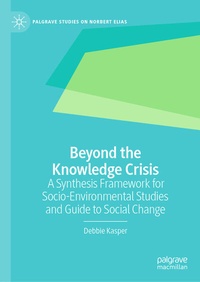
Beyond the Knowledge Crisis
Description
Reviews / Votes
"Although not about Norbert Elias, Beyond the Knowledge Crisis is very much in Eliasian spirit. Broad in sweep, Kasper's book examines the ecological crisis- the practical issue of politics and policy now and in the near future. The author's stress throughout is on the word synthesis , recognizing that a theoretical and empirical intellectual synthesis of history and the social and natural sciences is necessary to tackle the global problems of the age. This very synthesis is that which Elias himself was seeking to achieve, especially in his late writings."-Stephen Mennell, Professor Emeritus of Sociology, University College Dublin, Ireland
"Debbie Kasper's Beyond the Knowledge Crisis is a vital work that arrives at a critical time. Scholars of Norbert Elias should be delighted with Kasper's explorations of his work and influence, but perhaps more importantly, all practitioners of integrative problem solving will find great insight and guidance here. Kasper provides a much-needed tonic during a time of enormous practical and existential challenges, when teachers and students alike need clear guidance to undertake integrative problem solving, especially in environmental studies. As an iconoclastic interdisciplinarian with a 30-year career learning and teaching, I can attest that it is rare to encounter a book that so skillfully and accurately depicts the world of professional practice that I have both inhabited and researched for so long. Kasper's work will help us navigate the complexities of setting and achieving truly interdisciplinary goals in the face of the great complexity that now demands them."
-Richard L. Wallace, Professor of Environmental Studies and Marine Science, Chair of the Environmental Studies Department, Director of the Food Studies Program, and Co-Director of the Whittaker Environmental Research Station, Ursinus College, USA
More details
Other editions
Additional editions
Person
Content
Introduction.- Chapter 1: The Crisis of the Librarian.- Chapter 2: Moving Toward Synthesis.- Chapter 3: A Science of Human Social Life? Present State, Future Prospects .- Chapter 4: Mapping the Territory.- Chapter 5: The Medium of Human Social Life.- Chapter 6: The Human Condition.- Chapter 7: Second Nature.- Chapter 8: Actions and Reactions.- Chapter 9: The Only Constant.- Conclusion: Insights, Applications, and Possibilities.