

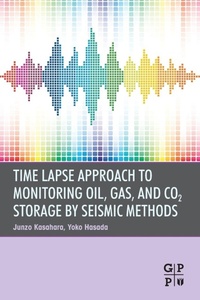
Time Lapse Approach to Monitoring Oil, Gas, and CO2 Storage by Seismic Methods
Published on 13. October 2016
Book
Paperback/Softback
216 pages
978-0-12-803588-7 (ISBN)
Description
Time Lapse Approach to Monitoring Oil, Gas, and CO2 Storage by Seismic Methods delivers a new technology to geoscientists, well logging experts, and reservoir engineers, giving them a new basis on which to influence decisions on oil and gas reservoir management.
Named ACROSS (Accurately Controlled and Routinely Operated Signal System), this new evaluation method is presented to address more complex reservoirs, such as shale and heavy oil. The book also discusses prolonged production methods for enhanced oil recovery. The monitoring of storage zones for carbon capture are also included, all helping the petroleum and reservoir engineer to fully extend the life of a field and locate untapped pockets of additional oil and gas resources. Rounded out with case studies from locations such as Japan, Saudi Arabia, and Canada, this book will help readers, scientists, and engineers alike to better manage the life of their oil and gas resources and reservoirs.
Named ACROSS (Accurately Controlled and Routinely Operated Signal System), this new evaluation method is presented to address more complex reservoirs, such as shale and heavy oil. The book also discusses prolonged production methods for enhanced oil recovery. The monitoring of storage zones for carbon capture are also included, all helping the petroleum and reservoir engineer to fully extend the life of a field and locate untapped pockets of additional oil and gas resources. Rounded out with case studies from locations such as Japan, Saudi Arabia, and Canada, this book will help readers, scientists, and engineers alike to better manage the life of their oil and gas resources and reservoirs.
More details
Language
English
Place of publication
United States
Publishing group
Elsevier Science & Technology
Target group
Professional and scholarly
Product notice
Paperback (trade)
Dimensions
Height: 229 mm
Width: 152 mm
Thickness: 12 mm
Weight
297 gr
ISBN-13
978-0-12-803588-7 (9780128035887)
Copyright in bibliographic data and cover images is held by Nielsen Book Services Limited or by the publishers or by their respective licensors: all rights reserved.
Schweitzer Classification
Other editions
Additional editions
Junzo Kasahara | Yoko Hasada
Time Lapse Approach to Monitoring Oil, Gas, and CO2 Storage by Seismic Methods
E-Book
10/2016
Gulf Professional Publishing
€71.95
Available for download
Persons
Junzo Kasahara received B.S., M.S., and D.Sc. degrees in geophysics from Nagoya University in 1965, 1967, and 1970, respectively. From 1970 to
1986, and then from 1988 to 2004, he was an assistant, associate, and full professor at the University of Tokyo. He worked in marine seismology. During 1974, 1976, and 1979, he was a visiting associate professor at the University of Hawaii. In 1986, he joined Schlumberger Japan as a manager for seismic interpretation and logging tool design. During his academic work, he published three books with the University of Tokyo Press. He was awarded the title of professor emeritus at the University of Tokyo. In 2004, he joined the Tono Geoscience Center as a senior researcher, where he worked on the ACROSS project. Between 2004 and 2008, he served for the extension of the Japan Continental Shelf. Currently, he is the principal
investigator of the geothermal project and a visiting professor at the University of Shizuoka. Dr. Hasada is a Research engineer with Daiwa Exploration and Consulting Co. Ltd., in Tokyo. Her education includes Dr. Sci. (Geophysics), Nagoya University, 2000, M.S. (Geophysics), Nagoya University, 1997, B.S. (Earth Sciences), Nagoya University, 1995
1986, and then from 1988 to 2004, he was an assistant, associate, and full professor at the University of Tokyo. He worked in marine seismology. During 1974, 1976, and 1979, he was a visiting associate professor at the University of Hawaii. In 1986, he joined Schlumberger Japan as a manager for seismic interpretation and logging tool design. During his academic work, he published three books with the University of Tokyo Press. He was awarded the title of professor emeritus at the University of Tokyo. In 2004, he joined the Tono Geoscience Center as a senior researcher, where he worked on the ACROSS project. Between 2004 and 2008, he served for the extension of the Japan Continental Shelf. Currently, he is the principal
investigator of the geothermal project and a visiting professor at the University of Shizuoka. Dr. Hasada is a Research engineer with Daiwa Exploration and Consulting Co. Ltd., in Tokyo. Her education includes Dr. Sci. (Geophysics), Nagoya University, 2000, M.S. (Geophysics), Nagoya University, 1997, B.S. (Earth Sciences), Nagoya University, 1995
Content
Chapter 1. What is Time Lapse?
Chapter 2. Various Time-Lapse Methods
Chapter 3. Active Seismic Approach by Accurately Controlled and Routinely Operated Signal System
Chapter 4. Imaging of Temporal Changes by Backpropagation
Chapter 5. Passive Seismic Approach
Chapter 6. Previous Time-Lapse Studies Other Than Accurately Controlled and Routinely Operated Signal System Method
Chapter 7. Case Studies Based on Accurately Controlled and Routinely Operated Signal System Methodology
Chapter 8. Near-Surface Effects
Chapter 9. Repeatability
Chapter 10. Rock Physics
Conclusions
Chapter 2. Various Time-Lapse Methods
Chapter 3. Active Seismic Approach by Accurately Controlled and Routinely Operated Signal System
Chapter 4. Imaging of Temporal Changes by Backpropagation
Chapter 5. Passive Seismic Approach
Chapter 6. Previous Time-Lapse Studies Other Than Accurately Controlled and Routinely Operated Signal System Method
Chapter 7. Case Studies Based on Accurately Controlled and Routinely Operated Signal System Methodology
Chapter 8. Near-Surface Effects
Chapter 9. Repeatability
Chapter 10. Rock Physics
Conclusions