

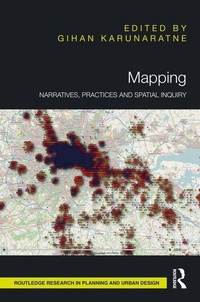
Mapping
Narratives, Practices and Spatial Inquiry
1st Edition
Will be published approx. on 29. December 2025
Book
Hardback
354 pages
978-1-032-93420-4 (ISBN)
Description
Mapping has evolved beyond navigation into a method for interpreting spatial, ephemeral, and sociopolitical dimensions of contemporary life. This volume explores how cartographic practices are being reimagined across disciplines to understand and reconfigure urban space.
The essays examine mapping as both representational and generative, spanning participatory mapping in informal settlements, film-based documentation of marginalized geographies, embodied cartographies, and data-driven analysis. Organized into five sections-Representation, Critical Cartographies, Mapping Belonging, Performative Cartographies, and Data Mapping-the collection highlights methodological and layered dimensions of contemporary mapping. By interrogating traditional cartography, the book emphasizes maps' role in constructing social realities and navigating contested urban terrains. Contributors demonstrate mapping as an engagement practice that reveals hidden geographies, amplifies marginal voices, and reimagines spaces.
This volume challenges readers to reconsider mapping as an interdisciplinary practice and mode of inquiry that can transform our understanding of complex environments and social dynamics. It will be of interest to researchers and students of urban design, architecture, planning, human geography, politics, and sociology.
The essays examine mapping as both representational and generative, spanning participatory mapping in informal settlements, film-based documentation of marginalized geographies, embodied cartographies, and data-driven analysis. Organized into five sections-Representation, Critical Cartographies, Mapping Belonging, Performative Cartographies, and Data Mapping-the collection highlights methodological and layered dimensions of contemporary mapping. By interrogating traditional cartography, the book emphasizes maps' role in constructing social realities and navigating contested urban terrains. Contributors demonstrate mapping as an engagement practice that reveals hidden geographies, amplifies marginal voices, and reimagines spaces.
This volume challenges readers to reconsider mapping as an interdisciplinary practice and mode of inquiry that can transform our understanding of complex environments and social dynamics. It will be of interest to researchers and students of urban design, architecture, planning, human geography, politics, and sociology.
More details
Series
Language
English
Place of publication
London
United Kingdom
Publishing group
Taylor & Francis Ltd
Target group
College/higher education
Professional and scholarly
Academic, Postgraduate, and Undergraduate Advanced
Illustrations
48 s/w Photographien bzw. Rasterbilder, 59 s/w Zeichnungen, 2 s/w Tabellen, 107 s/w Abbildungen
2 Tables, black and white; 59 Line drawings, black and white; 48 Halftones, black and white; 107 Illustrations, black and white
Dimensions
Height: 243 mm
Width: 164 mm
Thickness: 27 mm
Weight
704 gr
ISBN-13
978-1-032-93420-4 (9781032934204)
Copyright in bibliographic data and cover images is held by Nielsen Book Services Limited or by the publishers or by their respective licensors: all rights reserved.
Schweitzer Classification
Other editions
Person
Gihan Karunaratne is an architect and academic whose research engages critically with urban transformation, spatial justice, and informal urbanisms, particularly in the Global South. His work explores the intersection of urban change and the lived experiences of marginalized communities, emphasizing the socio-spatial dynamics of informality and resilience. Karunaratne foregrounds often-overlooked dimensions of urban life, offering insights into the structural inequalities that shape contemporary cities. His publications with Routledge -including Informal Settlement of the Global South, Resilient Urbanism, and Displaced Urbanism-contribute significantly to scholarly discourse on architecture, urban design, and the complexities of precarity in rapidly evolving urban contexts.
Content
Introduction (Gihan Karunaratne) Section I. Representation: The Map as a Transformational Device 1. The Revenge of the Straight Line: Smooth and Striated Space in Thomas Pynchon's Mason and Dixon (Sean Griffiths) (University of Westminster/ Modern Architect/Fashion Architecture Taste) 2. Maps as Mediations: Space, Ideology, and the Politics of Representation (Kanishka Goonewardena) 3. Harvest Mapping (Graeme Brooker, Patrick Quinn and Joe Trickett)Section II. Mapping and Counter-Mapping: Critical Cartographies of Power and Place 4. Mapping Us and the Empathetic City: Nigel Coates in conversation with Tom Dyckhoff - edited and introduced by Doreen Bernath (Nigel Coates, Tom Dyckhoff and Doreen Bernath) 5. Outside the baselines: Mapping hidden stories in the Postcolonial Colombo (Gihan Karunaratne, Jagath Munasinghe and Youcao Ren) 6. Cartography and mercantile port cities in Early Modern Asia: Goa, Batavia, Macau, and Nagasaki (K.B. Izac Tsai) 7. Cartographic and Filmic Topographies - The Case of Tehran (Hamideh Farahmandian and Francois Penz) Section III. Mapping Belonging: Community, Culture, and Identity 8. Community mapping of informal settlements: Experiences from Maputo, Mozambique (Remigio Chilaule, Gustavo Ribeiro, Cristina Henriques and Johan Mottelson) 9. Community, Culture, and Space: Mapping Belonging Through Participatory Art in Urban Contexts (Azadeh Fatehrad) 10. Mapping Health: Auditing Healthy New Towns in the UK (David Howard and Hannah Grove) 11. Risky Environments: Transect Investigations in the FEMA Floodplain (Kira Clingen) Section IV. Performative Cartographies: Embodied and Ephemeral Practices 12. Mapping and its Projective Multi-Dimensionality (Marc Schoonderbeek) 13. Mapping the everyday (Heidi Saarinen) 14. Performative Cartographies: Capturing ephemerality through notational drawing (Angeliki Sakellariou) Section V. Mapping with Data 15. Mapping as a Lens to Address Complex Problems (Ed Parham) 16. Inferring data through Mapping (Luigi Pintacuda and Silvio Carta) 17. Overcoming Embedded Logics: Requisite Imagination and Authorship in the Process of Mapping (Anthony Vanky)