

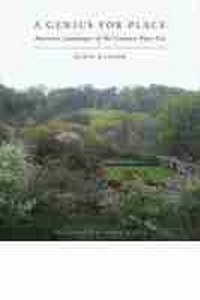
A Genius for Place
American Landscapes of the Country Place Era
Published on 27. August 2013
Book
Paperback/Softback
424 pages
978-1-62534-048-1 (ISBN)
Description
In this beautifully illustrated survey, landscape historian Robin Karson traces the development of a distinctly American style of landscape design through an analysis of seven country places created by some of the nation's most talented landscape practitioners. In the mid-nineteenth century Frederick Law Olmsted, the designer of New York's Central Park, developed an approach to landscape design based on the principles of the English Picturesque which also emphasised a specifically American experience of nature and scenery. After Olmsted's retirement in 1897, these precepts continued to ground a new generation of American landscape architects through the next four decades, a period known as the "country place era," a time of rapid economic, social, and cultural change.
In the early twentieth century, new fortunes made it possible for wealthy Americans to commission country estates as a means of aggrandising social status. These private havens also offered their owners respite from crowded cities and a way to preserve and celebrate places of distinctive landscape beauty. The commissions provided burgeoning numbers of landscape architects with opportunities to experiment with stylistic influences derived from Beaux-Arts, Arts and Crafts, and even Asian principles.
The chapters in this book trace a progression in the period from the naturalistic wild gardens of Warren Manning to the mysterious "Prairie style" landscapes of Jens Jensen to the proto-modernist gardens of Fletcher Steele. Other practitioners covered are Charles Platt, Ellen Biddle Shipman, Beatrix Farrand, Marian Coffin, and Lockwood de Forest Jr. The projects profiled follow a broad geographic arc, from Stockbridge, Massachusetts, to Santa Barbara, California. All seven landscapes are now open to visitors.
Analysing these designs in context with one another and against the backdrop of the professional and cultural currents that shaped larger projects-such as parks, campuses, and planned communities-Karson creates a rich and comprehensive picture of the artistic achievements of the period. Striking black-and-white images by landscape photographer Carol Betsch illuminate the transporting spirit of these country places today, while hundreds of drawings, plans, and historical photographs bring the past to life.
In the early twentieth century, new fortunes made it possible for wealthy Americans to commission country estates as a means of aggrandising social status. These private havens also offered their owners respite from crowded cities and a way to preserve and celebrate places of distinctive landscape beauty. The commissions provided burgeoning numbers of landscape architects with opportunities to experiment with stylistic influences derived from Beaux-Arts, Arts and Crafts, and even Asian principles.
The chapters in this book trace a progression in the period from the naturalistic wild gardens of Warren Manning to the mysterious "Prairie style" landscapes of Jens Jensen to the proto-modernist gardens of Fletcher Steele. Other practitioners covered are Charles Platt, Ellen Biddle Shipman, Beatrix Farrand, Marian Coffin, and Lockwood de Forest Jr. The projects profiled follow a broad geographic arc, from Stockbridge, Massachusetts, to Santa Barbara, California. All seven landscapes are now open to visitors.
Analysing these designs in context with one another and against the backdrop of the professional and cultural currents that shaped larger projects-such as parks, campuses, and planned communities-Karson creates a rich and comprehensive picture of the artistic achievements of the period. Striking black-and-white images by landscape photographer Carol Betsch illuminate the transporting spirit of these country places today, while hundreds of drawings, plans, and historical photographs bring the past to life.
Reviews / Votes
The most important book on American gardens for at least a decade, this giant tome spans the first 40 years of the 20th century...Superlative black-and-white photographs by Carol Betsch, taken in the 1990s, already have a classic look about them."" London TelegraphMore details
Language
English
Place of publication
Massachusetts
United States
Target group
Professional and scholarly
Illustrations
483 duotone illustrations
Weight
1200 gr
ISBN-13
978-1-62534-048-1 (9781625340481)
Copyright in bibliographic data and cover images is held by Nielsen Book Services Limited or by the publishers or by their respective licensors: all rights reserved.
Schweitzer Classification
Person
Robin Karson is author of Fletcer Steele, Landscape Architect and The Muses of Gwinn, and coeditor of Pioneers of American Landscape Design. She serves as executive director of the Library of American Landscape History.