

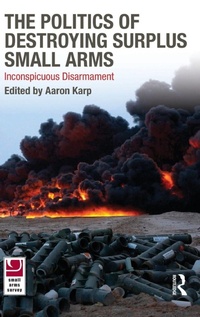
The Politics of Destroying Surplus Small Arms
Inconspicuous Disarmament
1st Edition
Published on 24. July 2009
Book
Hardback
272 pages
978-0-415-49461-8 (ISBN)
Description
Although it receives much less attention than better known disarmament processes, the destruction of small arms is reshaping the military arsenals of the world. Out of roughly 200 modern military small arms world-wide, about 500,000 are destroyed every year. The commitment of major governments and international organizations makes small arms destruction is a permanent addition to the global disarmament repertoire. But the prospects for greater military small arms disarmament may be declining, as war in Afghanistan and Iraq create unprecedented demand for second-hand weaponry.
Inconspicuous disarmament of small arms and ammunition is reshaping the global picture of firearms, light weapons and ammunition. The process is far from comprehensive, but much more than cosmetic. Small arms destruction is here to stay, but its contributions may be fleeting. This book is the first full-length examination of the issue. The case studies in this volume examine the politics of military small arms disarmament. When, they ask, is surplus destruction most likely? And what can be done to make destruction more likely and more effective?
Case studies examine small arms destruction by NATO and the OSCE, and in Bulgaria, Cambodia, Germany, Kazakhstan, Papua New Guinea, Romania, Serbia, Ukraine and others.
This book was published as a special issue of Contemporary Security Policy.
Inconspicuous disarmament of small arms and ammunition is reshaping the global picture of firearms, light weapons and ammunition. The process is far from comprehensive, but much more than cosmetic. Small arms destruction is here to stay, but its contributions may be fleeting. This book is the first full-length examination of the issue. The case studies in this volume examine the politics of military small arms disarmament. When, they ask, is surplus destruction most likely? And what can be done to make destruction more likely and more effective?
Case studies examine small arms destruction by NATO and the OSCE, and in Bulgaria, Cambodia, Germany, Kazakhstan, Papua New Guinea, Romania, Serbia, Ukraine and others.
This book was published as a special issue of Contemporary Security Policy.
More details
Language
English
Place of publication
London
United Kingdom
Publishing group
Taylor & Francis Ltd
Target group
College/higher education
Product notice
Paper over boards
Dimensions
Height: 240 mm
Width: 161 mm
Thickness: 19 mm
Weight
578 gr
ISBN-13
978-0-415-49461-8 (9780415494618)
Copyright in bibliographic data and cover images is held by Nielsen Book Services Limited or by the publishers or by their respective licensors: all rights reserved.
Schweitzer Classification
Other editions
Additional editions
E-Book
06/2014
1st Edition
Routledge
€64.49
Available for download
E-Book
06/2014
1st Edition
Routledge
€64.49
Available for download
Book
07/2009
1st Edition
Routledge
€71.60
Shipment within 15-20 days
Person
Aaron Karp is Lecturer in Political Science at Old Dominion University in Norfolk, Virginia and Senior Consultant with the Small Arms Survey in Geneva, Switzerland.
Content
1. Introduction: Inconspicuous Disarmament Aaron Karp INSTITUTIONS OF SMALL ARMS DESTRUCTION 2. NATO and Demilitarization of Surplus Weapons and Ammunition Peter Courtney-Greene 3. The OSCE Experience with Surplus Small Arms and Ammunition Yurii Kryvonos and Elli Kytoemaeki UNILATERAL INITIATIVE 4. Germany: From Surplus Exports to Destruction Christina Beeck COOPERATIVE DESTRUCTION 5. Bulgaria and Romania: Quick Start, Ambiguous Progress Sami Faltas 6. Cambodia: Surplus Destruction After War and Genocide Rebecca Roberts 7. Kazakhstan: Where Surplus Arms Are Not a Problem Michael Ashkenazi 8. Papua New Guinea: Small Numbers, Big Fuss, Real Results Philip Alpers 9. Serbia: Choosing Between Profit and Security Hugh Griffiths 10. Ukraine: Coping with Post-Soviet Legacies Hugh Griffiths and Aaron Karp