

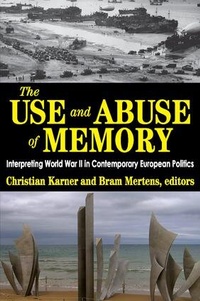
The Use and Abuse of Memory
Interpreting World War II in Contemporary European Politics
1st Edition
Published on 30. October 2013
Book
Hardback
290 pages
978-1-4128-5194-7 (ISBN)
Description
Decades after the previously unimaginable horrors of the Nazi extermination camps and the dropping of nuclear bombs on Hiroshima and Nagasaki, their memories remain part of our lives. In academic and human terms, preserving awareness of this past is an ethical imperative. This volume concerns narratives about-and allusions to-World War II across contemporary Europe, and explains why contemporary Europeans continue to be drawn to it as a template of comparison, interpretation, even prediction.
This volume adds a distinctly interdisciplinary approach to the trajectories of recent academic inquiries. Historians, sociologists, anthropologists, linguists, political scientists, and area study specialists contribute wide-ranging theoretical paradigms, disciplinary frameworks, and methodological approaches.
The volume focuses on how, where, and to what effect World War II has been remembered. The editors discuss how World War II in particular continues to be a point of reference across the political spectrum and not only in Europe. It will be of interest for those interested in popular culture, World War II history, and national identity studies.
This volume adds a distinctly interdisciplinary approach to the trajectories of recent academic inquiries. Historians, sociologists, anthropologists, linguists, political scientists, and area study specialists contribute wide-ranging theoretical paradigms, disciplinary frameworks, and methodological approaches.
The volume focuses on how, where, and to what effect World War II has been remembered. The editors discuss how World War II in particular continues to be a point of reference across the political spectrum and not only in Europe. It will be of interest for those interested in popular culture, World War II history, and national identity studies.
More details
Language
English
Place of publication
New York
United States
Publishing group
Taylor & Francis Inc
Dimensions
Height: 229 mm
Width: 152 mm
Weight
700 gr
ISBN-13
978-1-4128-5194-7 (9781412851947)
Copyright in bibliographic data and cover images is held by Nielsen Book Services Limited or by the publishers or by their respective licensors: all rights reserved.
Schweitzer Classification
Other editions
Additional editions
Christian Karner
The Use and Abuse of Memory
Interpreting World War II in Contemporary European Politics
Book
09/2017
1st Edition
Routledge
€78.27
Shipment within 10-20 days
Christian Karner
The Use and Abuse of Memory
Interpreting World War II in Contemporary European Politics
E-Book
09/2017
Routledge
€65.99
Available for download
Christian Karner
The Use and Abuse of Memory
Interpreting World War II in Contemporary European Politics
E-Book
09/2017
Routledge
€65.99
Available for download
Person
Christian Karner
Content
Introduction: Memories and Analogies of World War II
Christian Karner and Bram Mertens
1 Genocide Memorialization and the Europeanization of Europe
Henning Grunwald
2 Appeasement Analogies in British Parliamentary Debates Preceding the 2003 Invasion of Iraq
Joseph Burridge
3 How Deeply Rooted Is the Commitment to "Never Again"? Dick Bengtsson's Swastikas and European Memory Culture
Tanja Schult
4 Cultural Memories of German Suffering during the Second World War: An Inability Not to Mourn?
Karl Wilds
5 From Perpetrators to Victims and Back Again: The Long Shadow of the Second World War in Belgium
Bram Mertens
6 L'Histoire bling-bling-Nicolas Sarkozy and the Historians
Paul Smith
7 The Pasts of the Present: World War II Memories and the Construction of Political Legitimacy in Post-Cold War Italy
Bjorn Thomassen and Rosario Forlenza
8 "The Nazis Strike Again": The Concept of "The German Enemy," Party Strategies, and Mass Perceptions through the Prism of the Greek Economic Crisis
Zinovia Lialiouti and Giorgos Bithymitris
9 Who Were the Anti-Fascists? Divergent Interpretations of WWII in Contemporary Post-Yugoslav History Textbooks
Jovana Mihajlovi Trbovc and Tamara Pavasovi Tro st
10 Multiple Dimensions and Discursive Contests in Austria's Mythscape
Christian Karner
11 World War II in Discourses of National Identification in Poland: An Intergenerational Perspective
Anna Duszak
12 From the "Reunification of the Ukrainian Lands" to "Soviet Occupation": The Molotov-Ribbentrop Pact in the Ukrainian Political Memory
Tatiana Zhurzhenko
13 "Often Very Harmful Things Start Out with Things That Are Very Harmless": European Reflections on Guilt and Innocence Inspired by Art about the Holocaust in the 1990s
Diana I. Popescu
14 Epilogue
Christian Karner and Bram Mertens
List of Contributors
Index
Christian Karner and Bram Mertens
1 Genocide Memorialization and the Europeanization of Europe
Henning Grunwald
2 Appeasement Analogies in British Parliamentary Debates Preceding the 2003 Invasion of Iraq
Joseph Burridge
3 How Deeply Rooted Is the Commitment to "Never Again"? Dick Bengtsson's Swastikas and European Memory Culture
Tanja Schult
4 Cultural Memories of German Suffering during the Second World War: An Inability Not to Mourn?
Karl Wilds
5 From Perpetrators to Victims and Back Again: The Long Shadow of the Second World War in Belgium
Bram Mertens
6 L'Histoire bling-bling-Nicolas Sarkozy and the Historians
Paul Smith
7 The Pasts of the Present: World War II Memories and the Construction of Political Legitimacy in Post-Cold War Italy
Bjorn Thomassen and Rosario Forlenza
8 "The Nazis Strike Again": The Concept of "The German Enemy," Party Strategies, and Mass Perceptions through the Prism of the Greek Economic Crisis
Zinovia Lialiouti and Giorgos Bithymitris
9 Who Were the Anti-Fascists? Divergent Interpretations of WWII in Contemporary Post-Yugoslav History Textbooks
Jovana Mihajlovi Trbovc and Tamara Pavasovi Tro st
10 Multiple Dimensions and Discursive Contests in Austria's Mythscape
Christian Karner
11 World War II in Discourses of National Identification in Poland: An Intergenerational Perspective
Anna Duszak
12 From the "Reunification of the Ukrainian Lands" to "Soviet Occupation": The Molotov-Ribbentrop Pact in the Ukrainian Political Memory
Tatiana Zhurzhenko
13 "Often Very Harmful Things Start Out with Things That Are Very Harmless": European Reflections on Guilt and Innocence Inspired by Art about the Holocaust in the 1990s
Diana I. Popescu
14 Epilogue
Christian Karner and Bram Mertens
List of Contributors
Index