

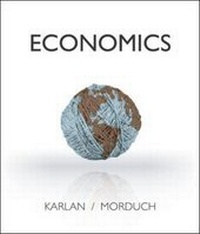
Economics
Published on 16. October 2013
Book
Hardback
1056 pages
978-0-07-351149-8 (ISBN)
Description
Built from the ground up to focus on what matters to students in today's high-tech, globalized world, Dean Karlan and Jonathan Morduch's Economics represents a new generation of products, optimized for digital delivery and available with the best-in-class adaptive study resources in McGraw-Hill's LearnSmart Advantage Suite. Engagement with real-world problems is built into the very fabric of the learning materials as students are encouraged to think about economics in efficient, innovative, and meaningful ways.
Drawing on the authors' experiences as academic economists, teachers, and policy advisors, a familiar curriculum is combined with material from new research and applied areas such as finance, behavioral economics, and the political economy, to share with students how what they're learning really matters. This modern approach is organized around learning objectives and matched with sound assessment tools aimed at enhancing students' analytical and critical thinking competencies. Students and faculty will find content that breaks down barriers between what goes on in the classroom and what is going on in our nation and broader world.
By teaching the right questions to ask, Karlan and Morduch provide readers with a method for working through decisions they'll face in life and ultimately show that economics is the common thread that enables us to understand, analyze, and solve problems in our local communities and around the world.
Connect is the only integrated learning system that empowers students by continuously adapting to deliver precisely what they need, when they need it, and how they need it, so that your class time is more engaging and effective.
Drawing on the authors' experiences as academic economists, teachers, and policy advisors, a familiar curriculum is combined with material from new research and applied areas such as finance, behavioral economics, and the political economy, to share with students how what they're learning really matters. This modern approach is organized around learning objectives and matched with sound assessment tools aimed at enhancing students' analytical and critical thinking competencies. Students and faculty will find content that breaks down barriers between what goes on in the classroom and what is going on in our nation and broader world.
By teaching the right questions to ask, Karlan and Morduch provide readers with a method for working through decisions they'll face in life and ultimately show that economics is the common thread that enables us to understand, analyze, and solve problems in our local communities and around the world.
Connect is the only integrated learning system that empowers students by continuously adapting to deliver precisely what they need, when they need it, and how they need it, so that your class time is more engaging and effective.
More details
Language
English
Place of publication
United States
Publishing group
McGraw-Hill Education - Europe
Target group
College/higher education
US School Grade: College Freshman
Illustrations
359 Illustrations
Dimensions
Height: 254 mm
Width: 239 mm
Thickness: 38 mm
Weight
2143 gr
ISBN-13
978-0-07-351149-8 (9780073511498)
Copyright in bibliographic data and cover images is held by Nielsen Book Services Limited or by the publishers or by their respective licensors: all rights reserved.
Schweitzer Classification
Other editions
New editions
Dean Karlan | Jonathan Morduch
Economics
Book
03/2017
2nd Edition
McGraw-Hill Education
€408.52
Article is exhausted; no reprint
Persons
Dean Karlan is Professor of Economics and Finance at Northwestern University and President and Founder of Innovations for Poverty Action (IPA). Dean started IPA in 2002 with two aims: to help learn what works and what does not in the fight against poverty and other social problems around the world, and then to implement successful ideas at scale. IPA has worked in over 50 countries, with 1,000 employees around the world. Dean's personal research focuses on using field experiments to learn more about the effectiveness of financial services for low-income households, with a focus on using behavioral economics approaches to improve financial products and services. His research includes related areas, such as building income for those in extreme poverty, charitable fund-raising, voting, health, and education. Dean is also co founder of stickK.com, a start-up that helps people use commitment contracts to achieve personal goals, such as losing weight or completing a problem set on time, and in 2015 he founded Impact Matters, an organization that helps assess whether charitable organizations are using and producing appropriate evidence of impact. Dean is a Sloan Foundation Research Fellow, a Guggenheim Fellow, and an Executive Committee member of the Board of the M.I.T. Jameel Poverty Action Lab. In 2007 he was awarded a Presidential Early Career Award for Scientists and Engineers. He is co editor of the Journal of Development Economics and on the editorial board of American Economic Journal: Applied Economics. He holds a BA from University of Virginia, an MPP and MBA from University of Chicago, and a PhD in Economics from MIT. In 2016 he coauthored Failing in the Field, and in 2011 he coauthored More Than Good Intentions:Improving the Ways the World's Poor Borrow, Save, Farm, Learn, and Stay Healthy.
Jonathan Morduch is Professor of Public Policy and Economics at New York University's Wagner Graduate School of Public Service. Jonathan focuses on innovations that expand the frontiers of finance and how financial markets shape economic growth and inequality. Jonathan has lived and worked in Asia, but his newest book, The Financial Diaries: How American Families Cope in a World of Uncertainty (written with Rachel Schneider and published by Princeton University Press, 2017), follows families in California, Mississippi, Ohio, Kentucky, and New York as they cope with economic ups and downs over a year. The new work jumps off from ideas in Portfolios of the Poor: How the World's Poor Live on $2 a Day (Princeton University Press, 2009), which Jonathan coauthored and which describes how families in Bangladesh, India, and South Africa devise ways to make it through a year living on $2 a day or less. Jonathan's research on financial markets is collected in The Economics of Micro-finance and Banking the World, both published by MIT Press. At NYU, Jonathan is executive director of the Financial Access Initiative, a center that supports research on extending access to finance in low-income communities. Jonathan's ideas have also shaped policy through work with the United Nations, World Bank, and other international organizations. In 2009, the Free University of Brussels awarded Jonathan an honorary doctorate to recognize his work on micro-finance. He holds a BA from Brown and a PhD from Harvard, both in Economics.
Jonathan Morduch is Professor of Public Policy and Economics at New York University's Wagner Graduate School of Public Service. Jonathan focuses on innovations that expand the frontiers of finance and how financial markets shape economic growth and inequality. Jonathan has lived and worked in Asia, but his newest book, The Financial Diaries: How American Families Cope in a World of Uncertainty (written with Rachel Schneider and published by Princeton University Press, 2017), follows families in California, Mississippi, Ohio, Kentucky, and New York as they cope with economic ups and downs over a year. The new work jumps off from ideas in Portfolios of the Poor: How the World's Poor Live on $2 a Day (Princeton University Press, 2009), which Jonathan coauthored and which describes how families in Bangladesh, India, and South Africa devise ways to make it through a year living on $2 a day or less. Jonathan's research on financial markets is collected in The Economics of Micro-finance and Banking the World, both published by MIT Press. At NYU, Jonathan is executive director of the Financial Access Initiative, a center that supports research on extending access to finance in low-income communities. Jonathan's ideas have also shaped policy through work with the United Nations, World Bank, and other international organizations. In 2009, the Free University of Brussels awarded Jonathan an honorary doctorate to recognize his work on micro-finance. He holds a BA from Brown and a PhD from Harvard, both in Economics.
Content
Thinking Like an Economist
Part 1: The Power of Economics
Chapter 1 Economics and Life
Chapter 2 Specialization and Exchange
Appendix A Math Essentials: Understanding Graphs and Slope
Part 2: Supply and Demand
Chapter 3 Markets
Appendix B Math Essentials: Working with Linear Equations
Chapter 4 Elasticity
Appendix C Math Essentials: Calculating Percentage Change, Slope, and Elasticity
Chapter 5 Efficiency
Appendix D Math Essentials: The Area Under a Linear Curve
Chapter 6 Government Intervention
Microeconomics: Thinking Like a Microeconomist
Part 3: Individual Decisions
Chapter 7 Consumer Behavior
Appendix E Using Indifference Curves
Chapter 8 Behavioral Economics: A Closer Look at Decision Making
Chapter 9 Game Theory and Strategic Thinking
Chapter 10 Information
Chapter 11 Time and Uncertainty
Appendix F Math Essentials: Compounding
Part 4: Firm Decisions
Chapter 12 The Costs of Production
Chapter 13 Perfect Competition
Chapter 14 Monopoly
Chapter 15 Monopolistic Competition and Oligopoly
Chapter 16 The Factors of Production
Chapter 17 International Trade
Part 5: Public Economics
Chapter 18 Externalities
Chapter 19 Public Goods and Common Resources
Chapter 20 Taxation and the Public Budget
Chapter 21 Poverty, Inequality, and Discrimination
Chapter 22 Political Choices
Chapter 23 Public Policy and Choice Architecture
Macroeconomics: Thinking Like a Macroeconomist
Part 6: The Data of Macroeconomics
Chapter 24 Measuring the Wealth of Nations
Chapter 25 The Cost of Living
Part 7: Economic Growth and Unemployment
Chapter 26 Economic Growth
Chapter 27 Unemployment and the Demand for Labor
Part 8: The Economy in the Short Run
Chapter 28 Aggregate Demand and Aggregate Supply
Chapter 29 Fiscal Policy and Public Finance
Part 9: The Financial System and Institutions
Chapter 30 The Basics of Finance
Appendix G Personal Finance (online)
Chapter 31 Money and the Monetary System
Chapter 32 Inflation
Chapter 33 Financial Crisis
Part 10: International Policy Issues
Chapter 34 Open-Market Macroeconomics
Chapter 35 Development Economics
Data Guide for Economists (online)
Glossary
Part 1: The Power of Economics
Chapter 1 Economics and Life
Chapter 2 Specialization and Exchange
Appendix A Math Essentials: Understanding Graphs and Slope
Part 2: Supply and Demand
Chapter 3 Markets
Appendix B Math Essentials: Working with Linear Equations
Chapter 4 Elasticity
Appendix C Math Essentials: Calculating Percentage Change, Slope, and Elasticity
Chapter 5 Efficiency
Appendix D Math Essentials: The Area Under a Linear Curve
Chapter 6 Government Intervention
Microeconomics: Thinking Like a Microeconomist
Part 3: Individual Decisions
Chapter 7 Consumer Behavior
Appendix E Using Indifference Curves
Chapter 8 Behavioral Economics: A Closer Look at Decision Making
Chapter 9 Game Theory and Strategic Thinking
Chapter 10 Information
Chapter 11 Time and Uncertainty
Appendix F Math Essentials: Compounding
Part 4: Firm Decisions
Chapter 12 The Costs of Production
Chapter 13 Perfect Competition
Chapter 14 Monopoly
Chapter 15 Monopolistic Competition and Oligopoly
Chapter 16 The Factors of Production
Chapter 17 International Trade
Part 5: Public Economics
Chapter 18 Externalities
Chapter 19 Public Goods and Common Resources
Chapter 20 Taxation and the Public Budget
Chapter 21 Poverty, Inequality, and Discrimination
Chapter 22 Political Choices
Chapter 23 Public Policy and Choice Architecture
Macroeconomics: Thinking Like a Macroeconomist
Part 6: The Data of Macroeconomics
Chapter 24 Measuring the Wealth of Nations
Chapter 25 The Cost of Living
Part 7: Economic Growth and Unemployment
Chapter 26 Economic Growth
Chapter 27 Unemployment and the Demand for Labor
Part 8: The Economy in the Short Run
Chapter 28 Aggregate Demand and Aggregate Supply
Chapter 29 Fiscal Policy and Public Finance
Part 9: The Financial System and Institutions
Chapter 30 The Basics of Finance
Appendix G Personal Finance (online)
Chapter 31 Money and the Monetary System
Chapter 32 Inflation
Chapter 33 Financial Crisis
Part 10: International Policy Issues
Chapter 34 Open-Market Macroeconomics
Chapter 35 Development Economics
Data Guide for Economists (online)
Glossary