

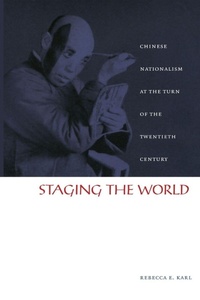
Staging the World
Chinese Nationalism at the Turn of the Twentieth Century
Published on 22. April 2002
Book
Paperback/Softback
320 pages
978-0-8223-2867-4 (ISBN)
Description
In Staging the World Rebecca E. Karl rethinks the production of nationalist discourse in China during the late Qing period, between China's defeat in the Sino-Japanese War in 1895 and the proclamation of the Republic in 1911. She argues that at this historical moment a growing Chinese identification with what we now call the Third World first made the modern world visible as a totality and that the key components of Chinese nationalist discourse developed in reference to this worldview.
The emergence of Chinese nationalism during this period is often portrayed as following from China's position vis-A-vis Japan and the West. Karl has mined the archives of the late Qing period to discern the foci of Chinese intellectuals from 1895 to 1911 to assert that even though the China/Japan/West triangle was crucial, it alone is an incomplete-and therefore flawed-model of the development of nationalism in China. Although the perceptions and concerns of these thinkers form the basis of Staging the World, Karl begins by examining a 1904 Shanghai production of an opera about a fictional partition of Poland and its modern reincarnation as an ethno-nation. By focusing on the type of dialogue this opera generated in China, Karl elucidates concepts such as race, colonization, globalization, and history. From there, she discusses how Chinese conceptions of nationalism were affected by the "discovery" of Hawai'i as a center of the Pacific, the Philippine revolution against the United States, and the relationship between nationality and ethnicity made apparent by the Boer War in South Africa.
The emergence of Chinese nationalism during this period is often portrayed as following from China's position vis-A-vis Japan and the West. Karl has mined the archives of the late Qing period to discern the foci of Chinese intellectuals from 1895 to 1911 to assert that even though the China/Japan/West triangle was crucial, it alone is an incomplete-and therefore flawed-model of the development of nationalism in China. Although the perceptions and concerns of these thinkers form the basis of Staging the World, Karl begins by examining a 1904 Shanghai production of an opera about a fictional partition of Poland and its modern reincarnation as an ethno-nation. By focusing on the type of dialogue this opera generated in China, Karl elucidates concepts such as race, colonization, globalization, and history. From there, she discusses how Chinese conceptions of nationalism were affected by the "discovery" of Hawai'i as a center of the Pacific, the Philippine revolution against the United States, and the relationship between nationality and ethnicity made apparent by the Boer War in South Africa.
Reviews / Votes
"Staging the World fundamentally challenges the conventional assumptions of late-nineteenth- and early-twentieth-century intellectual history and proposes a creative, alternative imagining of the historiography of modern China. This is a rare work of intellectual ambition and righteous moral sense."-Lionel M. Jensen, author of Manufacturing Confucianism: Chinese Traditions and Universal Civilization "Rebecca Karl not only explores an exciting period in Chinese intellectual history but also provides an alternative mapping of global relations based on a constellation of common subordinated nations. Those who, like me, are not specialists of Chinese history will find this vision of the world from below a refreshing revelation."-Michael Hardt, author of Empire (with Antonio Negri)More details
Series
Language
English
Place of publication
North Carolina
United States
Target group
Professional and scholarly
Product notice
Paperback (trade)
Dimensions
Height: 234 mm
Width: 156 mm
Thickness: 18 mm
Weight
503 gr
ISBN-13
978-0-8223-2867-4 (9780822328674)
Copyright in bibliographic data and cover images is held by Nielsen Book Services Limited or by the publishers or by their respective licensors: all rights reserved.
Schweitzer Classification
Other editions
Additional editions
Rebecca E. Karl | Rey Chow | Harry Harootunian
Staging the World
Chinese Nationalism at the Turn of the Twentieth Century
E-Book
04/2002
1st Edition
De Gruyter
€208.99
Available for download
Person
Rebecca E. Karl is Associate Professor of History at New York University. She is the author of The Magic of Concepts: History and the Economic in Twentieth-Century China and Mao Zedong and China in the Twentieth-Century World: A Concise History and co-translator (with Xueping Zhong) of Cai Xiang's Revolution and Its Narratives: China's Socialist Literary and Cultural Imaginaries, 1949-1966, all also published by Duke University Press. She co-translated and coedited (with Lydia H. Liu and Dorothy Ko) The Birth of Chinese Feminism: Essential Texts in Transnational Theory.
Content
Preface & Acknowledgments
Part I
1. Introduction: Shifting Perspectives on Modern Chinese Nationalism
2. Staging the World
Part II
3. Deterritorializing Politics: The Pacific and Hawaii as Chinese National Space
4. Recognizing Colonialism: The Philippines and Revolution
5. Promoting the Ethnos: The Boer War and Discourses of the People
Part III
6. Performing on the World Stage in Asia
7. Re-creating China's World
Conclusion
Appendix
Notes
Bibliography
Index
Part I
1. Introduction: Shifting Perspectives on Modern Chinese Nationalism
2. Staging the World
Part II
3. Deterritorializing Politics: The Pacific and Hawaii as Chinese National Space
4. Recognizing Colonialism: The Philippines and Revolution
5. Promoting the Ethnos: The Boer War and Discourses of the People
Part III
6. Performing on the World Stage in Asia
7. Re-creating China's World
Conclusion
Appendix
Notes
Bibliography
Index