

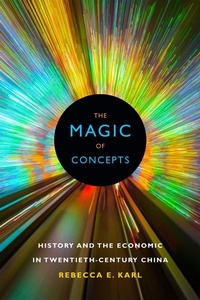
The Magic of Concepts
History and the Economic in Twentieth-Century China
Published on 3. March 2017
Book
Hardback
232 pages
978-0-8223-6310-1 (ISBN)
Description
In The Magic of Concepts Rebecca E. Karl interrogates "the economic" as concept and practice as it was construed historically in China in the 1930s and again in the 1980s and 1990s. Separated by the Chinese Revolution and Mao's socialist experiments, each era witnessed urgent discussions about how to think about economic concepts derived from capitalism in modern China. Both eras were highly cosmopolitan and each faced its own global crisis in economic and historical philosophy: in the 1930s, capitalism's failures suggested that socialism offered a plausible solution, while the abandonment of socialism five decades later provoked a rethinking of the relationship between history and the economic as social practice. Interweaving a critical historiography of modern China with the work of the Marxist-trained economist Wang Yanan, Karl shows how "magical concepts" based on dehistoricized Eurocentric and capitalist conceptions of historical activity that purport to exist outside lived experiences have erased much of the critical import of China's twentieth-century history. In this volume, Karl retrieves the economic to argue for a more nuanced and critical account of twentieth-century Chinese and global historical practice.
Reviews / Votes
"A challenging and often compelling perspective on modern Chinese history." - Terry Peach (European Journal of the History of Economic Thought) "An intelligent analysis of important historiographical issues in modern Chinese history." - Margherita Zanasi (American Historical Review) "Since The Magic of Concepts came out, I have found myself constantly recommending it to friends and colleagues, and in particular to friends and colleagues who are not scholars of modern China. And not just because I assume all modern China specialists already pay attention to Rebecca Karl's work; rather, it is because she achieves in this book what historians often strive and fail to do, or at least fail to do well-to truly engage the global and the present from the specific geographical and chronological perspective of our chosen historical subjects." - Fabio Lanza (Journal of Asian Studies) "Karl's book . . . is an important contribution to the fields of Chinese, global, and economic history. . . . Her argument challenges us to ever more carefully observe our perspective and level of analysis, deconstruct our models and tools of research, and realize the 'magic' of the concepts we utilize and repeat." - Thorben Pelzer (Connections) "The Magic of Concepts makes a powerful case that the limitations of empiricism and reified consciousness have foreclosed realms of inquiry that possess considerable potential to complicate and deepen our understanding of social history. . . . This book is eloquent testimony to the need for historians to pursue a serious engagement with such theory in our training and in our research, not just to open new possibilities in our scholarship but to make sense of our own increasingly unstable historical moment." - Jake Werner (Journal of Social History)More details
Language
English
Place of publication
North Carolina
United States
Target group
Professional and scholarly
Product notice
Cloth over boards
Dimensions
Height: 234 mm
Width: 157 mm
Thickness: 18 mm
Weight
454 gr
ISBN-13
978-0-8223-6310-1 (9780822363101)
Copyright in bibliographic data and cover images is held by Nielsen Book Services Limited or by the publishers or by their respective licensors: all rights reserved.
Schweitzer Classification
Other editions
Additional editions
E-Book
03/2017
1st Edition
De Gruyter
€198.99
Available for download
Person
Rebecca E. Karl is Associate Professor of History at New York University. She is the author of Mao Zedong and China in the Twentieth-Century World: A Concise History and Staging the World: Chinese Nationalism at the Turn of the Twentieth Century, and co-translator (with Xueping Zhong) of Cai Xiang's Revolution and Its Narratives: China's Socialist Literary and Cultural Imaginaries, 1949-1966, all also published by Duke University Press. She co-translated and coedited (with Lydia H. Liu and Dorothy Ko) The Birth of Chinese Feminism: Essential Texts in Transnational Theory.
Content
Preface and Acknowledgments ix
Introduction. Repetition and Magic 1
1. The Economic, China, World History: A Critique of Pure Ideology 19
2. The Economic and the State: The Asiatic Mode of Production 40
3. The Economic as Transhistory: Temporality, the Market, and the Austrian School 73
4. The Economic as Lived Experience: Semicolonialism and China 113
5. The Economic as Culture and the Culture of the Economic: Filming Shanghai 141
Afterword 160
Notes 167
Bibliography 199
Index 213
Introduction. Repetition and Magic 1
1. The Economic, China, World History: A Critique of Pure Ideology 19
2. The Economic and the State: The Asiatic Mode of Production 40
3. The Economic as Transhistory: Temporality, the Market, and the Austrian School 73
4. The Economic as Lived Experience: Semicolonialism and China 113
5. The Economic as Culture and the Culture of the Economic: Filming Shanghai 141
Afterword 160
Notes 167
Bibliography 199
Index 213