

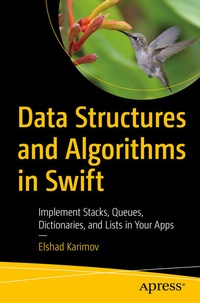
Data Structures and Algorithms in Swift
Implement Stacks, Queues, Dictionaries, and Lists in Your Apps
Published on 26. March 2020
Book
Paperback/Softback
XIII, 208 pages
978-1-4842-5768-5 (ISBN)
Description
Control the performance and stability of the apps you develop in Swift by working with and understanding advanced concepts in data structures and algorithms.
All professional developers have to know which data structure and algorithms to use in their development process. Your choice directly affects the performance of your application. With this book, you'll increase the performance of your software, become a better developer, and even pass tricky interview questions better when looking at professional development opportunities.
Guided by compact and practical chapters, you'll learn the nature and proper use of data structures such as arrays, dictionaries, sets, stacks, queues, lists, hash tables, trie, heaps, binary trees, red black trees, and R-trees. Use the main differences among them to determine which will make your applications efficient and faster. Then tackle algorithms. Work with Big O notation; sorting algorithms such as Insertion, Merge, and Quick; Naive and Rabin Karp algorithms; and Graph Algorithms.
Data Structures and Algorithms in Swift encourages you to further and understand how to best choose the perfect algorithm for your application's needs.
Who This Book Is For
Developers who have intermediate knowledge in Swift and want to improve their code performance and pass more complex interviews
All professional developers have to know which data structure and algorithms to use in their development process. Your choice directly affects the performance of your application. With this book, you'll increase the performance of your software, become a better developer, and even pass tricky interview questions better when looking at professional development opportunities.
Guided by compact and practical chapters, you'll learn the nature and proper use of data structures such as arrays, dictionaries, sets, stacks, queues, lists, hash tables, trie, heaps, binary trees, red black trees, and R-trees. Use the main differences among them to determine which will make your applications efficient and faster. Then tackle algorithms. Work with Big O notation; sorting algorithms such as Insertion, Merge, and Quick; Naive and Rabin Karp algorithms; and Graph Algorithms.
Data Structures and Algorithms in Swift encourages you to further and understand how to best choose the perfect algorithm for your application's needs.
What You'll Learn
- Retrieve, add, and remove elements in arrays
- Implement stacks, queues, and lists in your apps
- Sort algorithms and choose the best ones for your apps
Who This Book Is For
Developers who have intermediate knowledge in Swift and want to improve their code performance and pass more complex interviews
More details
Edition
First Edition
Language
English
Place of publication
Berkeley
United States
Target group
Professional and scholarly
Illustrations
95 s/w Abbildungen
XIII, 208 p. 95 illus.
Dimensions
Height: 235 mm
Width: 155 mm
Thickness: 13 mm
Weight
347 gr
ISBN-13
978-1-4842-5768-5 (9781484257685)
DOI
10.1007/978-1-4842-5769-2
Schweitzer Classification
Other editions
Additional editions
Elshad Karimov
Data Structures and Algorithms in Swift
Implement Stacks, Queues, Dictionaries, and Lists in Your Apps
E-Book
03/2020
APress
€62.99
Available for download
Person
Elshad Karimov
is an experienced programmer with a solid background in iOS development as well as Oracle, SQL, C#, Java, and HTML/CSS. He's familiar with the performance limits and characteristics of Swift and the nature and function of embedded databases and system datastores.
Content
Chapter 1: Arrays.- Chapter 2: Dictionaries.- Chapter 3: Sets.- Chapter 4: Stacks.- Chapter 5: Queue.- Chapter 6: Linked Lists.- Chapter 7: Hash Tables.- Chapter 8: Trees.- Chapter 9: Trie Data Structures.- Chapter 10: Binary Tree.- Chapter 11: Binary Search Tree.- Chapter 12: Red Black Tree.- Chapter 13: Big O.- Chapter 14: Sorting Algorithms.- Chapter 15: Search Algorithms.- Chapter 16: Graph Algorithms.- Chapter 17: Choosing the Best Algorithm.