

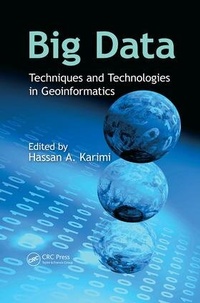
Big Data
Techniques and Technologies in Geoinformatics
1st Edition
Published on 29. March 2017
Book
Paperback/Softback
312 pages
978-1-138-07319-7 (ISBN)
Description
Big data has always been a major challenge in geoinformatics as geospatial data come in various types and formats, new geospatial data are acquired very fast, and geospatial databases are inherently very large. And while there have been advances in hardware and software for handling big data, they often fall short of handling geospatial big data efficiently and effectively. Big Data: Techniques and Technologies in Geoinformatics tackles these challenges head on, integrating coverage of techniques and technologies for storing, managing, and computing geospatial big data.
Providing a perspective based on analysis of time, applications, and resources, this book familiarizes readers with geospatial applications that fall under the category of big data. It explores new trends in geospatial data collection, such as geo-crowdsourcing and advanced data collection technologies such as LiDAR point clouds. The book features a range of topics on big data techniques and technologies in geoinformatics including distributed computing, geospatial data analytics, social media, and volunteered geographic information.
With chapters contributed by experts in geoinformatics and in domains such as computing and engineering, the book provides an understanding of the challenges and issues of big data in geoinformatics applications. The book is a single collection of current and emerging techniques, technologies, and tools that are needed to collect, analyze, manage, process, and visualize geospatial big data.
Providing a perspective based on analysis of time, applications, and resources, this book familiarizes readers with geospatial applications that fall under the category of big data. It explores new trends in geospatial data collection, such as geo-crowdsourcing and advanced data collection technologies such as LiDAR point clouds. The book features a range of topics on big data techniques and technologies in geoinformatics including distributed computing, geospatial data analytics, social media, and volunteered geographic information.
With chapters contributed by experts in geoinformatics and in domains such as computing and engineering, the book provides an understanding of the challenges and issues of big data in geoinformatics applications. The book is a single collection of current and emerging techniques, technologies, and tools that are needed to collect, analyze, manage, process, and visualize geospatial big data.
More details
Language
English
Place of publication
London
United Kingdom
Publishing group
Taylor & Francis Ltd
Target group
Professional and scholarly
Academic and Professional Practice & Development
Illustrations
111 s/w Abbildungen, 24 s/w Tabellen
24 Tables, black and white; 111 Illustrations, black and white
Dimensions
Height: 234 mm
Width: 156 mm
Weight
467 gr
ISBN-13
978-1-138-07319-7 (9781138073197)
Copyright in bibliographic data and cover images is held by Nielsen Book Services Limited or by the publishers or by their respective licensors: all rights reserved.
Schweitzer Classification
Other editions
New editions
Book
approx. 06/2026
2nd Edition
CRC Press
€77.50
Not yet published
Additional editions
E-Book
02/2014
1st Edition
CRC Press
€195.49
Available for download
Book
02/2014
1st Edition
CRC Press
€289.69
Article exhausted; check for reprint
Person
Hassan A. Karimi
Content
Part I: Geospatial Data Collection and Applications. Advanced Geospatial Data Collection Technologies. Geo-Crowdsourcing: A New Trend in Collecting Geospatial Data. Big Data in Location-Based Services. Big Data in Satellite Imagery. Part II: Geospatial Data Analytics. Geostatistics. Geospatial Data Mining. Machine Learning. Geovisualization. Part III: Data-Intensive Geospatial Computing. Distributed Geospatial Data-Intensive Computing. Grid Computing for Geospatial Data-Intensive Problems. Cloud Computing for Geospatial Data-Intensive Problems. Parallel Computing for Geospatial Data-Intensive Problems.