

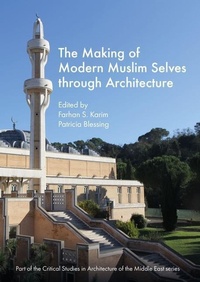
The Making of Modern Muslim Selves through Architecture
Published on 26. January 2024
Book
Hardback
390 pages
978-1-78938-851-0 (ISBN)
Description
This collection seeks to explore alternative definitions of bounded identities, facilitating new approaches to spatial and architectural forms. Taking as its starting point the emergence of a new sense of 'boundary' emerged from the post-19th century dissolution of large, heterogeneous empires into a mosaic of nation-states in the Islamic world. This new sense of boundaries has not only determined the ways in which we imagine and construct the idea of modern citizenship, but also redefines relationships between the nation, citizenship, cities and architecture.
It brings critical perspectives to our understanding of the interrelation between the accumulated flows and the evolving concepts of boundary in predominantly Muslim societies and within the global Muslim diaspora. Essays in this book seeks to investigate how architecture mediates the creation and deployment of boundaries and boundedness that have been devised to define, enable, obstruct, accumulate and/or control flows able to disrupt bounded territories or identities.
More generally, the book explores how architecture might be considered as a means to understand the relationship between flows and boundaries and its implication of defining modern self. The essays in this volume collectively address how the construction of self is primarily a spatial event and operated within the crucial nexus of power-knowledge-space.
Contributors investigate how architecture mediates the creation and deployment of boundaries and boundedness, how architecture might be considered as a means to understand the relationship between flows and boundaries and its implications for how we define the modern self.
Part of the Critical Studies in Architecture of the Middle East series.
It brings critical perspectives to our understanding of the interrelation between the accumulated flows and the evolving concepts of boundary in predominantly Muslim societies and within the global Muslim diaspora. Essays in this book seeks to investigate how architecture mediates the creation and deployment of boundaries and boundedness that have been devised to define, enable, obstruct, accumulate and/or control flows able to disrupt bounded territories or identities.
More generally, the book explores how architecture might be considered as a means to understand the relationship between flows and boundaries and its implication of defining modern self. The essays in this volume collectively address how the construction of self is primarily a spatial event and operated within the crucial nexus of power-knowledge-space.
Contributors investigate how architecture mediates the creation and deployment of boundaries and boundedness, how architecture might be considered as a means to understand the relationship between flows and boundaries and its implications for how we define the modern self.
Part of the Critical Studies in Architecture of the Middle East series.
More details
Series
Language
English
Place of publication
United Kingdom
Publishing group
Intellect
Target group
College/higher education
Illustrations
167 Halftones, black and white
Dimensions
Height: 176 mm
Width: 238 mm
Thickness: 25 mm
Weight
986 gr
ISBN-13
978-1-78938-851-0 (9781789388510)
Copyright in bibliographic data and cover images is held by Nielsen Book Services Limited or by the publishers or by their respective licensors: all rights reserved.
Schweitzer Classification
Other editions
Additional editions
Farhan S. Karim | Patricia Blessing
The Making of Modern Muslim Selves through Architecture
E-Book
10/2023
Intellect Books
€119.99
Available for download
Persons
Farhan Karim is an associate professor in the School of Architecture and Design at the University of Kansas and the current president of the Society of Architectural and Urban Historians of Asia. He worked as an architect, interior designer and furniture designer in Bangladesh and Australia.
Patricia Blessing is associate professor of art and art history at Stanford University.
Patricia Blessing is associate professor of art and art history at Stanford University.
Content
List of Figures vii
Acknowledgements xiii
Introduction: Confining Contingency 1
Farhan Karim
Chapter 1. Housing Others: Design and Identity in a Bedouin Village 21
Noam Shoked
Chapter 2. Building for the Lost Lands: Ottoman Architects in Mandatory Palestine and the Case of Hassan Bey Mosque 51
Mu?jde Dila Gu?mu?s?
Chapter 3. The First Aussie Mosques: Mediating Boundaries despite the 'White Australia' Policy 77
Katharine Bartsch, Md. Mizanur Rashid, and Peter Scriver
Chapter 4. Architecture of Exclusion: The Savujbulagh-i Mukri Garrison, Border-Making, and the Transformation of the Ottoman-Qajar Frontier 111
Nader Sayadi
Chapter 5. Staging Baghdad as a Problem of Development 139
Huma Gupta
Chapter 6. Tehran's Decentralization Project and the Emergence of Modern Socio-Spatial Boundaries 167
Elmira Jafari and Carola Hein
Chapter 7. Reconstructing the Muslim Self in Diaspora: Socio-Spatial Practices in Urban European Mosques 193
Elisabeth Becker
Chapter 8. The Search for the Mosque of Florence: A Space of Negotiated Identities 219
Hanan Kataw
Chapter 9. The Rome Mosque and Islamic Center: A Case of Diasporic Architecture in the Globalized Mediterranean 237
Theodore Van Loan and Eva-Maria Troelenberg
Chapter 10. One House of Worship with Many Rooves: Imposing Architecture to Mediate Sunni, Alevi, and Gu?lenist Islam in Turkey 253
Angela Andersen
Chapter 11. Architectural Modes of Collective Identity: The Case of Hizbullah's 'Mleeta Tourist Landmark of the Resistance' in South Lebanon 277
Heike Delitz and Stefan Maneval
Chapter 12. The Bangladesh Liberation War Museum and the Inconclusivity of Architecture 309
Anooradha Iyer Siddiqi
Contributor Biographies 353
Index 359
Acknowledgements xiii
Introduction: Confining Contingency 1
Farhan Karim
Chapter 1. Housing Others: Design and Identity in a Bedouin Village 21
Noam Shoked
Chapter 2. Building for the Lost Lands: Ottoman Architects in Mandatory Palestine and the Case of Hassan Bey Mosque 51
Mu?jde Dila Gu?mu?s?
Chapter 3. The First Aussie Mosques: Mediating Boundaries despite the 'White Australia' Policy 77
Katharine Bartsch, Md. Mizanur Rashid, and Peter Scriver
Chapter 4. Architecture of Exclusion: The Savujbulagh-i Mukri Garrison, Border-Making, and the Transformation of the Ottoman-Qajar Frontier 111
Nader Sayadi
Chapter 5. Staging Baghdad as a Problem of Development 139
Huma Gupta
Chapter 6. Tehran's Decentralization Project and the Emergence of Modern Socio-Spatial Boundaries 167
Elmira Jafari and Carola Hein
Chapter 7. Reconstructing the Muslim Self in Diaspora: Socio-Spatial Practices in Urban European Mosques 193
Elisabeth Becker
Chapter 8. The Search for the Mosque of Florence: A Space of Negotiated Identities 219
Hanan Kataw
Chapter 9. The Rome Mosque and Islamic Center: A Case of Diasporic Architecture in the Globalized Mediterranean 237
Theodore Van Loan and Eva-Maria Troelenberg
Chapter 10. One House of Worship with Many Rooves: Imposing Architecture to Mediate Sunni, Alevi, and Gu?lenist Islam in Turkey 253
Angela Andersen
Chapter 11. Architectural Modes of Collective Identity: The Case of Hizbullah's 'Mleeta Tourist Landmark of the Resistance' in South Lebanon 277
Heike Delitz and Stefan Maneval
Chapter 12. The Bangladesh Liberation War Museum and the Inconclusivity of Architecture 309
Anooradha Iyer Siddiqi
Contributor Biographies 353
Index 359