

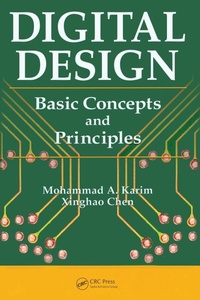
Digital Design
Basic Concepts and Principles
1st Edition
Published on 27. November 2007
Book
Hardback
504 pages
978-1-4200-6131-4 (ISBN)
Description
In today's digital design environment, engineers must achieve quick turn-around time with ready accesses to circuit synthesis and simulation applications. This type of productivity relies on the principles and practices of computer aided design (CAD). Digital Design: Basic Concepts and Principles addresses the many challenging issues critical to today's digital design practices such as hazards and logic minimization, finite-state-machine synthesis, cycles and races, and testability theories while providing hands-on experience using one of the industry's most popular design application, Xilinx Web PACK (TM).
The authors begin by discussing conventional and unconventional number systems, binary coding theories, and arithmetic as well as logic functions and Boolean algebra. Building upon classic theories of digital systems, the book illustrates the importance of logic minimization using the Karnaugh map technique. It continues by discussing implementation options and examining the pros and cons of each method in addition to an assessment of tradeoffs that often accompany design practices. The book also covers testability, emphasizing that a good digital design must be easy to verify and test with the lowest cost possible. Throughout the text, the authors analyze combinational and sequential logic elements and illustrate the designs of these components in structural, hierarchical, and behavior VHDL descriptions.
Coveringfundamentals and best practices, Digital Design: Basic Concepts and Principles provides you with critical knowledge of how each digital component ties together to form a system and develops the skills you need to design and simulate these digital components using modern CAD software.
The authors begin by discussing conventional and unconventional number systems, binary coding theories, and arithmetic as well as logic functions and Boolean algebra. Building upon classic theories of digital systems, the book illustrates the importance of logic minimization using the Karnaugh map technique. It continues by discussing implementation options and examining the pros and cons of each method in addition to an assessment of tradeoffs that often accompany design practices. The book also covers testability, emphasizing that a good digital design must be easy to verify and test with the lowest cost possible. Throughout the text, the authors analyze combinational and sequential logic elements and illustrate the designs of these components in structural, hierarchical, and behavior VHDL descriptions.
Coveringfundamentals and best practices, Digital Design: Basic Concepts and Principles provides you with critical knowledge of how each digital component ties together to form a system and develops the skills you need to design and simulate these digital components using modern CAD software.
More details
Language
English
Place of publication
Bosa Roca
United States
Publishing group
Taylor & Francis Inc
Target group
College/higher education
Undergraduate
Illustrations
510 s/w Abbildungen, 1 s/w Photographie bzw. Rasterbild, 48 s/w Tabellen
48 Tables, black and white; 1 Halftones, black and white; 510 Illustrations, black and white
Dimensions
Height: 260 mm
Width: 183 mm
Thickness: 32 mm
Weight
1137 gr
ISBN-13
978-1-4200-6131-4 (9781420061314)
Copyright in bibliographic data and cover images is held by Nielsen Book Services Limited or by the publishers or by their respective licensors: all rights reserved.
Schweitzer Classification
Other editions
Additional editions
E-Book
12/2017
CRC Press
€178.99
Available for download
E-Book
12/2017
CRC Press
€178.99
Available for download
Persons
Old Dominion University, Norfolk, Virginia, USA
Content
Data Type and Representations. Boolean Algebra. Minimization of Logic Functions. Logic Function Implementation. Introduction to VHDL. Design of Modular Combinatorial Components. Sequential Logic Elements. Synchronous Sequential Circuits. Modular Sequential Components. Sequential Arithmetic. Asynchronous Sequential Circuits. Introduction to Testability.