

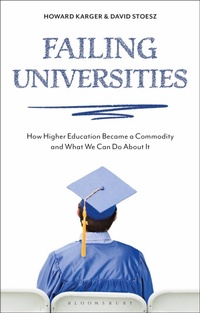
Failing Universities
How Higher Education Became a Commodity and What We Can Do About It
Published on 28. November 2024
Book
Hardback
248 pages
978-1-350-38381-4 (ISBN)
Description
Colleges and universities were once places where students came to learn, experts, intellectuals, and others came to teach, and where knowledge was created. Today, America's higher education system is severely compromised by commodification and corporatization, which have transformed higher education into a marketplace. This book examines the effects of these transformations, providing a comprehensive critique of the problems the sector faces.
It outlines how higher education's commodification has impacted areas including affordability, access, waste, hierarchal administrative structures, faculty governance, the college sports industrial complex, and status and social mobility based on institutional prestige. The authors explore alternative policy solutions and examples of systems of higher education that are both effective and cost-effective. They propose a forward-looking agenda for structural reform that is less expensive and more educationally sound than the current model. Emphasising social cohesion, sustainability, a respect for diversity and an understanding of democracy and democratic principles, Failing Universities offers alternative solutions for US higher education to return to its basic mission.
It outlines how higher education's commodification has impacted areas including affordability, access, waste, hierarchal administrative structures, faculty governance, the college sports industrial complex, and status and social mobility based on institutional prestige. The authors explore alternative policy solutions and examples of systems of higher education that are both effective and cost-effective. They propose a forward-looking agenda for structural reform that is less expensive and more educationally sound than the current model. Emphasising social cohesion, sustainability, a respect for diversity and an understanding of democracy and democratic principles, Failing Universities offers alternative solutions for US higher education to return to its basic mission.
Reviews / Votes
This is a must-read for those troubled by the current state of higher education in the United States. Following their detailed and penetrating analysis of the processes of commodification and corporatization impacting upon American universities and colleges, the authors present an inspiring blueprint for educational reform and revitalization. -- Michael Seltzer, Professor Emeritus, Oslo Metropolitan University, Norway As this eye-opening book clearly demonstrates, in a country where GDP is the measure of national success, and maximum income the measure of personal success, our universities are unsurprisingly abandoning the humanities and critical thinking for the values of Midas. Santayana warned that those who forget history are doomed to repeat it. May this well-researched volume help us turn the Titanic of higher education around. -- John De Graaf, Co-Author of "What's The Economy For, Anyway?" (Bloomsbury, 2011) Failing Universities is a timely, important, and controversial work that is broad, scholarly, and databased. Written by experts, it reveals how universities have changed in their administration, funding, operations, and expenses and, significantly, suggests useful ways of getting them back on track to their original educational mission. -- Steven Rose, Professor Emeritus, George Mason University, USAMore details
Language
English
Place of publication
London
United Kingdom
Publishing group
Bloomsbury Publishing PLC
Target group
Professional and scholarly
College/higher education
Illustrations
15 bw illus
Dimensions
Height: 222 mm
Width: 145 mm
Thickness: 17 mm
Weight
443 gr
ISBN-13
978-1-350-38381-4 (9781350383814)
Copyright in bibliographic data and cover images is held by Nielsen Book Services Limited or by the publishers or by their respective licensors: all rights reserved.
Schweitzer Classification
Persons
Howard Karger is a former professor of social work and a three-time Senior Fulbright Scholar. His experience in higher education covers 40 years in academic and administrative roles in religious, public, international and private universities. He was previously the PhD director at the University of Houston (UH), USA, and served on the executive committee of the Faculty Senate, and Head of School at the University of Queensland in Brisbane, Australia. Howard was director of the School of Social Work at Hawaii Pacific University (HPU), USA, where he retired in 2019. In addition to administrative experience, Howard is the author or co-author of 10 books and 90 articles or book chapters, and has sat on several editorial boards.
David Stoesz, PhD, is the founder of Up$tart (https://www.upstartbenefits.com), developing innovative software to optimize economic supports for low-income college students. He has published 14 books, including Quixote's Ghost: The Right, the Liberati, and the Future of Social Policy (2016), which won the Pro Humanitate Literary Award. A veteran professor, David has taught at a women's college, two HBCUs, and was appointed to an endowed Chair at Virginia Commonwealth University, USA. He has received two Fulbright Distinguished Chair awards: Great Britain in 2014 and Australia in 2017. In 2010 he was inducted into the National Academy of Social Insurance.
David Stoesz, PhD, is the founder of Up$tart (https://www.upstartbenefits.com), developing innovative software to optimize economic supports for low-income college students. He has published 14 books, including Quixote's Ghost: The Right, the Liberati, and the Future of Social Policy (2016), which won the Pro Humanitate Literary Award. A veteran professor, David has taught at a women's college, two HBCUs, and was appointed to an endowed Chair at Virginia Commonwealth University, USA. He has received two Fulbright Distinguished Chair awards: Great Britain in 2014 and Australia in 2017. In 2010 he was inducted into the National Academy of Social Insurance.
Content
Preface
Acknowledgments
1 The Price of Admission
2 Just Another Commodity
3. Driving Up the Cost of Higher Education
4. American Universities, Inc.
5. The College Sports Industrial Complex
6. Inequality and the Corporatization of Higher Education
Conclusion: A Framework for Reforming Higher Education
Notes
Index
Acknowledgments
1 The Price of Admission
2 Just Another Commodity
3. Driving Up the Cost of Higher Education
4. American Universities, Inc.
5. The College Sports Industrial Complex
6. Inequality and the Corporatization of Higher Education
Conclusion: A Framework for Reforming Higher Education
Notes
Index