

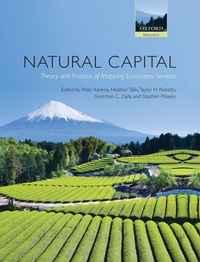
Natural Capital
Theory and Practice of Mapping Ecosystem Services
Published on 7. April 2011
Book
Hardback
392 pages
978-0-19-958899-2 (ISBN)
Description
In 2005, The Millennium Ecosystem Assessment (MA) provided the first global assessment of the world's ecosystems and ecosystem services. It concluded that recent trends in ecosystem change threatened human wellbeing due to declining ecosystem services. This bleak prophecy has galvanized conservation organizations, ecologists, and economists to work toward rigorous valuations of ecosystem services at a spatial scale and with a resolution that can inform public policy.
The editors have assembled the world's leading scientists in the fields of conservation, policy analysis, and resource economics to provide the most intensive and best technical analyses of ecosystem services to date. A key idea that guides the science is that the modelling and valuation approaches being developed should use data that are readily available around the world. In addition, the book documents a toolbox of ecosystem service mapping, modeling, and valuation models that both The Nature Conservancy and the World Wide Fund for Nature (WWF) are beginning to apply around the world as they transform conservation from a biodiversity only to a people and ecosystem services agenda. The book addresses land, freshwater, and marine systems at a variety of spatial scales and includes discussion of how to treat both climate change and cultural values when examining tradeoffs among ecosystem services.
The editors have assembled the world's leading scientists in the fields of conservation, policy analysis, and resource economics to provide the most intensive and best technical analyses of ecosystem services to date. A key idea that guides the science is that the modelling and valuation approaches being developed should use data that are readily available around the world. In addition, the book documents a toolbox of ecosystem service mapping, modeling, and valuation models that both The Nature Conservancy and the World Wide Fund for Nature (WWF) are beginning to apply around the world as they transform conservation from a biodiversity only to a people and ecosystem services agenda. The book addresses land, freshwater, and marine systems at a variety of spatial scales and includes discussion of how to treat both climate change and cultural values when examining tradeoffs among ecosystem services.
Reviews / Votes
A valuable summary of the strengths and weaknesses of the tools we currently use for valuation. * Bulletin of the British Ecological Society * Natural Capital: Theory and Practice of Mapping Ecosystem Services^r is a very timely and useful contribution to the endeavor of mapping ecosystem services. * Trends in Ecology and Evolution *More details
Language
English
Place of publication
Oxford
United Kingdom
Target group
College/higher education
Professional and scholarly
This graduate level text is suitable for students and professional researchers in the fields of conservation biology, ecology, and ecological/environmental economics. It will also be a valuable reference for conservation practitioners, land managers, and government/NGO consultants and advisers.
Illustrations
Over 100 black and white illustrations, and an 8 page colour plate section
Dimensions
Height: 260 mm
Width: 208 mm
Thickness: 26 mm
Weight
1060 gr
ISBN-13
978-0-19-958899-2 (9780199588992)
Copyright in bibliographic data and cover images is held by Nielsen Book Services Limited or by the publishers or by their respective licensors: all rights reserved.
Schweitzer Classification
Other editions
Additional editions
Peter Kareiva | Heather Tallis | Taylor H. Ricketts
Natural Capital
Theory and Practice of Mapping Ecosystem Services
Book
04/2011
Oxford University Press
€93.00
Shipment within 15-20 days
Peter Kareiva | Heather Tallis | Taylor H. Ricketts
Natural Capital
Theory and Practice of Mapping Ecosystem Services
E-Book
04/2011
1st Edition
OUP eBook
€69.99
Available for download
Persons
Lead editor, Peter Kareiva has worked as a private consultant, as a Professor at several universities (including Brown University, UCSB and University of Washington), a Director of a Conservation Biology group at NOAA Fisheries, and is now a Vice President and Chief Scientist for The Nature Conservancy, the world's largest environmental NGO with over 500 scientists on staff. His focus has been on applying rigorous quantitative tools to support resource and conservation decisions in a pragmatic manner. He has edited five books and written a conservation science textbook, while mentoring over thirty PhD and postdoctoral students who have gone on to faculty positions and government or non-profit positions around the world. His awards include a Guggenheim fellowship and election to the American Academy of Arts and Science. He has worked in Asia, Latin America and North America and in marine, freshwater and terrestrial ecosystems.
The other editors have a wealth of experience in the field.
The other editors have a wealth of experience in the field.
Editor
Chief Scientist and Vice President, The Nature Conservancy and Visiting Professor, Santa Clara University, USA
Lead Scientist, The Natural Capital Project, Stanford University, USA
Managing Director, Conservation Science Program, World Wildlife Fund, USA
Stanford University, USA
Fesler-Lampert Professor of Ecological/Environmental Economics, University of Minnesota, USA
Content
SECTION ONE: A VISION FOR ECOSYSTEM SERVICES IN DECISIONS; SECTION TWO: MULTI-TIERED MODELS FOR ECOSYSTEM SERVICES; SECTION THREE: EXTENSIONS, APPLICATIONS, AND THE NEXT GENERATION OF ECOSYSTEM SERVICE ASSESSMENTS