

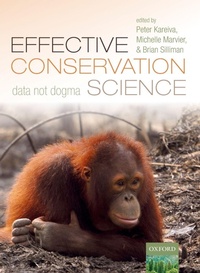
Effective Conservation Science
Data Not Dogma
Published on 12. October 2017
Book
Hardback
206 pages
978-0-19-880897-8 (ISBN)
Description
This novel text assembles some of the most intriguing voices in modern conservation biology. Collectively they highlight many of the most challenging questions being asked in conservation science today, each of which will benefit from new experiments, new data, and new analyses. The book's principal aim is to inspire readers to tackle these uncomfortable issues head-on. A second goal is to be reflective and consider how the field has reacted to challenges to orthodoxy, and to what extent have or can these challenges advance conservation science. Furthermore, several chapters discuss how to guard against confirmation bias. The overall goal is that this book will lead to greater conservation of ecosystems and biodiversity by harnessing the engine of constructive scientific scepticism in service of better results.
Reviews / Votes
This collection does an excellent job of challenging some of the ideas that have established themselves in our belief systems and popular science. * Trevor D. Davies, The Quarterly Review of Biology * [Effective conservation science] can serve as a compilation of representative criticisms in this high-profile and controversial field of research. Recommended. * J. Nabe, CHOICE * The book tackles the philosophical and scientific issues that have divided the field of conservation biology in recent years. * Keith Kloor, Slate *More details
Language
English
Place of publication
Oxford
United Kingdom
Target group
Professional and scholarly
Illustrations
45 illustrations
Dimensions
Height: 252 mm
Width: 194 mm
Thickness: 16 mm
Weight
609 gr
ISBN-13
978-0-19-880897-8 (9780198808978)
Copyright in bibliographic data and cover images is held by Nielsen Book Services Limited or by the publishers or by their respective licensors: all rights reserved.
Schweitzer Classification
Other editions
Additional editions
Peter M. Kareiva | Michelle Marvier | Brian R. Silliman
Effective Conservation Science
Data Not Dogma
Book
10/2017
Oxford University Press
€75.00
Shipment within 15-20 days
E-Book
10/2017
1st Edition
OUP eBook
€53.99
Available for download
Persons
Peter Kareiva has taught at multiple universities (including Brown, University of Washington, UC Santa Barbara, Stanford, UCLA, Santa Clara University and University of Virginia). He has worked as a private consultant and led a NOAA research group at the Northwest Fisheries Science Center on Conservation Biology. He spent over ten years as a Lead, and then Chief Scientist at The Nature Conservancy. He is a member of the National Academy of Science and the American Academy of Arts and Sciences. With Michelle Marvier he has co-authored a textbook in conservation science. He now directs an interdisciplinary program in Environmental Science at UCLA, where an emphasis is placed on the importance of narratives in promoting environmental values.
Michelle Marvier is a professor of Environmental Studies and Sciences at Santa Clara University. She received her Ph.D. from the University of California, Santa Cruz and was a NSF postdoctoral fellow at the University of Washington. Michelle has worked for NOAA Fisheries on salmon conservation and has applied evidence-based risk analysis to understand the environmental impacts of genetically engineered crops. She has published over 40 articles, and she currently serves on the editorial board of Frontiers in Ecology and the Environment. With Peter Kareiva, Michelle coauthored the textbook, Conservation Science: Balancing the Needs of People and Nature.
Brian Silliman is the Rachel Carson Associate Professor of Marine Conservation Biology at Duke University. He was named a Smith Conservation Fellow in 2004, a Visiting Professor with the Royal Netherlands Society of Sciences in 2011, and fellow of the American Association for the Advancement of Science in 2016. He has also received a Young Investigator Award from the American Society of Naturalists (2006) and NSF Career Grant Award (2011). Dr. Silliman has published two co-edited books and over 130 journal articles. His teaching and research are focused on community ecology, conservation and restoration, and ecological consequences of positive interactions.
Michelle Marvier is a professor of Environmental Studies and Sciences at Santa Clara University. She received her Ph.D. from the University of California, Santa Cruz and was a NSF postdoctoral fellow at the University of Washington. Michelle has worked for NOAA Fisheries on salmon conservation and has applied evidence-based risk analysis to understand the environmental impacts of genetically engineered crops. She has published over 40 articles, and she currently serves on the editorial board of Frontiers in Ecology and the Environment. With Peter Kareiva, Michelle coauthored the textbook, Conservation Science: Balancing the Needs of People and Nature.
Brian Silliman is the Rachel Carson Associate Professor of Marine Conservation Biology at Duke University. He was named a Smith Conservation Fellow in 2004, a Visiting Professor with the Royal Netherlands Society of Sciences in 2011, and fellow of the American Association for the Advancement of Science in 2016. He has also received a Young Investigator Award from the American Society of Naturalists (2006) and NSF Career Grant Award (2011). Dr. Silliman has published two co-edited books and over 130 journal articles. His teaching and research are focused on community ecology, conservation and restoration, and ecological consequences of positive interactions.
Editor
Pritzker Distinguished Professor and IOES DirectorPritzker Distinguished Professor and IOES Director, Institute of the Environment and Sustainability (IOES), USA
ProfessorProfessor, Department of Environmental Studies and Sciences, Santa Clara University, USA
Rachel Carson Associate Professor of Marine Conservation BiologyRachel Carson Associate Professor of Marine Conservation Biology, Nicholas School of the Environment, Duke University, USA
Content
REPRODUCIBILITY, BIAS, AND OBJECTIVITY IN CONSERVATION SCIENCE; CHALLENGES TO FOUNDATIONAL PREMISES IN CONSERVATION; ICONIC CONSERVATION TALES: SORTING TRUTH FROM FICTION; QUESTIONING ACCEPTED STRATEGIES AND INTERVENTIONS; CONCLUSION