

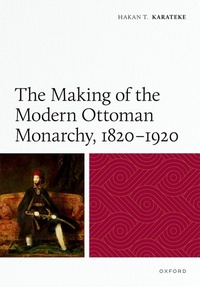
The Making of the Modern Ottoman Monarchy, 1820-1920
Will be published approx. on 31. October 2026
Book
Hardback
320 pages
978-0-19-790793-1 (ISBN)
Description
In the nineteenth century, the Ottoman monarchy was transformed. The sultan, a remote and formidable figure of absolute power in the 1820s, was, by the 1920s recast as a modern monarch attuned to new norms of governance. In the process, the Ottoman imperial court voluntarily embraced emerging European models of so-called 'enlightened' monarchy.
To explore this shift for the first time, Hakan Karateke interrogates nineteenth-century Ottoman court rituals and their layered symbolism. Following an introductory chapter that situates the Ottoman drive to modernize in the 1830s and 1840s within the wider European context, the book devotes each subsequent chapter to a distinct type of ceremony. The chapters on enthronement and the ritual of girding the sword trace these traditions from their premodern roots to their nineteenth-century adaptations. Other ceremonies examined include the celebration of the two major Muslim festivals (the Feast of Ramadan and the Feast of Sacrifice), the sultan's Friday procession to the mosque, and his receptions of guests at the imperial court. Another chapter focuses on the dynasty's veneration of sacred relics and the rituals surrounding them.
Taken together, these ceremonial practices show how the court and the sultan guided the dynasty through a period of acute crisis for monarchies, when their prestige was in decline. In doing so, the Ottoman imperial court laid the foundations of a liberal empire that redefined sovereignty, reshaped governance, and transformed the very role of the monarch in a globalizing world.
To explore this shift for the first time, Hakan Karateke interrogates nineteenth-century Ottoman court rituals and their layered symbolism. Following an introductory chapter that situates the Ottoman drive to modernize in the 1830s and 1840s within the wider European context, the book devotes each subsequent chapter to a distinct type of ceremony. The chapters on enthronement and the ritual of girding the sword trace these traditions from their premodern roots to their nineteenth-century adaptations. Other ceremonies examined include the celebration of the two major Muslim festivals (the Feast of Ramadan and the Feast of Sacrifice), the sultan's Friday procession to the mosque, and his receptions of guests at the imperial court. Another chapter focuses on the dynasty's veneration of sacred relics and the rituals surrounding them.
Taken together, these ceremonial practices show how the court and the sultan guided the dynasty through a period of acute crisis for monarchies, when their prestige was in decline. In doing so, the Ottoman imperial court laid the foundations of a liberal empire that redefined sovereignty, reshaped governance, and transformed the very role of the monarch in a globalizing world.
More details
Language
English
Place of publication
Oxford
United Kingdom
Target group
College/higher education
Product notice
sewn/stitched
Cloth over boards
Dimensions
Height: 234 mm
Width: 156 mm
ISBN-13
978-0-19-790793-1 (9780197907931)
Copyright in bibliographic data and cover images is held by Nielsen Book Services Limited or by the publishers or by their respective licensors: all rights reserved.
Schweitzer Classification
Person
Hakan T. Karateke is Professor of Ottoman and Turkish Studies at the University of Chicago. He studied at Bo?azici University in Istanbul, Bamberg University in Germany, and the University of Vienna, where he earned his degrees. He taught at Harvard University from 2002 to 2008 and, since 2009, has been a member of the Department of Middle Eastern Studies at the University of Chicago. His research focuses on the social and cultural history of the Ottoman world, and he is currently preparing a book on the cultural history of the Turkish language, tracing its development from its Inner Asian origins to the twentieth century.