

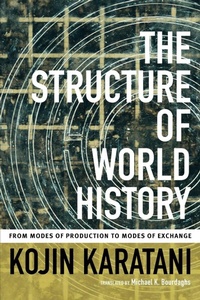
The Structure of World History
From Modes of Production to Modes of Exchange
Will be published approx. on 28. March 2014
Book
Paperback/Softback
376 pages
978-0-8223-5676-9 (ISBN)
Description
In this major, paradigm-shifting work, Kojin Karatani systematically re-reads Marx's version of world history, shifting the focus of critique from modes of production to modes of exchange. Karatani seeks to understand both Capital-Nation-State, the interlocking system that is the dominant form of modern global society, and the possibilities for superseding it. In The Structure of World History, he traces different modes of exchange, including the pooling of resources that characterizes nomadic tribes, the gift exchange systems developed after the adoption of fixed-settlement agriculture, the exchange of obedience for protection that arises with the emergence of the state, the commodity exchanges that characterize capitalism, and, finally, a future mode of exchange based on the return of gift exchange, albeit modified for the contemporary moment. He argues that this final stage-marking the overcoming of capital, nation, and state-is best understood in light of Kant's writings on eternal peace. The Structure of World History is in many ways the capstone of Karatani's brilliant career, yet it also signals new directions in his thought.
Reviews / Votes
"In place of a singular conception of development, Karatani envisions a truly world-historical perspective. Moreover, his unique approach to world history demonstrates the value of establishing a more constructive dialogue between philosophy, anthropology, sociology, economics and historical studies." - Yamoi Pham (Journal of World Systems Theory) "The Structure of World History is a must-read for anybody who is interested in a universal master narrative being in search not only for power of resistance against this system but also for possible ways 'to transcend the capitalist social formation from within' (p. 291)." - Steffi Richter (H-Asia, H-Net Reviews) "Well argued, and with a highly approachable translation by Michael Bourdaghs, this work is both an excellent entry point for those unfamiliar with Karatani's previous work, and an excellent continuation of the themes he has previously explored. By providing such an ambitious and innovative work, Karatani offers much to the fields of anthropology, sociology and historical study, as well as a starting point for theorists interested in the concept of mode D and the promises it contains." - Wesley R. Bishop (Capital & Class)More details
Language
English
Place of publication
North Carolina
United States
Target group
Professional and scholarly
Product notice
Paperback (trade)
Illustrations
6 tables, 1 figure
Dimensions
Height: 229 mm
Width: 152 mm
Thickness: 21 mm
Weight
544 gr
ISBN-13
978-0-8223-5676-9 (9780822356769)
Copyright in bibliographic data and cover images is held by Nielsen Book Services Limited or by the publishers or by their respective licensors: all rights reserved.
Schweitzer Classification
Other editions
Additional editions
E-Book
03/2014
1st Edition
Duke University Press Books
€208.99
Available for download
Persons
Kojin Karatani is an internationally renowned theorist and philosopher. Previously, he was a professor at Hosei University in Tokyo, Kinki University in Osaka, and Columbia University. Among the dozens of books that he has written in Japanese, four have been translated into English: History and Repetition; Transcritique: Kant and Marx; Architecture as Metaphor: Language, Number, Money; and Origins of Modern Japanese Literature, which is also published by Duke University Press.
Content
Translator's Note vii
Author's Preface to the English Translation ix
Preface xiii
Introduction. On Modes of Exchange 1
Part I. Mini World Systems 29
1. The Sedentary Revolution 35
2. The Gift and Magic 50
Part II. World-Empire 57
3. The State 63
4. World Money 81
5. World Empires 104
6. Universal Religions 127
Part III. The Modern World System 157
7. The Modern State 165
8. Industrial Capital 182
9. Nation 209
10. Associationism 228
Part IV. The Present and the Future 265
11. The Stages of Global Capitalism and Repetition 267
12. Toward a World Republic 285
Acknowledgments 309
Notes 311
Bibliography 339
Index
Author's Preface to the English Translation ix
Preface xiii
Introduction. On Modes of Exchange 1
Part I. Mini World Systems 29
1. The Sedentary Revolution 35
2. The Gift and Magic 50
Part II. World-Empire 57
3. The State 63
4. World Money 81
5. World Empires 104
6. Universal Religions 127
Part III. The Modern World System 157
7. The Modern State 165
8. Industrial Capital 182
9. Nation 209
10. Associationism 228
Part IV. The Present and the Future 265
11. The Stages of Global Capitalism and Repetition 267
12. Toward a World Republic 285
Acknowledgments 309
Notes 311
Bibliography 339
Index