

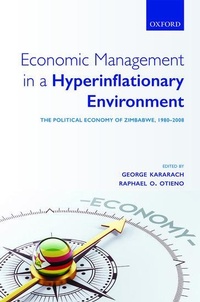
Economic Management in a Hyperinflationary Environment
The Political Economy of Zimbabwe, 1980-2008
Published on 11. February 2016
Book
Hardback
576 pages
978-0-19-874750-5 (ISBN)
Description
This volume provides an accessible and up-to-date account of the difficulties that the Zimbabwean economy and its population experienced during the crisis which peaked in 2008. It details the suffering and chaos that befell the country with dramatic socio-economic consequences on growth, macroeconomic stability, service delivery, livelihoods, and development. The volume seeks to provide a political economy analysis of leadership and economic management in developing economies based on Zimbabwe's experience. It examines the triggers of the crisis, and the negative impact on productive sectors such as manufacturing and agriculture, social sectors such as education and health, and on financial services. The volume will be of interest to students of policy and economic management, as well as to government departments, central banks in developing countries, development agencies, donors, and NGOs.
More details
Language
English
Place of publication
Oxford
United Kingdom
Target group
College/higher education
Professional and scholarly
Product notice
sewn/stitched
Cloth over boards
Illustrations
155 Figures and 120 Tables
Dimensions
Height: 236 mm
Width: 160 mm
Thickness: 36 mm
Weight
658 gr
ISBN-13
978-0-19-874750-5 (9780198747505)
Schweitzer Classification
Other editions
Additional editions
George Kararach | Raphael O. Otieno
Economic Management in a Hyperinflationary Environment
The Political Economy of Zimbabwe, 1980-2008
E-Book
02/2016
1st Edition
OUP eBook
€115.99
Available for download
Persons
George Kararach is Senior Consultant in the Statistics Department at The African Development Bank. He holds a PhD in Economics from Leeds University. He published three books: Macro-economic policy and the political limits of reforms in developing countries (ARRF, 2011), Rethinking development challenges for public policy in Africa (with K. Hanson and T. Shaw, Palgrave Macmillan, 2012), and Development Policy in Africa: mastering the future? (Palgrave Macmillan, 2014). Dr Kararach has previously worked for UNICEF, UNDP, and the African Capacity Building Foundation.
Raphael O. Otieno is Director of Debt Management Programme at Macroeconomic and Financial Management Institute of Eastern and Southern Africa (MEFMI) in Harare. He holds an M.A. in Public Policy from the National Graduate Institute for Policy Studies (GRIPS), Tokyo, Japan, and a B.A. in Economics from the University of Nairobi. Mr Otieno has much experience in public finance and macroeconomic analysis. He has held senior positions in Kenya's public service including the Ministries of Finance and Planning, as Policy Analyst at the Kenya Institute for Public Policy Research and Analysis (KIPPRA), and as Senior Research Officer/Economist at the Central Bank of Kenya.
Raphael O. Otieno is Director of Debt Management Programme at Macroeconomic and Financial Management Institute of Eastern and Southern Africa (MEFMI) in Harare. He holds an M.A. in Public Policy from the National Graduate Institute for Policy Studies (GRIPS), Tokyo, Japan, and a B.A. in Economics from the University of Nairobi. Mr Otieno has much experience in public finance and macroeconomic analysis. He has held senior positions in Kenya's public service including the Ministries of Finance and Planning, as Policy Analyst at the Kenya Institute for Public Policy Research and Analysis (KIPPRA), and as Senior Research Officer/Economist at the Central Bank of Kenya.
Content
PART I: OVERVIEW OF THE CRISIS; PART II: PRODUCTIVE SECTOR PERFORMANCE; PART III: BANKING, CAPITAL MARKETS AND FINANCIAL SERVICES; PART IV: MONETARY POLICY AND PUBLIC FINANCIAL MANAGEMENT; PART V: SOCIAL DIMENSIONS OF THE CRISIS; PART VI: CONCLUDING REMARKS