

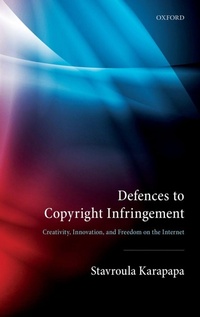
Defences to Copyright Infringement
Creativity, Innovation and Freedom on the Internet
Published on 26. March 2020
Book
Hardback
448 pages
978-0-19-879563-6 (ISBN)
Description
Defences to copyright infringement have gained increased significance over the past twenty years. The fourth industrial revolution emerged with the development of innovative copy-reliant services and business models, which have transformed the way in which copyright works can be used and re-used, spanning from digital learning methods, to mass digitization initiatives, media monitoring services, image transformation tools or content-mining technologies. The lawfulness and legitimacy of such innovative services and business methods, that arguably have the potential to enhance public welfare, is dubious and challenges copyright law. EU copyright contains diverse, yet specifically enumerated, narrowly drafted, and strictly interpreted defensive rules, often taking the form of the so-called exceptions and limitations to copyright. In addition, defendants may also deny liability by attacking one or more of the elements of infringement, by bringing forward for instance claims negating copyright subsistence or the scope of copyright protection. Because the fourth industrial revolution comes with the promise of innovation and business growth, which are stated objectives of EU copyright, it invites an examination of defensive rules as an organic whole.
This book adopts such a holistic approach in its exploration of the limits of permissibility under EU copyright, including not only legislatively mentioned exceptions and limitations but also doctrinal principles and external to copyright rules with a view to unveil possible gaps and overlaps, offering a novel classification of defensive rules, and evaluating the adaptability of the law towards technological change. Discussing recent legislative developments, such as the provisions of the Digital Single Market Directive, and case law from the Court of Justice, and bringing insights from an extensive set of national laws and cases, this book tells the story of copyright from the perspective of copyright defences, offering both positivist and normative insights into law and doctrine and arguing towards a principle-based understanding of the scope of defences that could inform future law and policy making.
This book adopts such a holistic approach in its exploration of the limits of permissibility under EU copyright, including not only legislatively mentioned exceptions and limitations but also doctrinal principles and external to copyright rules with a view to unveil possible gaps and overlaps, offering a novel classification of defensive rules, and evaluating the adaptability of the law towards technological change. Discussing recent legislative developments, such as the provisions of the Digital Single Market Directive, and case law from the Court of Justice, and bringing insights from an extensive set of national laws and cases, this book tells the story of copyright from the perspective of copyright defences, offering both positivist and normative insights into law and doctrine and arguing towards a principle-based understanding of the scope of defences that could inform future law and policy making.
Reviews / Votes
Practitioners and scholars of intellectual property law, and in particular those studying the nuances of copyright law, need look no further than Professor Stavroula Karapapa's Defences to Copyright Infringement for an in-depth and unique insight into the world of copyright defences. * Jennifer Graham, Liverpool John Moores University, Liverpool, UK, International Journal of Law and Information Technology * exceedingly well-organized and laid out ... this book will likely prove to be a useful guide for policymakers seeking to update European copyright law so that it can keep pace with technological change. * Michael A. Crystal, Commonwealth Law Bulletin * exceedingly well-organized and laid out ... this book will likely prove to be a useful guide for policymakers seeking to update European copyright law so that it can keep pace with technological change. * Michael A. Crystal, Commonwealth Law Bulletin * this book remains relevant, offering the reader with a spherical and realistic break-down of the adaptability of copyright law to technological change, through the exploration of EU copyright defences, while determining how well those sit within the current copyright framework. * Ioanna Lapatoura, European Intellectual Proprety Review *More details
Language
English
Place of publication
Oxford
United Kingdom
Target group
Professional and scholarly
Dimensions
Height: 240 mm
Width: 161 mm
Thickness: 28 mm
Weight
819 gr
ISBN-13
978-0-19-879563-6 (9780198795636)
Copyright in bibliographic data and cover images is held by Nielsen Book Services Limited or by the publishers or by their respective licensors: all rights reserved.
Schweitzer Classification
Other editions
Additional editions
Stavroula Karapapa
Defences to Copyright Infringement
Creativity, Innovation and Freedom on the Internet
E-Book
03/2020
1st Edition
OUP eBook
€71.99
Available for download
Stavroula Karapapa
Defences to Copyright Infringement
Creativity, Innovation and Freedom on the Internet
E-Book
03/2020
1st Edition
OUP eBook
€76.49
Available for download
Person
Stavroula Karapapa is the Professor of Intellectual Property and Information Law at the University of Essex. She has published extensively on copyright law and policy, trade mark law, and the protection of digital rights. She is the author of Private Copying (Routledge, 2012) and co-author of Copyright and Mass Digitization (OUP, 2013) and Intellectual Property Law (OUP, 2019).
Content
1: Introduction
A. Denials of the elements of infringement
2: Subsistence negating claims
3: Scope limitations
4: Transient and incidental copying
5: Implicitly authorized uses
B. Rationale-based defences to infringement
6: Speech entitlements
7: Public policy privileges
8: Remunerated exceptions
9: External defences
10: Conclusion
A. Denials of the elements of infringement
2: Subsistence negating claims
3: Scope limitations
4: Transient and incidental copying
5: Implicitly authorized uses
B. Rationale-based defences to infringement
6: Speech entitlements
7: Public policy privileges
8: Remunerated exceptions
9: External defences
10: Conclusion