

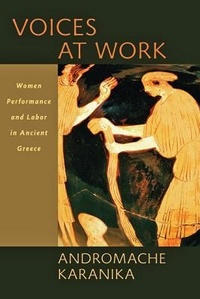
Voices at Work
Women, Performance, and Labor in Ancient Greece
Will be published approx. on 27. May 2014
Book
Hardback
320 pages
978-1-4214-1255-9 (ISBN)
Description
In ancient Greece, women's daily lives were occupied by various forms of labor. These experiences of work have largely been forgotten. Andromache Karanika has examined Greek poetry for depictions of women working and has discovered evidence of their lamentations and work songs. Voices at Work explores the complex relationships between ancient Greek poetry, the female poetic voice, and the practices and rituals surrounding women's labor in the ancient world. The poetic voice is closely tied to women's domestic and agricultural labor. Weaving, for example, was both a common form of female labor and a practice referred to for understanding the craft of poetry. Textile and agricultural production involved storytelling, singing, and poetry. Everyday labor employed-beyond its socioeconomic function - the power of poetic creation. Karanika starts with the assumption that there are certain forms of poetic expression and performance in the ancient world which are distinctively female.
She considers these to be markers of a female "voice" in ancient Greek poetry and presents a number of case studies: Calypso and Circe sing while they weave; in Odyssey 6 a washing scene captures female performances. Both of these instances are examples of the female voice filtered into the fabric of the epic. Karanika brings to the surface the words of women who informed the oral tradition from which Greek epic poetry emerged. In other words, she gives a voice to silence.
She considers these to be markers of a female "voice" in ancient Greek poetry and presents a number of case studies: Calypso and Circe sing while they weave; in Odyssey 6 a washing scene captures female performances. Both of these instances are examples of the female voice filtered into the fabric of the epic. Karanika brings to the surface the words of women who informed the oral tradition from which Greek epic poetry emerged. In other words, she gives a voice to silence.
Reviews / Votes
This fascinating investigation of a previously neglected topic will appeal to those interested in classics, gender studies, and the history of work. Choice Drawing from a wealth of ancient and comparative sources, and harnessing a range of theoretical approaches, Karanika offers a landmark study of female labour and Greek poetics. The book... offers important new insights into Greek poetry. -- Barbara Graziosi Times Higher Education Voices at Work adds to a growing corpus of scholarship on female vocality in the ancient world and, with its focus on the nexus between the female voice, women's labour and poetics, brings an important and valuable new dimension to the field. Cloelia: Women's Classical Caucus Newsletter In this challenging and sophisticated book, Andromache Karanika works against the grain of ancient disdain for songs related to women and work, in order to (re)establish the central pace of femininity and labor in ancient poetics... Karanika successfully adumbrates a diverse array of genres and gendered voices which are muted or silenced in ancient sources and modern scholarship. Her work demonstrates a mastery of a multitude of evidence... Karanika's monograph deserves a wide audience. -- Peter Miller Bryn Mawr Classical ReviewMore details
Language
English
Place of publication
Baltimore, MD
United States
Target group
Professional and scholarly
Product notice
sewn/stitched
Cloth over boards
Illustrations
6 s/w Abbildungen
6 Illustrations, black and white
Dimensions
Height: 239 mm
Width: 152 mm
Thickness: 25 mm
Weight
549 gr
ISBN-13
978-1-4214-1255-9 (9781421412559)
DOI
10.1353/book.29442
Copyright in bibliographic data and cover images is held by Nielsen Book Services Limited or by the publishers or by their respective licensors: all rights reserved.
Schweitzer Classification
Other editions
Additional editions
E-Book
05/2014
Johns Hopkins University Press
€45.49
Available for download
Person
Andromache Karanika is an associate professor of classics at the University of California, Irvine.
Content
Acknowledgments
Note on Transliteration and Translation
Introduction
1. Women, Labor, and Performance in Homer
2. Gender, Genre, and Women's Work in the Odyssey
3. Work and Performance in Captivity
4. Fragments of Songs, Moments at Work
5. Finding Work Songs, Dances, and Ritual Acts
6. From Lullabies to Children's Songs: Some Diachronic Perspectives
7. No More Weaving: The Poetics of Interruption
8. The Tradition of Harvesting Songs
Epilogue
Notes
Bibliography
Index
Note on Transliteration and Translation
Introduction
1. Women, Labor, and Performance in Homer
2. Gender, Genre, and Women's Work in the Odyssey
3. Work and Performance in Captivity
4. Fragments of Songs, Moments at Work
5. Finding Work Songs, Dances, and Ritual Acts
6. From Lullabies to Children's Songs: Some Diachronic Perspectives
7. No More Weaving: The Poetics of Interruption
8. The Tradition of Harvesting Songs
Epilogue
Notes
Bibliography
Index