

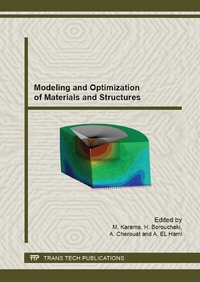
Modeling and Optimization of Materials and Structures
The main objectives of this special issue (consisting mainly of a selection of extended papers presented at 5th International Symposium on AirCraft Materials ACMA 2014) are to push the current limits in modeling and computation in response to industrial and society challenges. It is also to control the calculations and models in a framework that takes into account the major sources of uncertainty to optimize materials and structures. Particular attention is given to the modeling and validation of composite materials and structures.
Published on 20. May 2015
Book
Paperback/Softback
162 pages
978-3-03835-424-6 (ISBN)
Description
The main objectives of this special issue (consisting mainly of a selection of extended papers presented at 5th International Symposium on AirCraft Materials ACMA 2014) are to push the current limits in modeling and computation in response to industrial and society challenges. It is also to control the calculations and models in a framework that takes into account the major sources of uncertainty to optimize materials and structures. Particular attention is given to the modeling and validation of composite materials and structures.
More details
Series
Language
English
Place of publication
Zurich
Switzerland
Target group
College/higher education
Professional and scholarly
Illustrations
Illustrations
Dimensions
Height: 240 mm
Width: 170 mm
Thickness: 8 mm
Weight
440 gr
ISBN-13
978-3-03835-424-6 (9783038354246)
DOI
10.4028/b-QlfS1L
Copyright in bibliographic data and cover images is held by Nielsen Book Services Limited or by the publishers or by their respective licensors: all rights reserved.
Schweitzer Classification
Other editions
Additional editions
Moussa Karama | H. Borouchaki | Abel Cherouat
Modeling and Optimization of Materials and Structures
The main objectives of this special issue (consisting mainly of a selection of extended papers presented at 5th International Symposium on AirCraft Materials ACMA 2014) are to push the current limits in modeling and computation in response to industrial and society challenges. It is also to control the calculations and models in a framework that takes into account the major sources of uncertainty to optimize materials and structures. Particular attention is given to the modeling and validation of composite materials and structures.
Software
05/2015
Trans Tech Publications Ltd
€165.22
Shipment within 10-20 days
Moussa Karama | H. Borouchaki | Abel Cherouat
Modeling and Optimization of Materials and Structures
The main objectives of this special issue (consisting mainly of a selection of extended papers presented at 5th International Symposium on AirCraft Materials ACMA 2014) are to push the current limits in modeling and computation in response to industrial and society challenges. It is also to control the calculations and models in a framework that takes into account the major sources of uncertainty to optimize materials and structures. Particular attention is given to the modeling and validation of composite materials and structures.
E-Book
04/2015
Trans Tech Publications Ltd
€171.20
Available for download
Persons
Eds. M. Karama, H. Borouchaki, A. Cherouat and A. EL Hami
Content
Preface
Fatigue Behavior of Aerospace Al-Cu, Al-Li and Al-Mg-Si Sheet Alloys
Experimental and Numerical Study of Interfacial Fracture Parameters of a Brazed Joints
3D Remeshing Simulation of Aluminum Foams Behavior under Static Load
Numerical Simulation of Composite Hemp Fibers Behavior for Aircraft Application
Modeling the Residual Stress in Woven Thermoset Composites Parts for Aerospace Applications Using Finite Element Methods
Concept of the Tip Effect in Single Walled Carbon Nanotube
Nanocomposite Based Carbon Nanotubes for Electromechanical Application
Numerical Modeling of the Flow of Particle-Filled Resin through a Dual Scale Fibrous Media
Analysis of the Hydroforming Process Using Metamodels
Weldability of Superalloys Hastelloy X by Yb: YAG Laser
A New Parameter Identification Approach by Experimental Design and Multiple Regressions Method: Application to the Elastoplastic Damage Constitutive Law of a Steel Thin Parts
Thermo-Viscoelastic Modeling of the Aircraft Tire Cornering
Reliability Study of a Coupled Three-Dimensional System with Uncertain Parameters
Reliability Based Design Optimization Framework for Boat Propeller
Hybrid Evolutionary Optimization Algorithm for Structures
Simulation and Optimization of an Actuator
Thick Composite Structures under a Load Pinch
Stress Reduction in Bone/Dental Implant Interface Using Elastomeric Stress Absorbers
A New Reverse Engineering Method for the 3D Surface Reconstruction without Contact
Fatigue Behavior of Aerospace Al-Cu, Al-Li and Al-Mg-Si Sheet Alloys
Experimental and Numerical Study of Interfacial Fracture Parameters of a Brazed Joints
3D Remeshing Simulation of Aluminum Foams Behavior under Static Load
Numerical Simulation of Composite Hemp Fibers Behavior for Aircraft Application
Modeling the Residual Stress in Woven Thermoset Composites Parts for Aerospace Applications Using Finite Element Methods
Concept of the Tip Effect in Single Walled Carbon Nanotube
Nanocomposite Based Carbon Nanotubes for Electromechanical Application
Numerical Modeling of the Flow of Particle-Filled Resin through a Dual Scale Fibrous Media
Analysis of the Hydroforming Process Using Metamodels
Weldability of Superalloys Hastelloy X by Yb: YAG Laser
A New Parameter Identification Approach by Experimental Design and Multiple Regressions Method: Application to the Elastoplastic Damage Constitutive Law of a Steel Thin Parts
Thermo-Viscoelastic Modeling of the Aircraft Tire Cornering
Reliability Study of a Coupled Three-Dimensional System with Uncertain Parameters
Reliability Based Design Optimization Framework for Boat Propeller
Hybrid Evolutionary Optimization Algorithm for Structures
Simulation and Optimization of an Actuator
Thick Composite Structures under a Load Pinch
Stress Reduction in Bone/Dental Implant Interface Using Elastomeric Stress Absorbers
A New Reverse Engineering Method for the 3D Surface Reconstruction without Contact