

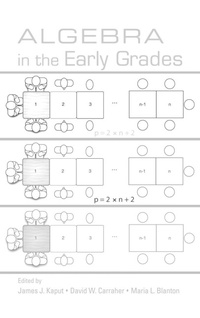
Algebra in the Early Grades
1st Edition
Published on 8. October 2007
Book
Hardback
552 pages
978-0-8058-5472-5 (ISBN)
Description
This volume is the first to offer a comprehensive, research-based, multi-faceted look at issues in early algebra. In recent years, the National Council for Teachers of Mathematics has recommended that algebra become a strand flowing throughout the K-12 curriculum, and the 2003 RAND Mathematics Study Panel has recommended that algebra be "the initial topical choice for focused and coordinated research and development [in K-12 mathematics]."
This book provides a rationale for a stronger and more sustained approach to algebra in school, as well as concrete examples of how algebraic reasoning may be developed in the early grades. It is organized around three themes:
The Nature of Early Algebra
Students' Capacity for Algebraic Thinking
Issues of Implementation: Taking Early Algebra to the Classrooms.
The contributors to this landmark volume have been at the forefront of an effort to integrate algebra into the existing early grades mathematics curriculum. They include scholars who have been developing the conceptual foundations for such changes as well as researchers and developers who have led empirical investigations in school settings.
Algebra in the Early Grades aims to bridge the worlds of research, practice, design, and theory for educators, researchers, students, policy makers, and curriculum developers in mathematics education.
This book provides a rationale for a stronger and more sustained approach to algebra in school, as well as concrete examples of how algebraic reasoning may be developed in the early grades. It is organized around three themes:
The Nature of Early Algebra
Students' Capacity for Algebraic Thinking
Issues of Implementation: Taking Early Algebra to the Classrooms.
The contributors to this landmark volume have been at the forefront of an effort to integrate algebra into the existing early grades mathematics curriculum. They include scholars who have been developing the conceptual foundations for such changes as well as researchers and developers who have led empirical investigations in school settings.
Algebra in the Early Grades aims to bridge the worlds of research, practice, design, and theory for educators, researchers, students, policy makers, and curriculum developers in mathematics education.
Reviews / Votes
"Algebraic learning, and early algebra in particular, was a passion of Jim Kaput. This book is not only a fitting tribute to his work, but a broad account of theory and research into early algebra and algebraic thinking. A multitude of frameworks and findings are provided that are potentially useful to researchers, teacher educators, and practitioners." -- Teachers College Record, November 20, 2008 "This is the only book that specifically addresses research on early algebra. It provides a nice mix of both conceptual/theoretical and practice-based chapters. Given the national attention early algebra is receiving, this book is sorely needed."-Eric Knuth
University of Wisconsin/Madison
More details
Series
Language
English
Place of publication
New York
United States
Publishing group
Taylor & Francis Inc
Target group
Professional and scholarly
College/higher education
Dimensions
Height: 235 mm
Width: 157 mm
Thickness: 37 mm
Weight
1037 gr
ISBN-13
978-0-8058-5472-5 (9780805854725)
Copyright in bibliographic data and cover images is held by Nielsen Book Services Limited or by the publishers or by their respective licensors: all rights reserved.
Schweitzer Classification
Other editions
Additional editions
James J. Kaput | David W. Carraher | Maria L. Blanton
Algebra in the Early Grades
E-Book
09/2017
Routledge
€101.99
Available for download
James J. Kaput | David W. Carraher | Maria L. Blanton
Algebra in the Early Grades
E-Book
09/2017
Routledge
€101.99
Available for download
James J. Kaput | David W. Carraher | Maria L. Blanton
Algebra in the Early Grades
Book
09/2007
1st Edition
Routledge
€111.00
Shipment within 10-20 days
Persons
Kaput, James J.; Carraher, David W.; Blanton, Maria L.
Content
Contents: Preface. Skeptic's Guide to Algebra in the Early Grades. Part I:The Nature of Early Algebra.J.J. Kaput, What Is Algebra? What Is Algebraic Reasoning? J.J. Kaput, M.L. Blanton, L.M. Armella, Algebra From a Symbolization Point of View. J. Mason, Making Use of Children's Powers to Produce Algebraic Thinking. J.P. Smith III, P.W. Thompson, Quantitative Reasoning and the Development of Algebraic Reasoning. E. Smith, Representational Thinking as a Framework for Introducing Functions in the Elementary Curriculum. Part II:Students' Capacity for Algebraic Thinking. V. Bastable, D, Schifter, Classroom Stories: Examples of Elementary Students Engaged in Early Algebra. C. Tierney, S. Monk, Children's Reasoning About Change Over Time. N. Mark-Zigdon, D. Tirosh, What Is a Legitimate Arithmetic Number Sentence? The Case of Kindergarten and First Grade Children. T. Boester, R. Lehrer, Visualizing Algebraic Reasoning. D.W. Carraher, A.D. Schliemann, J.L. Schwartz, Early Algebra Is Not the Same as Algebra Early. B.M. Brizuela, D. Earnest, Multiple Notational Systems and Algebraic Understandings: The Case of the "Best Deal" Problem. I. Peled, D.W. Carraher, Signed Numbers and Algebraic Thinking. Part III:Issues of Implementation: Taking Early Algebra to the Classrooms. M.L. Franke, T.P. Carpenter, D. Battey, Content Matters: The Case of Algebra Reasoning in Teacher Professional Development. M.L. Blanton, J.J. Kaput, Building District Capacity for Teacher Development in Algebraic Reasoning. B. Dougherty, Measure Up: A Quantitative View of Early Algebra. D. Schifter, S. Monk, S.J. Russell, V. Bastable, Early Algebra: What Does Understanding the Laws of Arithmetic Mean in the Elementary Grades? P. Goldenberg, N. Shteingold, Early Algebra: The MW Perspective. Afterword: A. Schoenfeld, Early Algebra as Mathematical Sense-Making.