

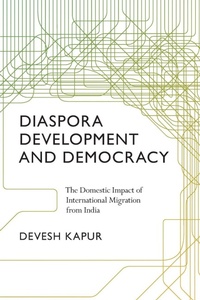
Diaspora, Development, and Democracy
The Domestic Impact of International Migration from India
Will be published approx. on 1. December 2013
Book
Paperback/Softback
344 pages
978-0-691-16211-9 (ISBN)
Description
What happens to a country when its skilled workers emigrate? The first book to examine the complex economic, social, and political effects of emigration on India, Diaspora, Development, and Democracy provides a conceptual framework for understanding the repercussions of international migration on migrants' home countries. Devesh Kapur finds that migration has influenced India far beyond a simplistic "brain drain"--migration's impact greatly depends on who leaves and why. The book offers new methods and empirical evidence for measuring these traits and shows how data about these characteristics link to specific outcomes. For instance, the positive selection of Indian migrants through education has strengthened India's democracy by creating a political space for previously excluded social groups. Because older Indian elites have an exit option, they are less likely to resist the loss of political power at home. Education and training abroad has played an important role in facilitating the flow of expertise to India, integrating the country into the world economy, positively shaping how India is perceived, and changing traditional conceptions of citizenship.
The book highlights a paradox--while international migration is a cause and consequence of globalization, its effects on countries of origin depend largely on factors internal to those countries. A rich portrait of the Indian migrant community, Diaspora, Development, and Democracy explores the complex political and economic consequences of migration for the countries migrants leave behind.
The book highlights a paradox--while international migration is a cause and consequence of globalization, its effects on countries of origin depend largely on factors internal to those countries. A rich portrait of the Indian migrant community, Diaspora, Development, and Democracy explores the complex political and economic consequences of migration for the countries migrants leave behind.
Reviews / Votes
Co-Winner of the 2012 Distinguished Book Award, Ethnicity, Nationalism, and Migration Section of the International Studies Association "Kapur's innovative study examines the impact of international migration from India on Indian democracy and development. His analytical framework allows him to investigate how household decision making is affected among those considering emigration, how those left behind are affected, how the diaspora affects India from abroad, and how returning Indians make a difference."--Choice "Kapur's [book] provide[s] a useful academic and analytical foil to easy generalizations about the influence of the Indian diaspora at home and abroad."--William Crawley, Asian Affairs "[T]he value of this book is extraordinary because of the author's insightful and systematic analysis of the various aspects of the Indian diaspora."--Norio Kondo, Developing EconomiesMore details
Language
English
Place of publication
New Jersey
United States
Target group
College/higher education
Professional and scholarly
Product notice
Paperback (trade)
Illustrations
27 line illus. 76 tables.
Dimensions
Height: 234 mm
Width: 156 mm
Thickness: 20 mm
Weight
590 gr
ISBN-13
978-0-691-16211-9 (9780691162119)
Copyright in bibliographic data and cover images is held by Nielsen Book Services Limited or by the publishers or by their respective licensors: all rights reserved.
Schweitzer Classification
Other editions
Additional editions
Devesh Kapur
Diaspora, Development, and Democracy
The Domestic Impact of International Migration from India
E-Book
08/2010
1st Edition
Princeton University Press
€30.49
Available for download
Person
Devesh Kapur is associate professor of political science and holds the Madan Lal Sobti Professorship for the Study of Contemporary India at the University of Pennsylvania.
Content
List of Figures and Tables ix Acknowledgments xiii Chapter 1: The Missing Leg of the Globalization Triad: International Migration 1 Chapter 2: Analytical Framework and Research Methodology 23 Chapter 3: Selection Characteristics of Emigration from India 50 Chapter 4: Economic Effects 84 Chapter 5: Social Remittances: Migration and the Flow of Ideas 124 Chapter 6: International Migration and the Paradox of India's Democracy 162 Chapter 7: The Indian Diaspora and Indian Foreign Policy: Soft Power or Soft Underbelly? 185 Chapter 8: Civil or Uncivil Transnational Society? The Janus Face of Long-Distance Nationalism 210 Chapter 9: Spatially Unbound Nations 253 Appendix I: Survey of Emigration from India (SEI) 273 Appendix II: Survey of Asian Indians in the United States (SAIUS): Methodology 281 Appendix III: Survey of Asian Indians in the United States (SAIUS): Questionnaire 287 Appendix IV: Database on India's Elites (1950-2000) 293 Bibliography 297 Index 315